







Question: Given the following Standard Cell Potentials EO; -> K+(aq) + e K(s) E = -2.93 V 12(s) + 2 e 2 Haq) I' E =
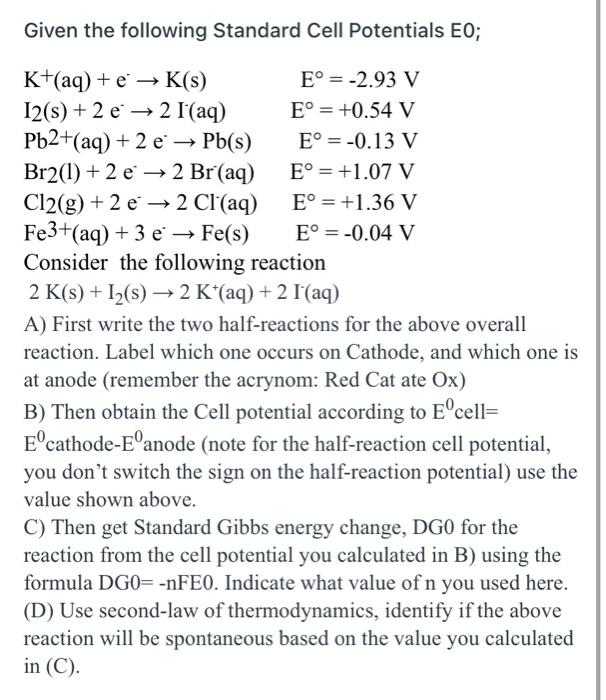
Given the following Standard Cell Potentials EO; -> K+(aq) + e K(s) E = -2.93 V 12(s) + 2 e 2 Haq) I' E = +0.54 V Pb2+(aq) + 2 e Pb(s) E = -0.13 V Br2(1) + 2 e 2 Br(aq) E = +1.07 V Cl2(g) + 2 e 2 Cl(aq) E = +1.36 V Fe3+(aq) + 3 e Fe(s) E = -0.04 V Consider the following reaction 2 K(s) +12(s) 2 K+(aq) + 2 H(aq) A) First write the two half-reactions for the above overall reaction. Label which one occurs on Cathode, and which one is at anode (remember the acrynom: Red Cat ate Ox) B) Then obtain the Cell potential according to Ecell= Ecathode-Eanode (note for the half-reaction cell potential, you don't switch the sign on the half-reaction potential) use the value shown above. C) Then get Standard Gibbs energy change, DG0 for the reaction from the cell potential you calculated in B) using the formula DGO=-nFE0. Indicate what value of n you used here. (D) Use second-law of thermodynamics, identify if the above reaction will be spontaneous based on the value you calculated in (C)
Step by Step Solution
There are 3 Steps involved in it

Get step-by-step solutions from verified subject matter experts
 Study Help