







Question: Given the function below. complete parts (a) through {c}. k c = D(x) = ?. where k is a positive constant and n is an
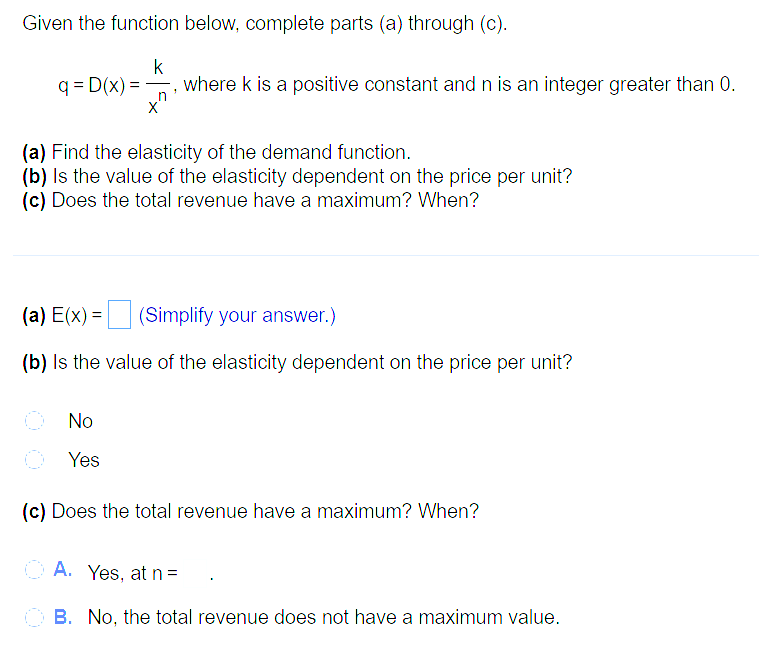
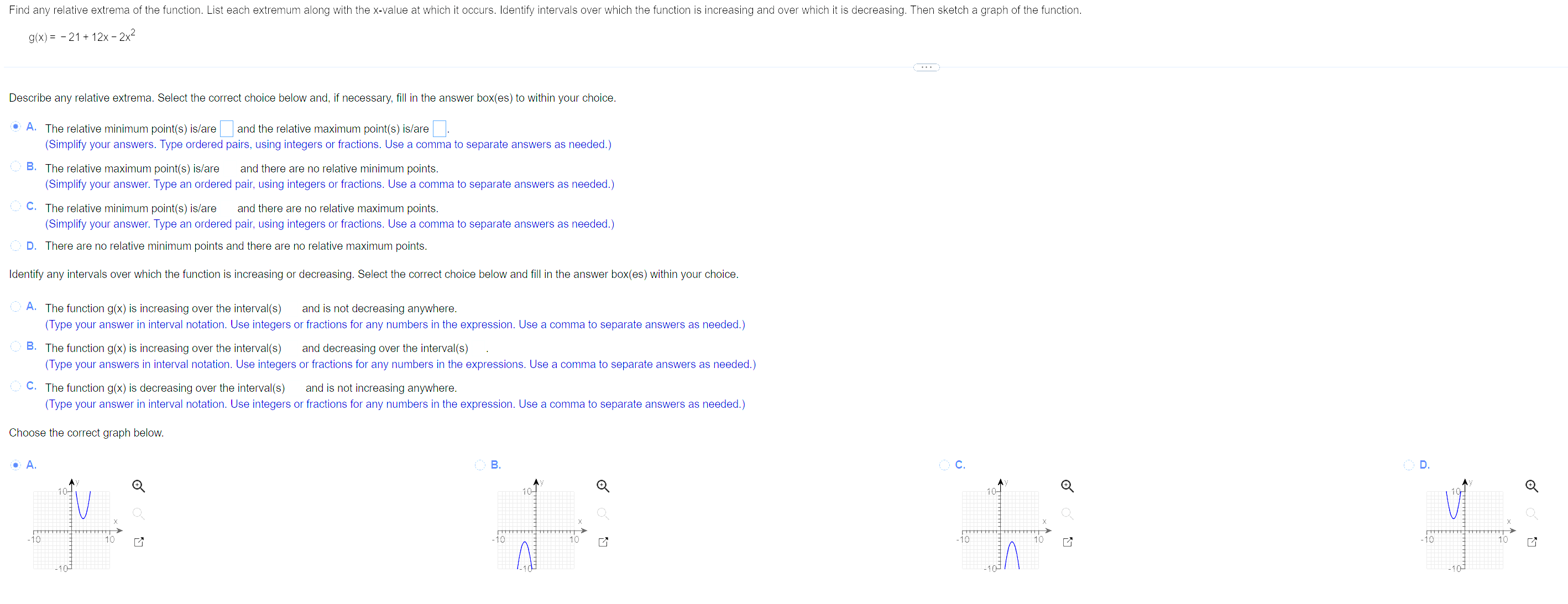
Given the function below. complete parts (a) through {c}. k c = D(x) = ?. where k is a positive constant and n is an integer greater than 0. X (a) Find the elasticity of the demand function. (b) Is the value of the elasticity dependent on the price per unit? (c) Does the total revenue have a maximum? When? (a) E(x) = (Simplify your answer.) (b) Is the value of the elasticity dependent on the price per unit? No Yes (c) Does the total revenue have a maximum? When? A- Yes. at n = B. No. the total revenue does not have a maximum value. Find any relative extrema of the function. List each extremum along with the x-value at which it occurs. Identify intervals over which the function is increasing and over which it is decreasing. Then sketch a graph of the function. g(x) = -21+12x - 2x2 Describe any relative extrema. Select the correct choice below and, if necessary, fill in the answer box(es) to within your choice. A. The relative minimum point(s) is/are and the relative maximum point(s) is/are. Simplify your answers. Type ordered pairs, using integers or fractions. Use a comma to separate answers as needed.) B. The relative maximum point(s) is/are and there are no relative minimum points. (Simplify your answer. Type an ordered pair, using integers or fractions. Use a comma to separate answers as needed.) C. The relative minimum point(s) is/are and there are no relative maximum points. Simplify your answer. Type an ordered pair, using integers or fractions. Use a comma to separate answers as needed.) D. There are no relative minimum points and there are no relative maximum points. Identify any intervals over which the function is increasing or decreasing. Select the correct choice below and fill in the answer box(es) within your choice. A. The function g(x) is increasing over the interval(s) and is not decreasing anywhere. Type your answer in interval notation. Use integers or fractions for any numbers in the expression. Use a comma to separate answers as needed.) B. The function g(x) is increasing over the interval(s) and decreasing over the interval(s) Type your answers in interval notation. Use integers or fractions for any numbers in the expressions. Use a comma to separate answers as needed.) C. The function g(x) is decreasing over the interval(s) and is not increasing anywhere. Type your answer in interval notation. Use integers or fractions for any numbers in the expression. Use a comma to separate answers as needed.) Choose the correct graph below. A. (C. T 10 10 10 10 10 10 10 10
Step by Step Solution
There are 3 Steps involved in it

Get step-by-step solutions from verified subject matter experts
 Study Help