



Question: Given the graph of f(t), let A = 0.25, A = 3.5, and A3 3. Let F' (t) = f(t). A -1 f(t) A.
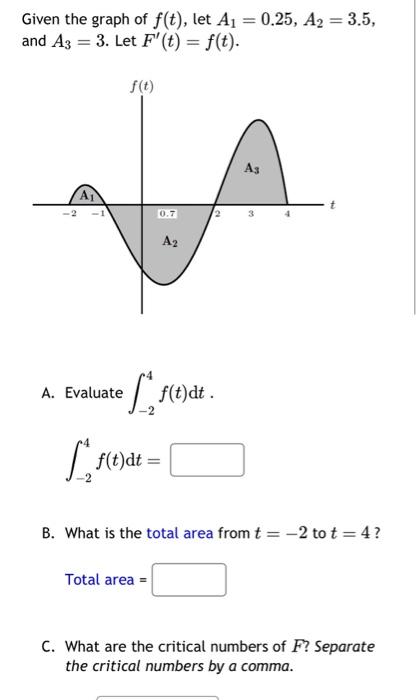
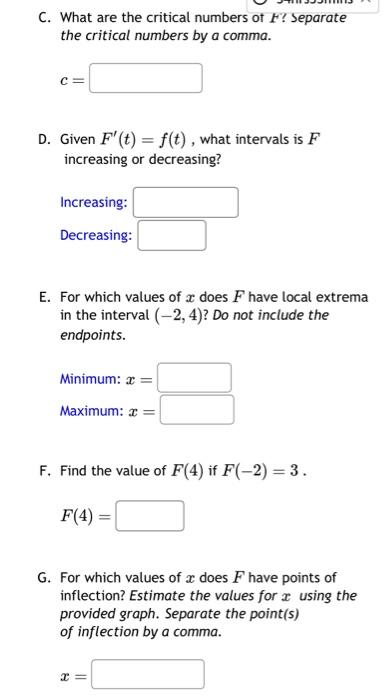
Given the graph of f(t), let A = 0.25, A = 3.5, and A3 3. Let F' (t) = f(t). A -1 f(t) A. Evaluate ef f(t) f(t)dt = 0.7 A2 Total area = 2 f(t)dt. As 3 B. What is the total area from t= -2 to t = 4? C. What are the critical numbers of F? Separate the critical numbers by a comma. C. What are the critical numbers of F? Separate the critical numbers by a comma. C= D. Given F' (t) = f(t), what intervals is F increasing or decreasing? Increasing: Decreasing: E. For which values of a does F have local extrema in the interval (-2, 4)? Do not include the endpoints. Minimum: x = Maximum: x = F. Find the value of F(4) if F(-2) = 3. F(4) = G. For which values of a does F have points of inflection? Estimate the values for using the provided graph. Separate the point(s) of inflection by a comma. x =
Step by Step Solution
There are 3 Steps involved in it
Lets go through each part of the question one by one A Evaluate the integral integral24 ft dt To evaluate this integral we need to calculate the net a... View full answer

Get step-by-step solutions from verified subject matter experts