







Question: Given the implementation of Binary Tree: template class BinNodePtr { private: int it; // The node's value BinNodePtr* lc; // left child pointer BinNodePtr* rc;
Given the implementation of Binary Tree:
template class BinNodePtr {
private:
int it; // The node's value
BinNodePtr* lc; // left child pointer
BinNodePtr* rc; // right child pointer
public:
int& val() { return it; }
BinNodePtr* left() const { return lc;}
BinNodePtr* right() const { return rc;}
};
void traversal(BinNode
if (subroot == NULL) return;
cout val();
traversal(subroot->left());
traversal(subroot->right());
}
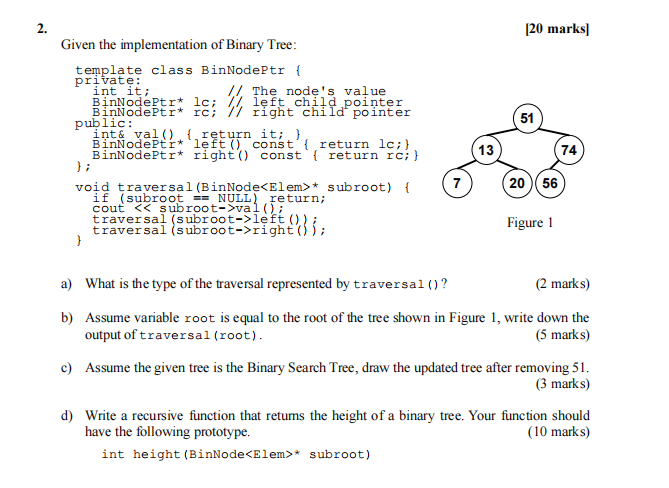
Figure 1
a)
What is the type of the traversal represented by traversal()?
(2 marks)
b)
Assume variable root is equal to the root of the tree shown in Figure 1, write down the
output of traversal(root).
(5 marks)
c)
Assume the given tree is the Binary Search Tree, draw the updated tree after removing 51.
(3 marks)
d)
Write a recursive function that returns the height of a binary tree. Your function should
have the following prototype.
(10 marks)
int height(BinNode
2. 2. [20 marks] 51 Given the implementation of Binary Tree: template class BinNodePtr { private: int it; The node's value BinNode Ptr* lc; left child pointer BinNodePtr* rc; right child pointer public: int& val() { return it; } BinNodeftr* 'left() const { return lc;}. BinNodeftr* right') const { return rc; } }; void traversal (BinNode
Step by Step Solution
There are 3 Steps involved in it

Get step-by-step solutions from verified subject matter experts
 Study Help