







Question: ) Given the mathematical function f(x) = x, determine the upper limit for x to make this function a probability density function starting from x
) Given the mathematical function f(x) = x, determine the upper limit for x to make this function a probability density function starting from x = 0 (i.e., determine b given a = 0).
b) Properly state the probability density function over all values of x 0.
c) Graph the probability density function over all values of x 0.
d) Using the above probability density function determine the probability that x will be between 0 and 1.
e) Using the above probability density function determine the probability that x will be between 1 and 4.
Function P is a function defined on the set of real numbers. We do not know the value of P for all cases, but we know that P(x) = 0.3 when 0
In creating solutions for business problems using predictive analytics, it is important to consider the following in identifying the right statistical analysis to perform:
A) Whether the variables (relevant for statistical analysis) are (1) dependent or independent, (2) qualitative or quantitative, and (3) the total number of variables.
B) Whether the variables (relevant for statistical analysis) are (1) dependent or independent and (2) qualitative or quantitative
C) Whether the variables (relevant for statistical analysis) are (1) dependent or independent and the total number of variables.
D) Whether the variables (relevant for statistical analysis) are (1) qualitative or quantitative and (2) the total number of variables.
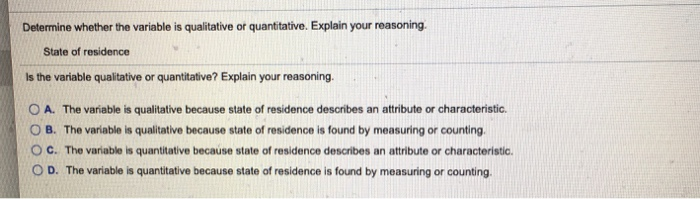
Determine whether the variable is qualitative or quantitative. Explain your reasoning. State of residence Is the variable qualitative or quantitative? Explain your reasoning. O A. The variable is qualitative because state of residence describes an attribute or characteristic. O B. The variable is qualitative because state of residence is found by measuring or counting. O C. The variable is quantitative because state of residence describes an attribute or characteristic. O D. The variable is quantitative because state of residence is found by measuring or counting
Step by Step Solution
There are 3 Steps involved in it

Get step-by-step solutions from verified subject matter experts
 Study Help