







Question: Given the memory configuration in Figure 2.10 below, answer the following questions given that, at this point, Job 4 arrives requesting a block of 100K.
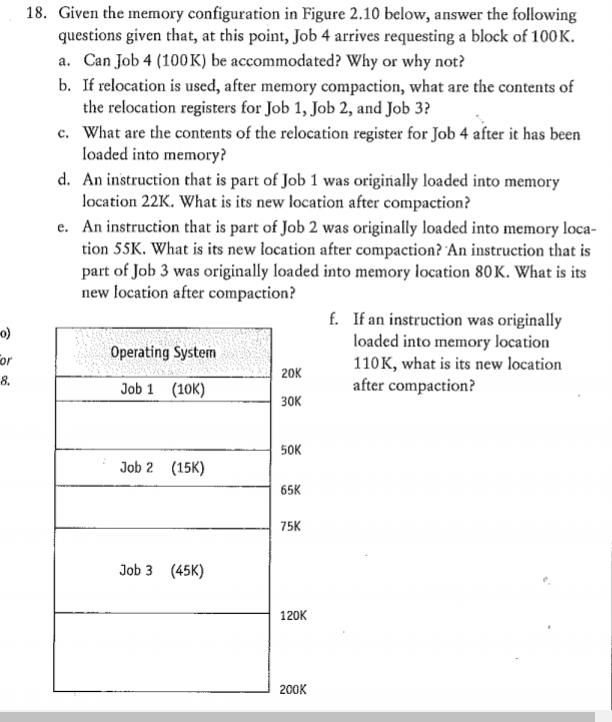
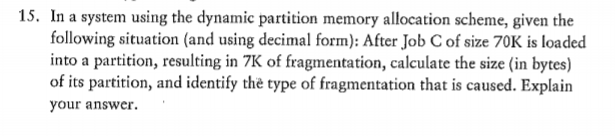
Given the memory configuration in Figure 2.10 below, answer the following questions given that, at this point, Job 4 arrives requesting a block of 100K. a. Can Job 4 (100K) be accommodated? Why or why not? b. If relocation is used, after memory compaction, what are the contents of 18. c. What are the contents of the relocation register for Job 4 after it has been d. An instruction that is part of Job 1 was originally loaded into memory e. An instruction that is part of Job 2 was originally loaded into memory loca- the relocation registers for Job 1, Job 2, and Job 3? loaded into memory? location 22K. What is its new location after compaction? tion 55K. What is its new location after compaction? An instruction that is part of Job 3 was originally loaded into memory location 80K. What is its new location after compaction? f. o) or 8. If an instruction was originally loaded into memory location 110K, what is its new location after compaction? Operating System 20K Job 1 (10K) 30K 50K 65K 75K Job 2 (15K) Job 3 (45K) 120K 200K In a system using the dynamic partition memory allocation scheme, given the following situation (and using decimal form): After Job C of size 70K is loaded into a partition, resulting in 7K of fragmentation, calculate the size (in bytes) of its partition, and identify th type of fragmentation that is caused. Explain your answer. 15
Step by Step Solution
There are 3 Steps involved in it

Get step-by-step solutions from verified subject matter experts
 Study Help