







Question: Given the pavement structure presented in Table 1 and the following load characteristics Axle Type = Single axle, dual tires Axle Load =18kips Tire Pressure
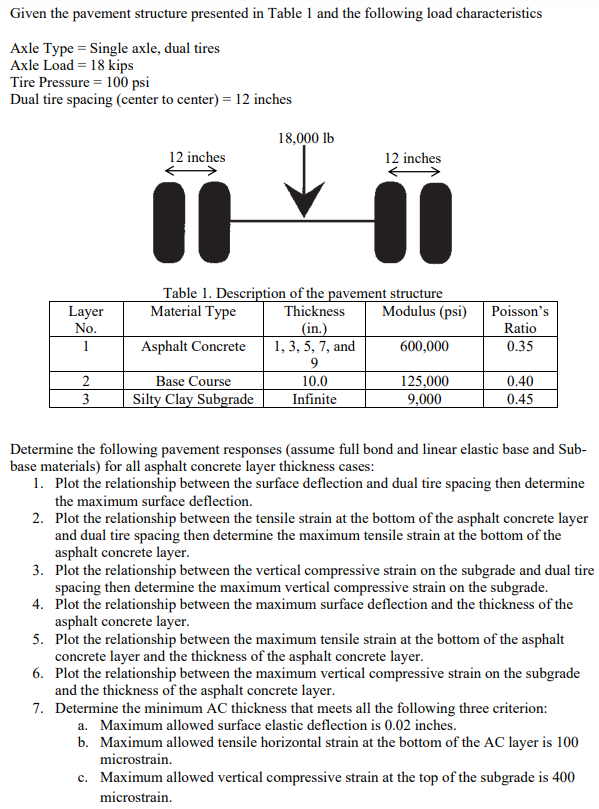
Given the pavement structure presented in Table 1 and the following load characteristics Axle Type = Single axle, dual tires Axle Load =18kips Tire Pressure =100psi Dual tire spacing (center to center) =12 inches Table 1. Description of the pavement structure Determine the following pavement responses (assume full bond and linear elastic base and Subbase materials) for all asphalt concrete layer thickness cases: 1. Plot the relationship between the surface deflection and dual tire spacing then determine the maximum surface deflection. 2. Plot the relationship between the tensile strain at the bottom of the asphalt concrete layer and dual tire spacing then determine the maximum tensile strain at the bottom of the asphalt concrete layer. 3. Plot the relationship between the vertical compressive strain on the subgrade and dual tire spacing then determine the maximum vertical compressive strain on the subgrade. 4. Plot the relationship between the maximum surface deflection and the thickness of the asphalt concrete layer. 5. Plot the relationship between the maximum tensile strain at the bottom of the asphalt concrete layer and the thickness of the asphalt concrete layer. 6. Plot the relationship between the maximum vertical compressive strain on the subgrade and the thickness of the asphalt concrete layer. 7. Determine the minimum AC thickness that meets all the following three criterion: a. Maximum allowed surface elastic deflection is 0.02 inches. b. Maximum allowed tensile horizontal strain at the bottom of the AC layer is 100 microstrain. c. Maximum allowed vertical compressive strain at the top of the subgrade is 400 microstrain. Given the pavement structure presented in Table 1 and the following load characteristics Axle Type = Single axle, dual tires Axle Load =18kips Tire Pressure =100psi Dual tire spacing (center to center) =12 inches Table 1. Description of the pavement structure Determine the following pavement responses (assume full bond and linear elastic base and Subbase materials) for all asphalt concrete layer thickness cases: 1. Plot the relationship between the surface deflection and dual tire spacing then determine the maximum surface deflection. 2. Plot the relationship between the tensile strain at the bottom of the asphalt concrete layer and dual tire spacing then determine the maximum tensile strain at the bottom of the asphalt concrete layer. 3. Plot the relationship between the vertical compressive strain on the subgrade and dual tire spacing then determine the maximum vertical compressive strain on the subgrade. 4. Plot the relationship between the maximum surface deflection and the thickness of the asphalt concrete layer. 5. Plot the relationship between the maximum tensile strain at the bottom of the asphalt concrete layer and the thickness of the asphalt concrete layer. 6. Plot the relationship between the maximum vertical compressive strain on the subgrade and the thickness of the asphalt concrete layer. 7. Determine the minimum AC thickness that meets all the following three criterion: a. Maximum allowed surface elastic deflection is 0.02 inches. b. Maximum allowed tensile horizontal strain at the bottom of the AC layer is 100 microstrain. c. Maximum allowed vertical compressive strain at the top of the subgrade is 400 microstrain
Step by Step Solution
There are 3 Steps involved in it

Get step-by-step solutions from verified subject matter experts
 Study Help