Question: Given the problem statement below, ideate 15 potential solutions. Pick your best solution and produce an isometric sketch (15pts) with notes to explain your solution.
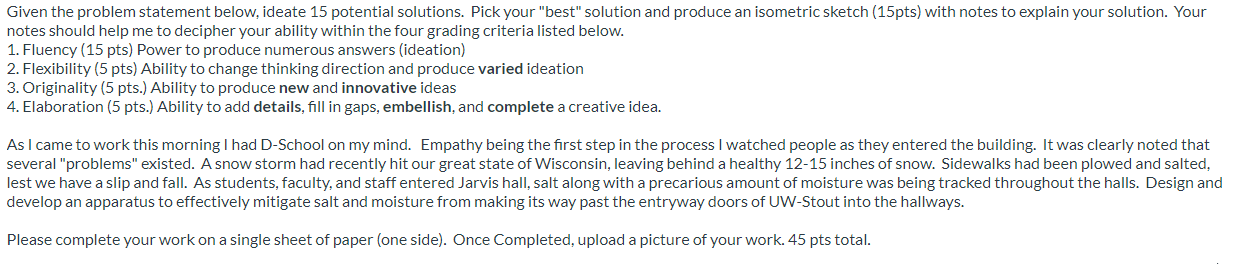
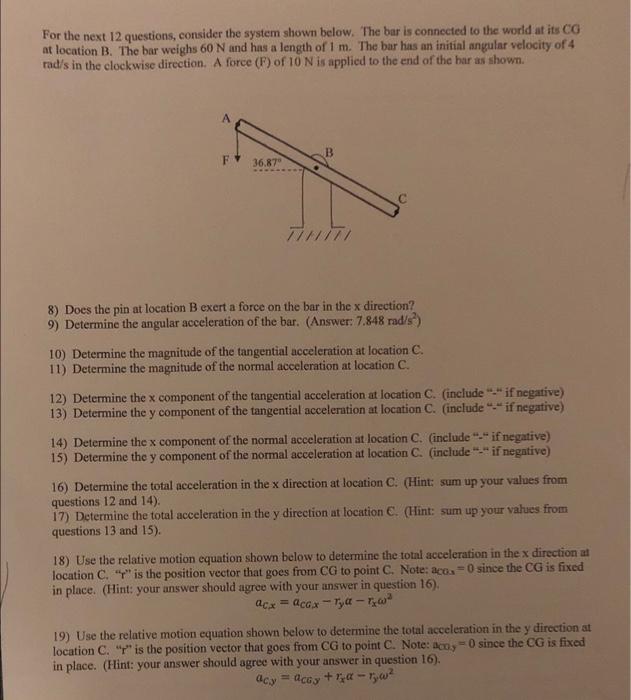
Given the problem statement below, ideate 15 potential solutions. Pick your "best" solution and produce an isometric sketch (15pts) with notes to explain your solution. Your notes should help me to decipher your ability within the four grading criteria listed below. 1. Fluency (15 pts) Power to produce numerous answers (ideation) 2. Flexibility (5 pts) Ability to change thinking direction and produce varied ideation 3. Originality (5 pts.) Ability to produce new and innovative ideas 4. Elaboration (5 pts.) Ability to add details, fill in gaps, embellish, and complete a creative idea. As I came to work this morning I had D-School on my mind. Empathy being the first step in the process I watched people as they entered the building. It was clearly noted that several "problems" existed. A snow storm had recently hit our great state of Wisconsin, leaving behind a healthy 12-15 inches of snow. Sidewalks had been plowed and salted, lest we have a slip and fall. As students, faculty, and staff entered Jarvis hall, salt along with a precarious amount of moisture was being tracked throughout the halls. Design and develop an apparatus to effectively mitigate salt and moisture from making its way past the entryway doors of UW-Stout into the hallways. Please complete your work on a single sheet of paper (one side). Once Completed, upload a picture of your work. 45 pts total. For the next 12 questions, consider the system shown below. The bar is connected to the world at its CG at location B. The bar weighs 60 N and has a length of 1 m. The bar has an initial angular velocity of 4 rad/s in the clockwise direction. A force (F) of 10 N is applied to the end of the bar as shown. B F 36.87 TWIT/ 8) Does the pin at location B exert a force on the bar in the x direction? 9) Determine the angular acceleration of the bar. (Answer: 7.848 rad/s) 10) Determine the magnitude of the tangential acceleration at location C. 11) Determine the magnitude of the normal acceleration at location C. 12) Determine the x component of the tangential acceleration at location C. (include "-" if negative) 13) Determine the y component of the tangential acceleration at location C. (include if negative) 14) Determine the x component of the normal acceleration at location C. (include "if negative) 15) Determine the y component of the normal acceleration at location C. (include "-" if negative) 16) Determine the total acceleration in the x direction at location C. (Hint: sum up your values from questions 12 and 14). 17) Determine the total acceleration in the y direction at location C. (Hint: sum up your values from questions 13 and 15). 18) Use the relative motion equation shown below to determine the total acceleration in the x direction at location C. "Y" is the position vector that goes from CG to point C. Note: aco. O since the CG is fixed in place. (Hint: your answer should agree with your answer in question 16). Qcx = QcGx - Tya - ,- 19) Use the relative motion equation shown below to determine the total acceleration in the y direction at location C. "" is the position vector that goes from CG to point C. Note: aco, since the CG is fixed in place. (Hint: your answer should agree with your answer in question 16). Acy Accy +80-tyw? Given the problem statement below, ideate 15 potential solutions. Pick your "best" solution and produce an isometric sketch (15pts) with notes to explain your solution. Your notes should help me to decipher your ability within the four grading criteria listed below. 1. Fluency (15 pts) Power to produce numerous answers (ideation) 2. Flexibility (5 pts) Ability to change thinking direction and produce varied ideation 3. Originality (5 pts.) Ability to produce new and innovative ideas 4. Elaboration (5 pts.) Ability to add details, fill in gaps, embellish, and complete a creative idea. As I came to work this morning I had D-School on my mind. Empathy being the first step in the process I watched people as they entered the building. It was clearly noted that several "problems" existed. A snow storm had recently hit our great state of Wisconsin, leaving behind a healthy 12-15 inches of snow. Sidewalks had been plowed and salted, lest we have a slip and fall. As students, faculty, and staff entered Jarvis hall, salt along with a precarious amount of moisture was being tracked throughout the halls. Design and develop an apparatus to effectively mitigate salt and moisture from making its way past the entryway doors of UW-Stout into the hallways. Please complete your work on a single sheet of paper (one side). Once Completed, upload a picture of your work. 45 pts total. For the next 12 questions, consider the system shown below. The bar is connected to the world at its CG at location B. The bar weighs 60 N and has a length of 1 m. The bar has an initial angular velocity of 4 rad/s in the clockwise direction. A force (F) of 10 N is applied to the end of the bar as shown. B F 36.87 TWIT/ 8) Does the pin at location B exert a force on the bar in the x direction? 9) Determine the angular acceleration of the bar. (Answer: 7.848 rad/s) 10) Determine the magnitude of the tangential acceleration at location C. 11) Determine the magnitude of the normal acceleration at location C. 12) Determine the x component of the tangential acceleration at location C. (include "-" if negative) 13) Determine the y component of the tangential acceleration at location C. (include if negative) 14) Determine the x component of the normal acceleration at location C. (include "if negative) 15) Determine the y component of the normal acceleration at location C. (include "-" if negative) 16) Determine the total acceleration in the x direction at location C. (Hint: sum up your values from questions 12 and 14). 17) Determine the total acceleration in the y direction at location C. (Hint: sum up your values from questions 13 and 15). 18) Use the relative motion equation shown below to determine the total acceleration in the x direction at location C. "Y" is the position vector that goes from CG to point C. Note: aco. O since the CG is fixed in place. (Hint: your answer should agree with your answer in question 16). Qcx = QcGx - Tya - ,- 19) Use the relative motion equation shown below to determine the total acceleration in the y direction at location C. "" is the position vector that goes from CG to point C. Note: aco, since the CG is fixed in place. (Hint: your answer should agree with your answer in question 16). Acy Accy +80-tyw









 Study Help