



Question: Given three floating-point numbers x, y, and z, output the square root of x, the absolute value of (y minus z) , and the factorial
Given three floating-point numbers x, y, and z, output the square root of x, the absolute value of (y minus z) , and the factorial of (the ceiling of z).
Output each floating-point value with two digits after the decimal point, which can be achieved as follows: print('%0.2f %0.2f %0.2f' % (your_value1, your_value2, your_value3))
Python Language
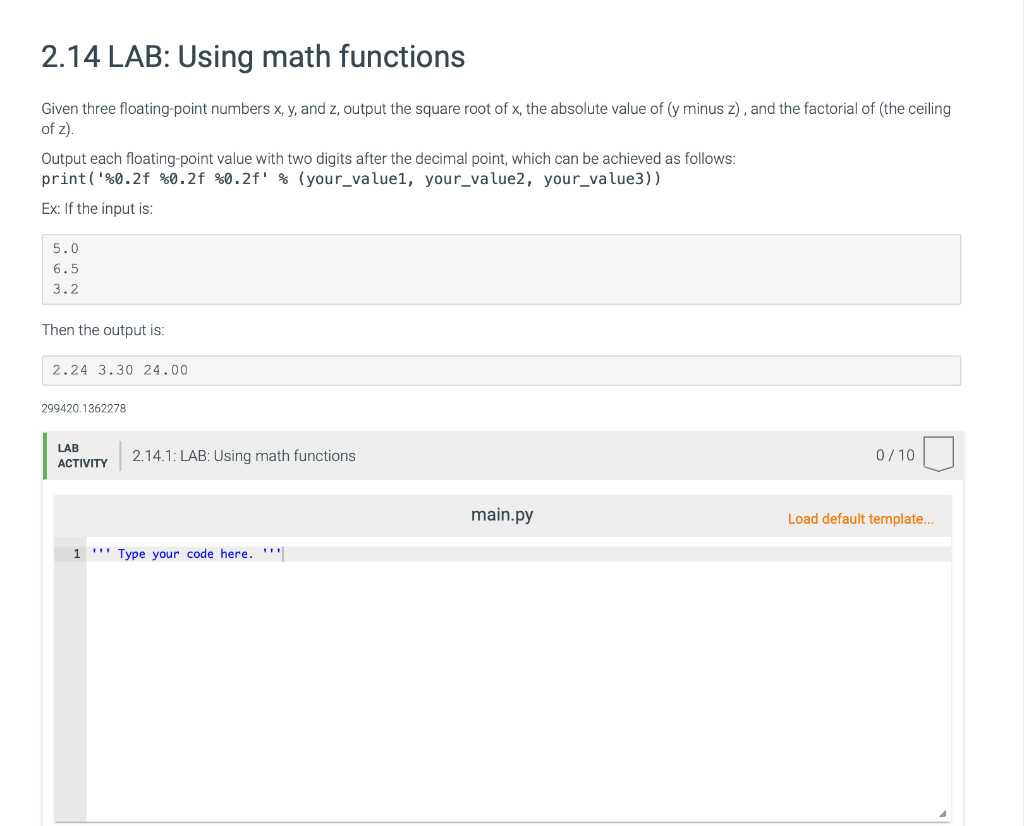
2.14 LAB: Using math functions Given three floating point numbers x, y, and z, output the square root of x, the absolute value of (y minus z), and the factorial of the ceiling of z). Output each floating-point value with two digits after the decimal point, which can be achieved as follows: print('%0.2f %0.2f %0.2f' % (your_value1, your_value2, your_value3)) Ex: If the input is: 5.0 6.5 3.2 Then the output is: 2.24 3.30 24.00 299420.1362278 LAB ACTIVITY 2.14.1: LAB: Using math functions 0/10 main.py Load default template... 1 " Type your code here
Step by Step Solution
There are 3 Steps involved in it

Get step-by-step solutions from verified subject matter experts