







Question: Given two relations R(AB) with an instance containing 2 tuples, and S(BCD) with an instance containing 3 tuples. (a) [14] Determine the minimum and maximum
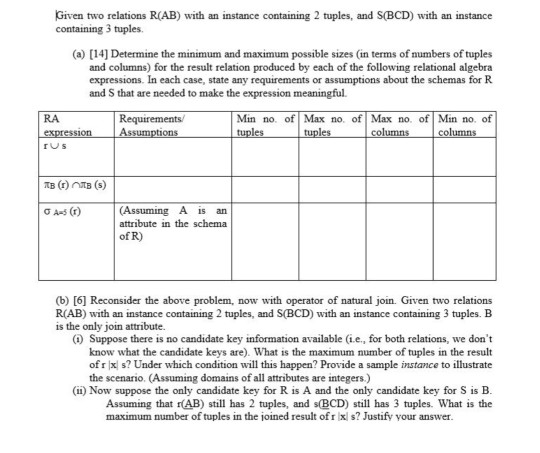
Given two relations R(AB) with an instance containing 2 tuples, and S(BCD) with an instance containing 3 tuples. (a) [14] Determine the minimum and maximum possible sizes (in terms of numbers of tuples and columns) for the result relation produced by each of the following relational algebra expressions. In each case, state any requirements or assumptions about the schemas for R and S that are needed to make the expression meaningful. RA Min no. of Max no. of Max no. of Min no. of rus TB TB (s) (Assuming A is an attribute in the schema of R) (b) [6] Reconsider the above problem, now with operator of natural join. Given two relations R(AB) with an instance containing 2 tuples, and S(BCD) with an instance containing 3 tuples. B is the only join attribute. O) Suppose there is no candidate key information available (i.e., for both relations, we don't know what the candidate keys are). What is the maximum number of tuples in the result of r xs? Under which condition will this happen? Provide a sample instance to illustrate the scenario. (Assuming domains of all attributes are integers) (ii) Now suppose the only candidate key for R is A and the only candidate key for S is B Assuming that AB) still has 2 tuples, and sBCD) still has 3 tuples. What is the maximum number of tuples in the joined result of r x s? Justify your
Step by Step Solution
There are 3 Steps involved in it

Get step-by-step solutions from verified subject matter experts
 Study Help