







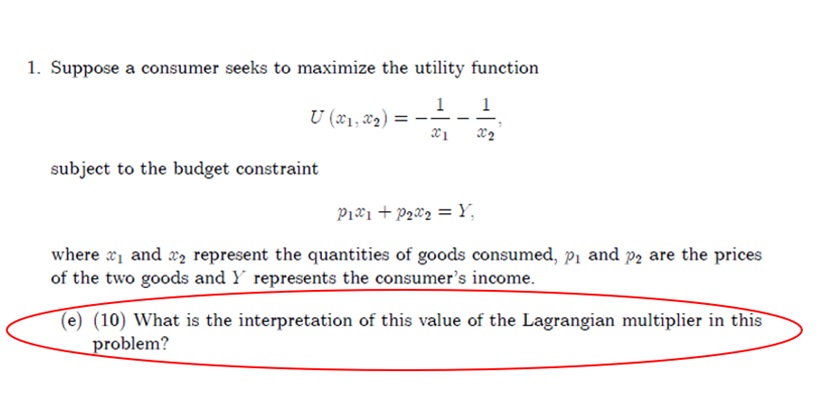
Question: Given: Utility Function: U(x 1 , x 2 ) = - 1/x 1 - 1/x 2 Budget Constraint: P 1 x 1 + P 2
Given:
Utility Function:
U(x1, x2) = - 1/x1- 1/x2
Budget Constraint:
P1x1 + P2x2= y
Where: x1, x2= Quantities of Goods Consumed
P1 = Price of Good x1
P2 = Price of Good x2
y = Consumer Income
Course Hero Expert Answer:
For Utility Maximization, we have the following LaGrangian Function:
Z = U(x1, x2) + (y - P1x1 - P2x2)
Z = - 1/x1- 1/x2+ (y - P1x1- P2x2) (1)
For the First Order Condition, we partially differentiate equation w.r.t. x1, x2& , then make them equal to zero.
Z/x12- P1= 0
or
1/x12 - P1= 0
P1= 1/x12
= 1/P1x12
= 1/ P1x12 (2)
Z/x2 = 1/x22- P2= 0
P2 = 1/x22
P2= 1/x22
= 1/P2x22 (3)
Z/ = y - P1x1 - P2x2 = 0
y = P1x1 + P2x2 (4)
This is the First Order Condition for Utility Maximization.
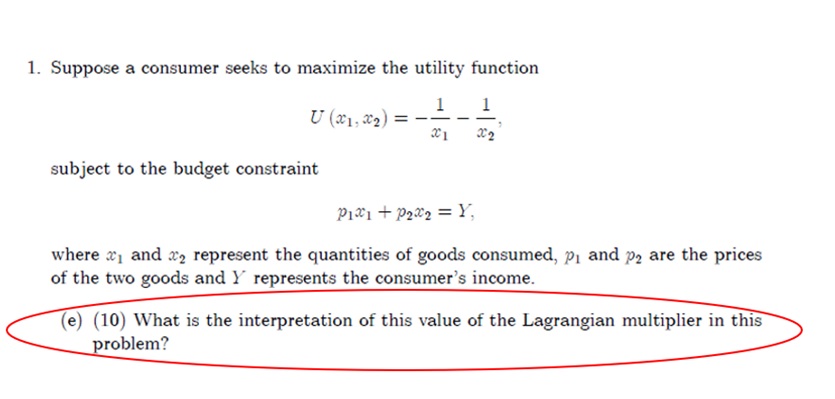
1. Suppose a consumer seeks to maximize the utility function U (2 1, 202 ) = 0 2 subject to the budget constraint P121 + P2 2 = Y, where a, and *2 represent the quantities of goods consumed, p, and p2 are the prices of the two goods and Y' represents the consumer's income. (e) (10) What is the interpretation of this value of the Lagrangian multiplier in this
Step by Step Solution
There are 3 Steps involved in it

Get step-by-step solutions from verified subject matter experts
 Study Help