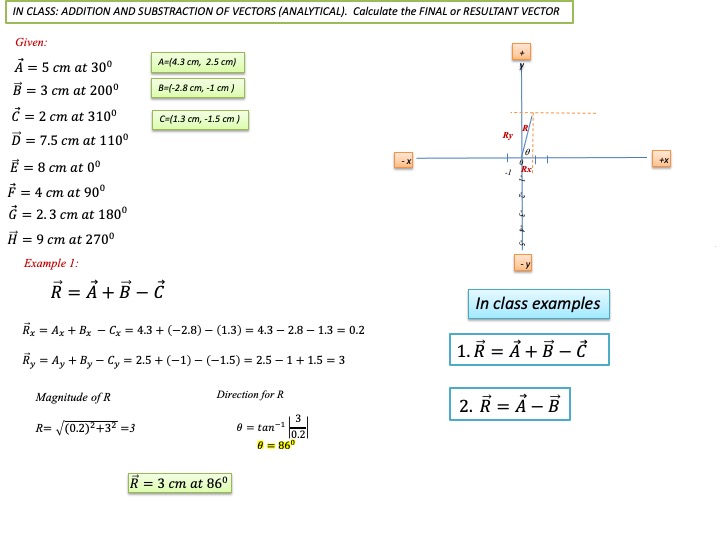
Question: Given: vec ( A ) = 5 c m a t 3 0 , A = ( 4 . 3 c m , 2 .

Given:
vec(A)=5cmat30,A=(4.3cm,2.5cm)
vec(B)=3cmat200,B=(-2.8cm,-1cm)
vec(C)=2cmat310,
vec(D)=7.5cmat110,
vec(E)=8cmat0,
vec(F)=4cmat90,
vec(G)=2.3cmat180,
vec(H)=9cmat270,
Example 1:
vec(R)=vec(A)+vec(B)-vec(C)
vec(R)x=Ax+Bx-Cx=4.3+(-2.8)-(1.3)=4.3-2.8-1.3=0.2
vec(R)y=Ay+By-Cy=2.5+(-1)-(-1.5)=2.5-1+1.5=3
1. vec(R)=vec(A)+vec(B)-vec(C)
Magnitude of R
R=(0.2)2+322=3
Direction for R
=tan-1|30.2|
 Given: vec(A)=5cmat30,A=(4.3cm,2.5cm) vec(B)=3cmat200,B=(-2.8cm,-1cm) vec(C)=2cmat310, vec(D)=7.5cmat110, vec(E)=8cmat0, vec(F)=4cmat90, vec(G)=2.3cmat180, vec(H)=9cmat270, Example 1:

Step by Step Solution

There are 3 Steps involved in it

1 Expert Approved Answer
Step: 1 Unlock blur-text-image

Question Has Been Solved by an Expert!

Get step-by-step solutions from verified subject matter experts

Step: 2 Unlock
Step: 3 Unlock

Students Have Also Explored These Related Physics Questions!