





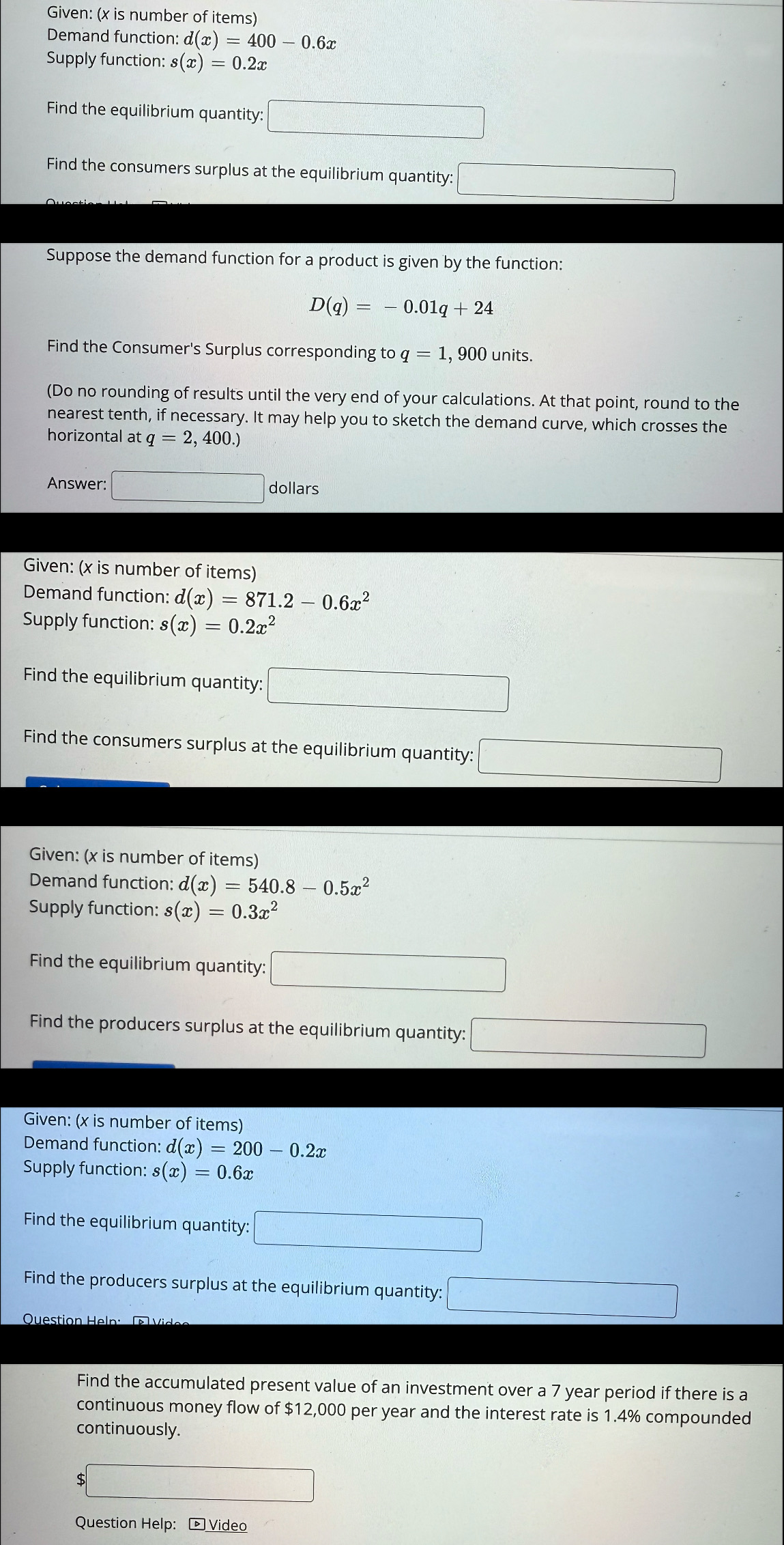
Question: Given: (x is number of items) Demand function: d(x) = 400 - 0.6x Supply function: s(x) = 0.2x Find the equilibrium quantity: Find the consumers
Given: (x is number of items) Demand function:
Given: (x is number of items) Demand function: d(x) = 400 - 0.6x Supply function: s(x) = 0.2x Find the equilibrium quantity: Find the consumers surplus at the equilibrium quantity: Suppose the demand function for a product is given by the function: D(q) = - 0.01q + 24 Find the Consumer's Surplus corresponding to q = 1, 900 units. (Do no rounding of results until the very end of your calculations. At that point, round to the nearest tenth, if necessary. It may help you to sketch the demand curve, which crosses the horizontal at q = 2, 400.) Answer: dollars Given: (x is number of items) Demand function: d(x) = 871.2 - 0.6x2 Supply function: s(a) = 0.2x2 Find the equilibrium quantity: Find the consumers surplus at the equilibrium quantity: Given: (x is number of items) Demand function: d(x) = 540.8 - 0.5x2 Supply function: s(x) = 0.3ac Find the equilibrium quantity: Find the producers surplus at the equilibrium quantity: Given: (x is number of items) Demand function: d(x) = 200 - 0.2x Supply function: s(x) = 0.6x Find the equilibrium quantity: Find the producers surplus at the equilibrium quantity: Question Help. Vide Find the accumulated present value of an investment over a 7 year period if there is a continuous money flow of $12,000 per year and the interest rate is 1.4% compounded continuously. Question Help: Video

Step by Step Solution

There are 3 Steps involved in it

1 Expert Approved Answer
Step: 1 Unlock blur-text-image

Question Has Been Solved by an Expert!

Get step-by-step solutions from verified subject matter experts

Step: 2 Unlock
Step: 3 Unlock

Students Have Also Explored These Related Mathematics Questions!