







Question: GLPK (GNU Linear Programming Kit) is an open source linear optimization software available at gnu.org/software/glpk/. The latest version of Octave should come with glpk. You
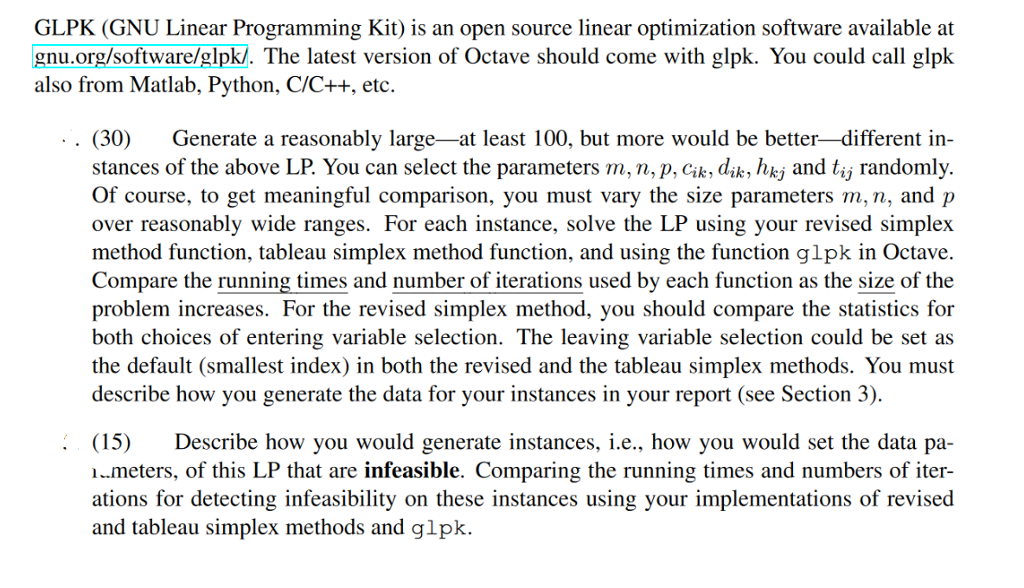
GLPK (GNU Linear Programming Kit) is an open source linear optimization software available at gnu.org/software/glpk/. The latest version of Octave should come with glpk. You could call glpk also from Matlab, Python, C/C++, etc. (30) Generate a reasonably largeat least 100, but more would be better different in- stances of the above LP. You can select the parameters m, n, p, Cik, dik, hkj and tij randomly. Of course, to get meaningful comparison, you must vary the size parameters m, n, and p over reasonably wide ranges. For each instance, solve the LP using your revised simplex method function, tableau simplex method function, and using the function glpk in Octave. Compare the running times and number of iterations used by each function as the size of the problem increases. For the revised simplex method, you should compare the statistics for both choices of entering variable selection. The leaving variable selection could be set as the default (smallest index) in both the revised and the tableau simplex methods. You must describe how you generate the data for your instances in your report (see Section 3). (15) Describe how you would generate instances, i.e., how you would set the data pa- 1.meters, of this LP that are infeasible. Comparing the running times and numbers of iter- ations for detecting infeasibility on these instances using your implementations of revised and tableau simplex methods and glpk. GLPK (GNU Linear Programming Kit) is an open source linear optimization software available at gnu.org/software/glpk/. The latest version of Octave should come with glpk. You could call glpk also from Matlab, Python, C/C++, etc. (30) Generate a reasonably largeat least 100, but more would be better different in- stances of the above LP. You can select the parameters m, n, p, Cik, dik, hkj and tij randomly. Of course, to get meaningful comparison, you must vary the size parameters m, n, and p over reasonably wide ranges. For each instance, solve the LP using your revised simplex method function, tableau simplex method function, and using the function glpk in Octave. Compare the running times and number of iterations used by each function as the size of the problem increases. For the revised simplex method, you should compare the statistics for both choices of entering variable selection. The leaving variable selection could be set as the default (smallest index) in both the revised and the tableau simplex methods. You must describe how you generate the data for your instances in your report (see Section 3). (15) Describe how you would generate instances, i.e., how you would set the data pa- 1.meters, of this LP that are infeasible. Comparing the running times and numbers of iter- ations for detecting infeasibility on these instances using your implementations of revised and tableau simplex methods and glpk
Step by Step Solution
There are 3 Steps involved in it

Get step-by-step solutions from verified subject matter experts
 Study Help