







Question: ****GNU Octave**** ****Problem4**** (you could just give me problem 4 answers But don't only give me problem 2 and 3, I will dislike) Problem 4.
****GNU Octave****
****Problem4****
(you could just give me problem 4 answers
But don't only give me problem 2 and 3, I will dislike)

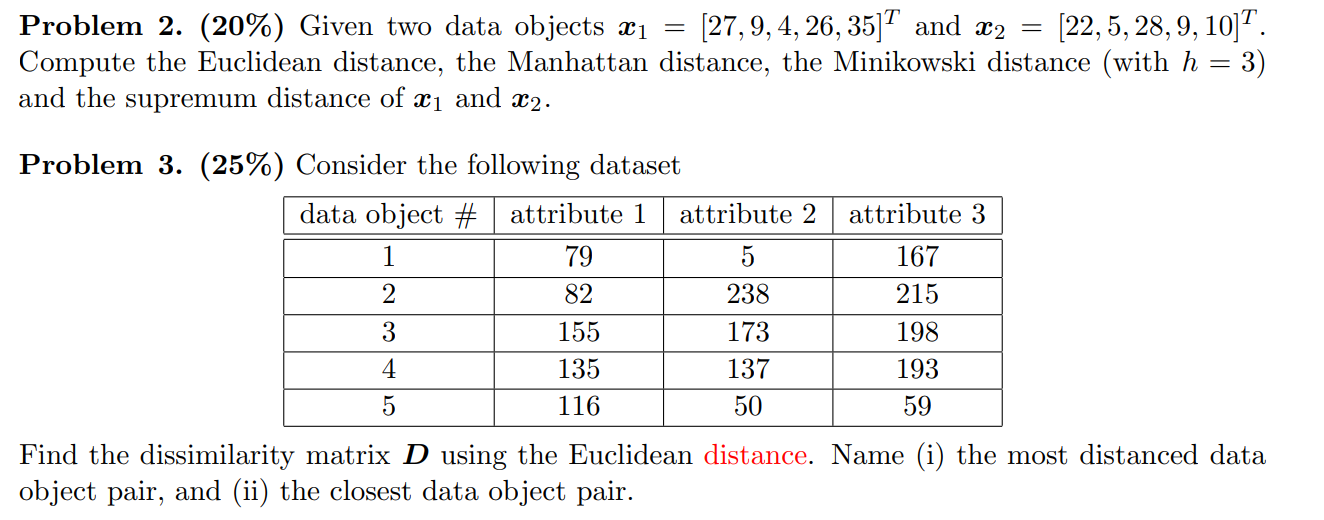
Problem 4. (30%) This is an OCTAVE problem. Build an OCTAVE function that takes the data matrix X and a positive integer p as input arguments. Output the dissimilarity matrix D using the distance function of Minikowski distance with h = p. Test your code with the dataset given in Problems 2 and 3. You are NOT ALLOWED to use the built-in function norm. Problem 2. (20%) Given two data objects Xi = [27,9, 4, 26, 3537 and x2 = [22, 5, 28, 9, 10) Compute the Euclidean distance, the Manhattan distance, the Minikowski distance (with h = 3) and the supremum distance of X1 and 12 Problem 3. (25%) Consider the following dataset data object # attribute 1 attribute 2 1 79 5 2 82 238 3 155 173 4 135 137 5 116 50 attribute 3 167 215 198 193 59 Find the dissimilarity matrix D using the Euclidean distance. Name (i) the most distanced data object pair, and (ii) the closest data object pair. Problem 4. (30%) This is an OCTAVE problem. Build an OCTAVE function that takes the data matrix X and a positive integer p as input arguments. Output the dissimilarity matrix D using the distance function of Minikowski distance with h = p. Test your code with the dataset given in Problems 2 and 3. You are NOT ALLOWED to use the built-in function norm. Problem 2. (20%) Given two data objects Xi = [27,9, 4, 26, 3537 and x2 = [22, 5, 28, 9, 10) Compute the Euclidean distance, the Manhattan distance, the Minikowski distance (with h = 3) and the supremum distance of X1 and 12 Problem 3. (25%) Consider the following dataset data object # attribute 1 attribute 2 1 79 5 2 82 238 3 155 173 4 135 137 5 116 50 attribute 3 167 215 198 193 59 Find the dissimilarity matrix D using the Euclidean distance. Name (i) the most distanced data object pair, and (ii) the closest data object pair
Step by Step Solution
There are 3 Steps involved in it
To solve Problem 4 you need to create an Octave function that calculates the Minkowski distance and ... View full answer

Get step-by-step solutions from verified subject matter experts
 Study Help