







Question: Go back and refresh yourself on competitive dimensions (pp. 28-30 in the text). Choosing one of those dimensions to reflect upon, answer this question: What's
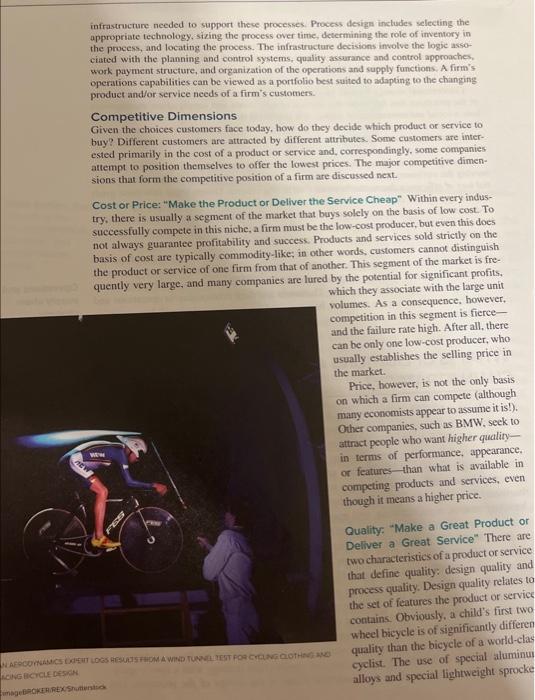
Go back and refresh yourself on "competitive dimensions" (pp. 28-30 in the text). Choosing one of those dimensions to reflect upon, answer this question: What's the relationship between the design of a manufacturing process and the firm's strategic competitive dimensions? I'm looking forward to your thinking about how a firm's chosen competitive dimensions would influence manufacturing design. infrastructure needed to support these processes. Process designt includes selecting the appropriate technology, sizing the process over time, determining the role of imventory in the process, and locating the process. The infrastructure decisions involve the logic associated with the planning and control systems, quality assurance and control approaches, work payment strueture, and organization of the operations and supply functions. A firm's operations capabilities can be viewed as a portfolio best suited to adapting to the changing product and/or service needs of a firm's customers. Competitive Dimensions Given the choices customers fice today, how do they decide which product or service to buy? Different customers are attracted by different attributes Some customers are interested primarily in the cost of a product or service and, correspondingly, some companies attempt to position themselves to offer the lowest prices. The major competitive dimensions that form the competitive position of a firm are discusved neat. Cost or Price: "Make the Product or Deliver the Service Cheap" Within every industry, there is usually a segment of the market that buys solely on the basis of low cost. To successfully compete in this niche, a firm must be the low-cost producer, but even this does not always guarantee profitability and success. Products and services sold strictly on the basis of cost are typically commodity-like, in other words, customers cannot distinguish the product or service of one firm from that of another. This segment of the market is frequently very large, and many companies are lured by the potential for significant profits, which they associate with the large uni volumes. As a consequence, however competition in this segment is fierceand the failure rate high. After all, ther can be only one low-cost producer, wh usually establishes the selling price the market. Price, however, is not the only ba on which a firm can compete (althou many economists appear to assume it i Other companies, such as BMW, see attract people who want higher quali in terms of performance, appears or features than what is availabi competing products and services, though it means a higher price. Quality: "Make a Great Produ Deliver a Great Service" The two characteristics of a product or : that define quality: design quali process quality. Design quality re the set of features the product or contains. Obviously, a child's fi wheel bicycle is of significantly quality than the bicycle of a wo cyclist. The use of special al alloys and special lightweight STRATEGT ANO 5USTAINAEUTY thapter 2 and chains is important to the performance needs of the advanced eyclist. These two types of bieycles are designed for different customers' needs. The higher-quality cyclist product commands a higher price in the markepplace due to its special features. The goal in establishing the proper level of design quality is to focus on the requirements of the customer. Overdesigned products and services with too many or inappropriate features will be viewed as prohibitively expensive. In comparison, underdesigned products and services will lose customers to produets that cost a litile more but are perceived by customers as offering greater value. Process quality, the second characteristic of quality, is critical because it relates directly to the reliability of the produet or service. Regardless of whether the product is a child's first two-wheeler or a bicyele for an international cyclist, customers want products without defects. Thus, the goal of process quality is to produce defect-free products and services. Product and service specifications, given in dimensional tolerances andfor service error rates, define how the product or service is to be made. Adherence to these specifications is critical to ensure the reliability of the product or service as defined by its intended use. Delivery Speed: "Make the Product or Deliver the Service Quickly" In some markets, a firm's ability to deliver more quickly than its competitors is critical. A company that can offer an onsite repair service in only 1 or 2 hours has a significant advantage over a competing firm that guarantees service only within 24 hours. Delivery Reliability: "Dellver it. When Promised" This dimension relates to the firm's ability to supply the product or service on or before a promised delivery due date. For an. automobile manufisturer, it is very important that its supplier of tires provide the needed quantity and types for each day's car production. If the tires needed for a particular car are not available when the car reaches the point on the assembly line where the tires are installed, the whole assembly line may have to be shut down until they arrive. For a service firm such as Federal Express, delivery reliability is the cornerstone of its strategy. Coping with Changes in Demand: "Change fts Volume" In many markets, a company's ability to respond to increzses and decreases in demand is important to its ability to compete. It is well known that a company with increasing demand can do little wrong. When demand is strong and increasing, costs are continuously reduced due to economies of scale, and investments in new technologies can be easily justified. But scaling back when demand decreases may require many difficult decisions about laying off employees and determining reduetions in assets. The ability to effectively deal with dynamic market demand over the long term is an essential element of operations strategy. Flexibility and New-Product Introduction Speed: "Change It" Flexibility, from a strategic perspective, refers to the ability of a company to offer a wide variety of products to its customers. An important element of this ability to offer different products is the time required for a company to develop a new product and to convert its processes to offer the new product. Other Product-Specific Criteria: "Support it" The competitive dimensions just described are certainly the most common. However, other dimensions often relate to specifie products or situations. Notice that most of the dimensions listed next are primarily services in nature. Ofien, special services are provided to augment the sales of manufactured products. 1. Technical liaison and support. A supplier may be expected to provide technical assistance for product development, particularly during the early atages of design and manufacturing. 2. Ability to meet a launch date. A firm may be required to coordinate with other firms on a complex project. In such cases, manufacturing may take place while development work is still being completed. Coordinating work between firms and having them work simultaneously on a project will reduce the total time required to complete the project. 3. Supplier after-sales support. An important competitive dimension may be the ability of a firm to support its product after the sale. This involves the availability of replacement parts and, possibly, the modification of older, existing products, bringing them up to new performance levels. The speed of response to these aftersale needs is often important as well. 4. Environmental impact. A dimension related to-criteria such as carbon dioxide emissions, the use of nonrenewable resources, and other factors that relate to sustainability. 5. Other dimensions. These typically include such factors as the colors available, size, weight, location of the fabrication site, the customization available, and product mix options. The Notion of Trade-Offs Central to the concept of operations and supply chain strategy is the notion of operations focus and trade-offs. The underlying logic is that an operation cannot excel simultaneously on all competitive dimensions. Consequently, management has to decide which parameters of performance are critical to the firm's success and then concentrate the resources of the firm on these particular characteristics. For example, if a company wants to focus on the speed of delivery, it cannot be very flexible in its ability to offer a wide range of products. Similarly, a low-cost strategy is not compatible with either speed of delivery or flexibility. High quality also is viewed as a trade-off to low cont. A strategic position is not sustainable unless there are compromises with other positions, Trade-offs occur when activities are incompatible so that more of one thing necessitates less of another. An airline can choose to serve meals-adding cost and slowing turnaround time at the gate - or it can choose not to, but it cannot do both without bearing major inefficiencies. Straddling occurs when a company seeks to match the benefits of a successful position while maintaining its existing position. It adds new features, services, or technologies onto the activities it already performs. The risky nature of this strategy is shown by Continental Airlines' ill-fated attempt to compele with Southwest Airlines. While maintaining its position as a full-service airline, Continental set out to match Southwest on a number of pointto-point routes. The airline dubbed the new service Continental Lite. It eliminated meals and first-class service, increased departure frequency, lowered fares, and shortened gate turnaround time. Because Continental remained a full-service airline on other routes, it continued to use travel agents and its mixed fleet of planes and to provide baggage checking and seat assignments. Trade-offs ultimately grounded Continental Lite. The airline lost hundreds of million: of dollars, and the chief executive officer lost his job. Its planes were delayed, leavin hub cities congested, slowed at the gate by baggage transfers. Late flights and cancella tions generated a thousand complaints a day. Continental Lite could not afford to compe on price and still pay standard travel agent commissions, but neither could it do witho agents for its full-service business. The airline compromised by cutting commissions all Continental flights. Similarly, it could not afford to offer the same frequent-flier be efits to travelers paying the much lower ticket prices for Lite service. It compromised ag
Step by Step Solution
There are 3 Steps involved in it

Get step-by-step solutions from verified subject matter experts
 Study Help