







Question: Goal: Hypothesis testing Understand hypothesis testing using t.tests Learn how to run t-testsinR Watch To learn about the statistics of hypothesis testing and t.tests: e
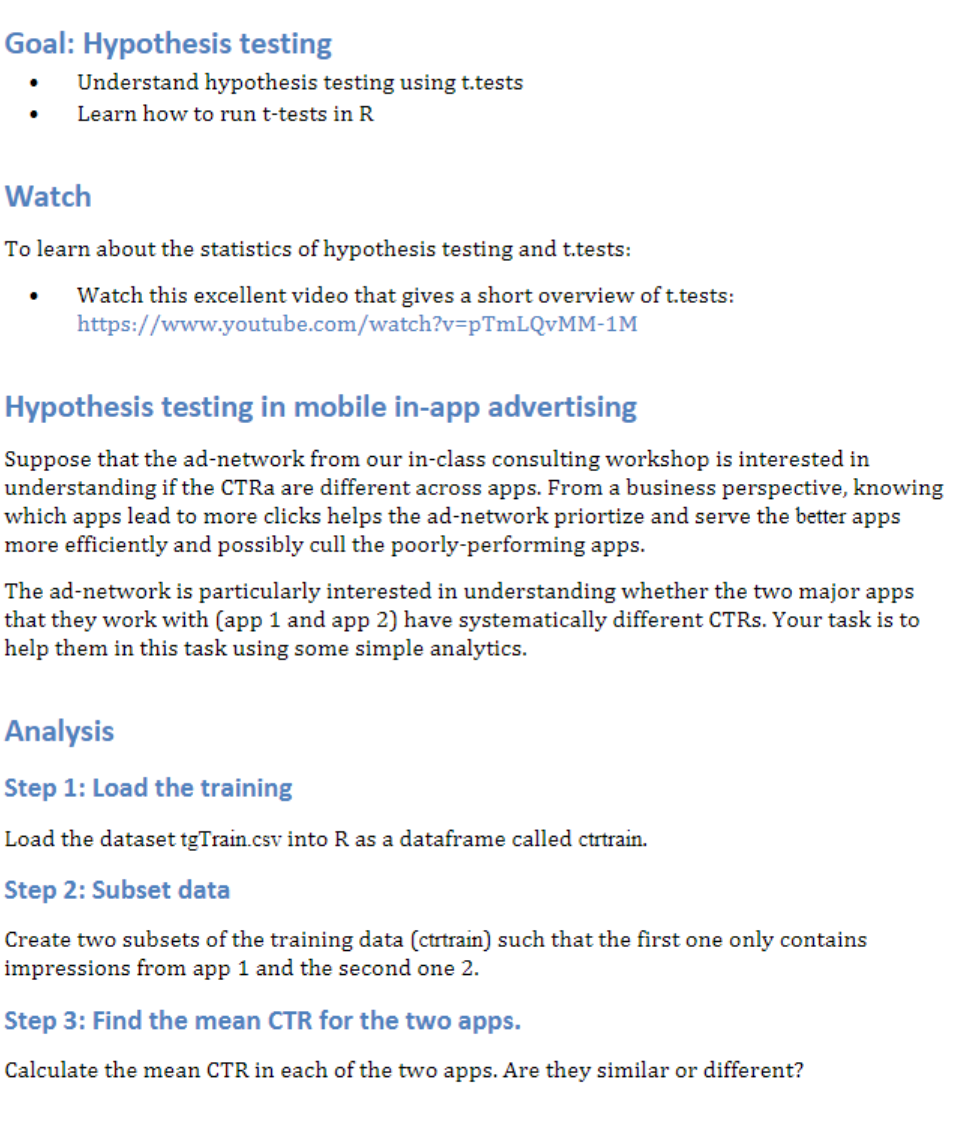
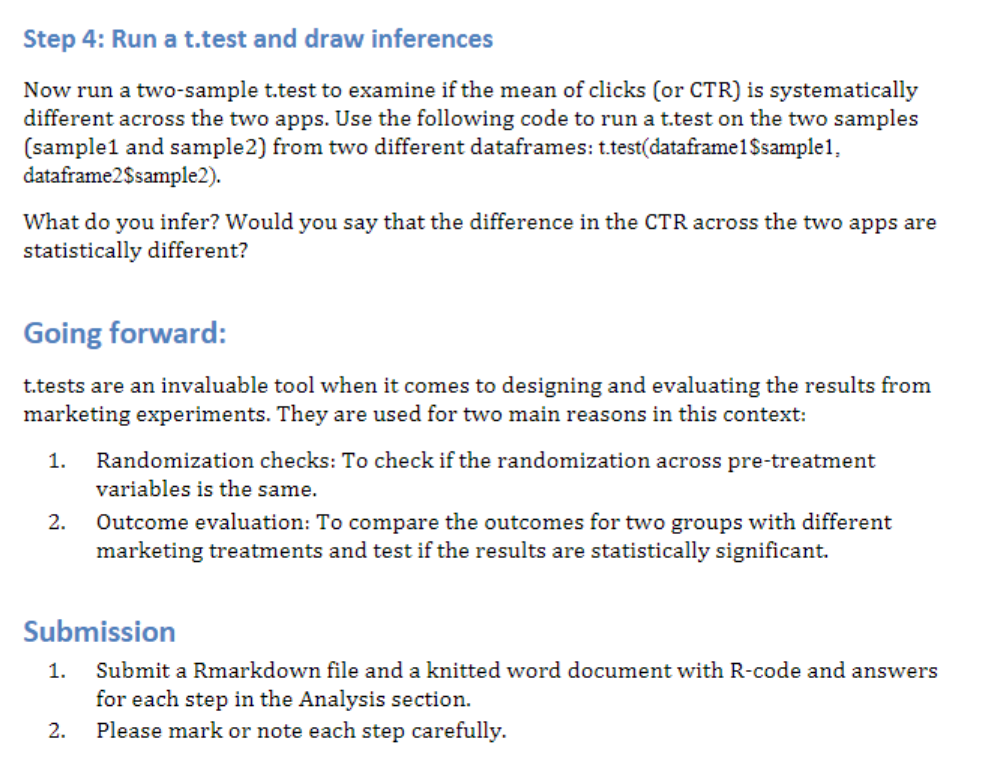
Goal: Hypothesis testing Understand hypothesis testing using t.tests Learn how to run t-testsinR Watch To learn about the statistics of hypothesis testing and t.tests: e Watch this excellent video that gives a short overview of t.tests: https://www.youtube.com/watch?v=pTmLQvMM-1M Hypothesis testing in mobile in-app advertising Suppose that the ad-network from our in-class consulting workshop is interested in understanding if the CTRa are different across apps. From a business perspective, knowing which apps lead to more clicks helps the ad-network priortize and serve the better apps more efficiently and possibly cull the poorly-performing apps. The ad-network is particularly interested in understanding whether the two major apps that they work with (app 1 and app 2) have systematically different CTRs. Your task is to help them in this task using some simple analytics. Analysis Step 1: Load the training Load the dataset tgTrain csv into R as a dataframe called ctrtrain. Step 2: Subset data Create two subsets of the training data (ctrtramn) such that the first one only contains impressions from app 1 and the second one 2. Step 3: Find the mean CTR for the two apps. Calculate the mean CTR in each of the two apps. Are they similar or different? Step 4: Run a t.test and draw inferences Now run a two-sample t.test to examine if the mean of clicks (or CTR) is systematically different across the two apps. Use the following code to run a t.test on the two samples (samplel and sample2) from two different dataframes: t test(dataframe1$samplel, dataframe2$sample2). What do you infer? Would you say that the difference in the CTR across the two apps are statistically different? Going forward: t.tests are an invaluable tool when it comes to designing and evaluating the results from marketing experiments. They are used for two main reasons in this context: 1. Randomization checks: To check if the randomization across pre-treatment variables is the same. 2. Outcome evaluation: To compare the outcomes for two groups with different marketing treatments and test if the results are statistically significant. Submission 1. Submit a Rmarkdown file and a knitted word document with R-code and answers for each step in the Analysis section. 2. Please mark or note each step carefully
Step by Step Solution
There are 3 Steps involved in it

Get step-by-step solutions from verified subject matter experts
 Study Help