Question: Good Afternoon, Can I get help with this task? I would greatly appreciate the support if you don't know how to help me. Then thank
Good Afternoon,
Can I get help with this task? I would greatly appreciate the support if you don't know how to help me. Then thank you for trying, but let another tutor try to help with my task.
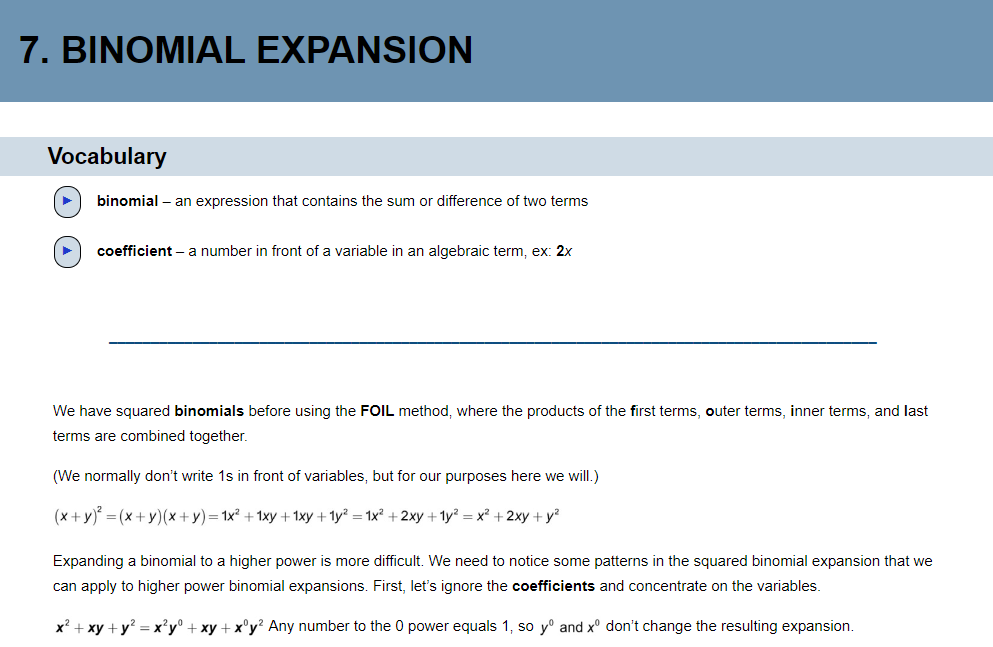
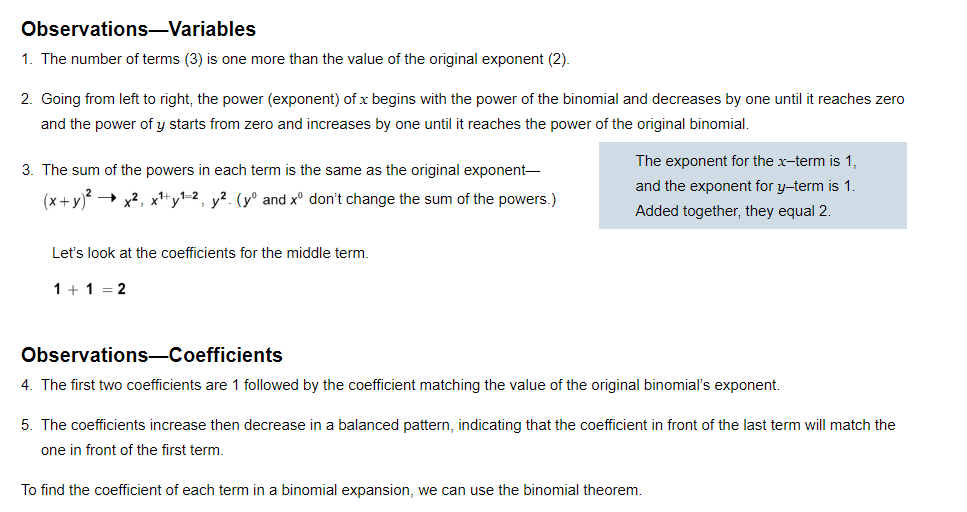
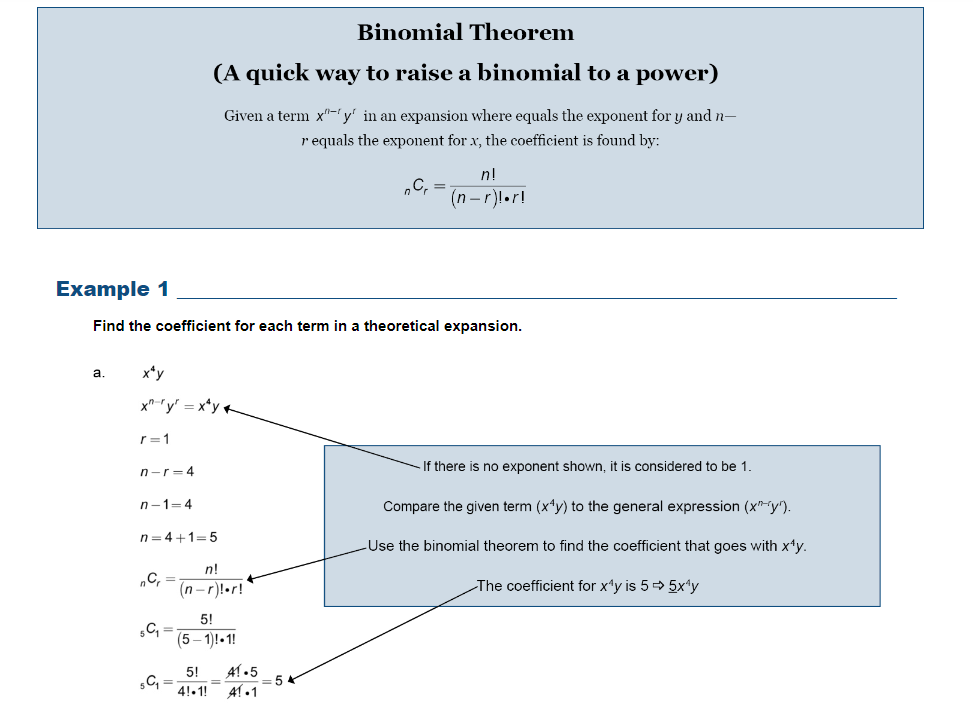
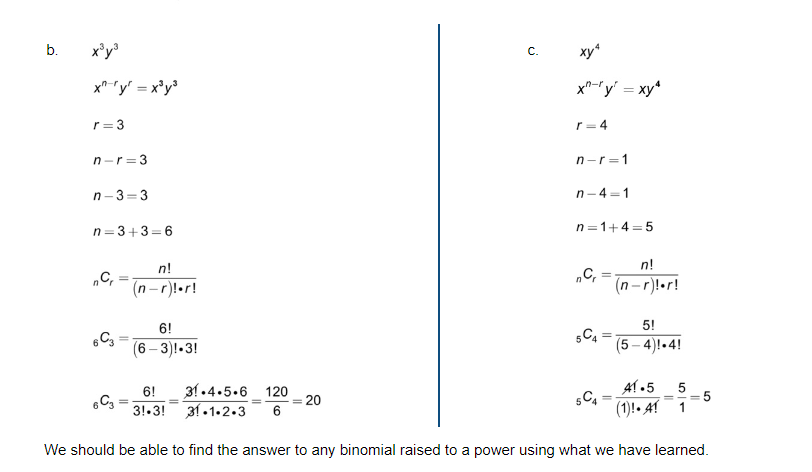
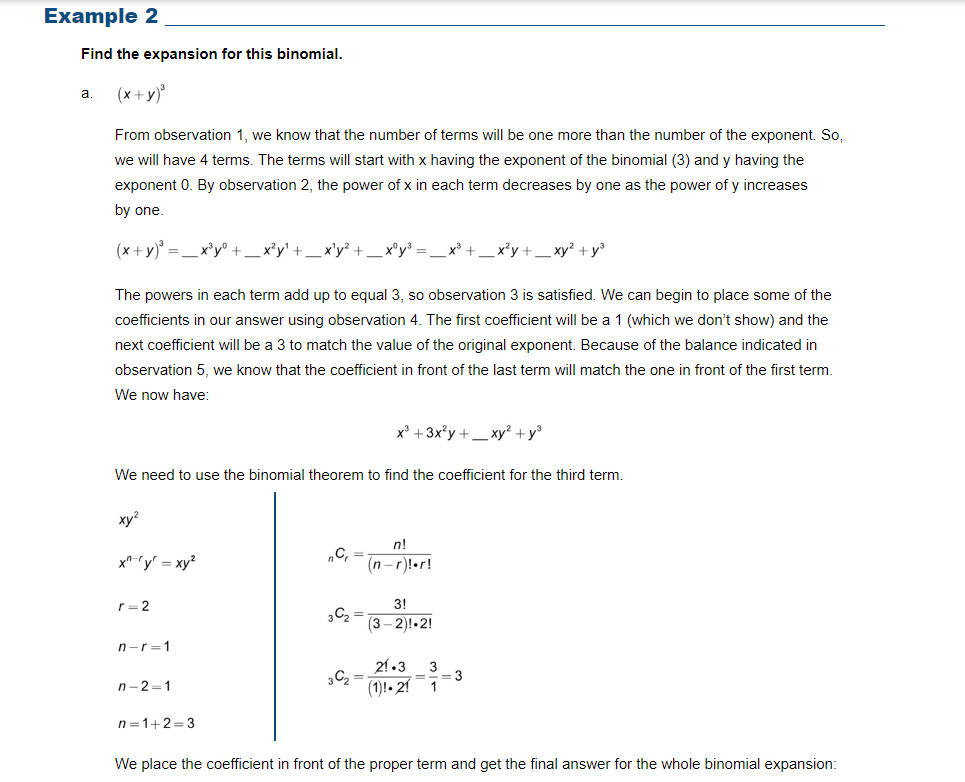
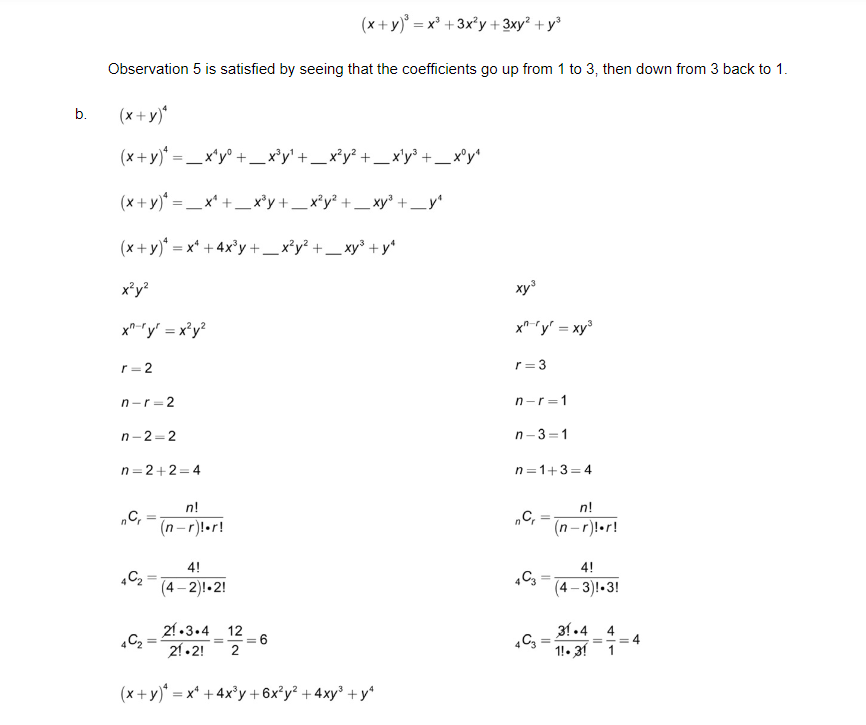
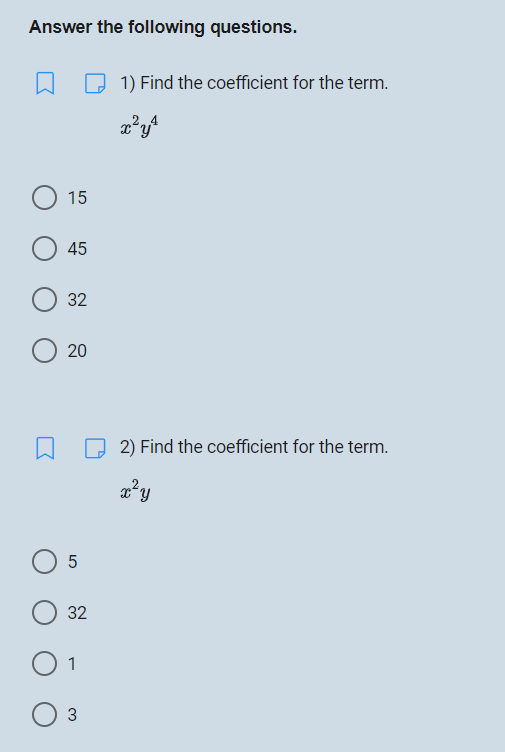
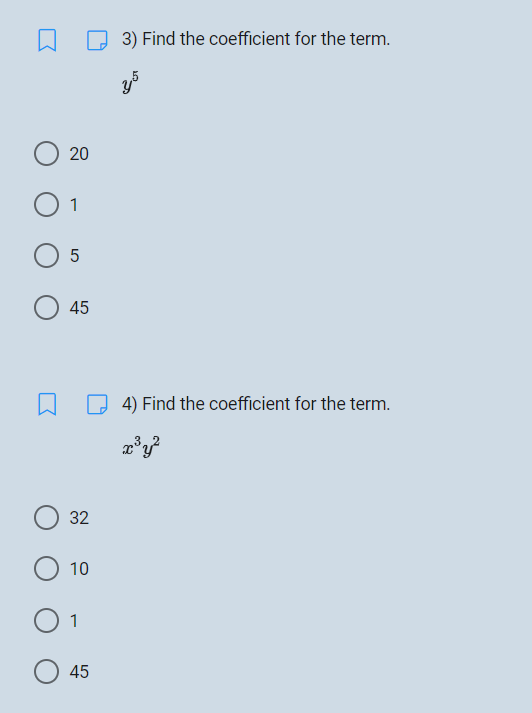
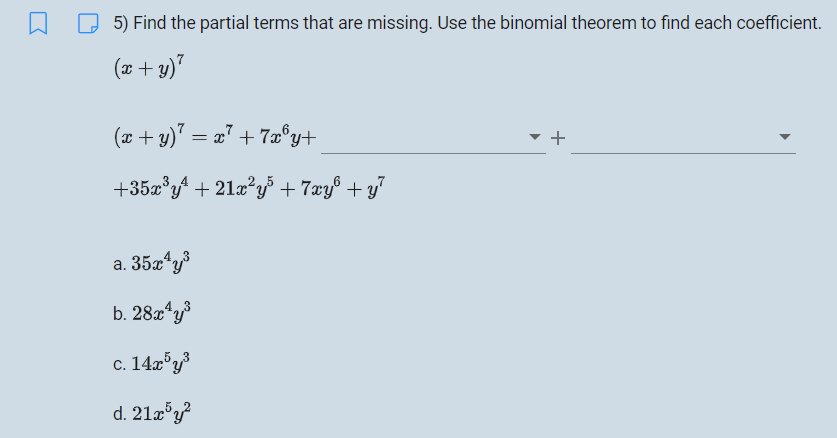
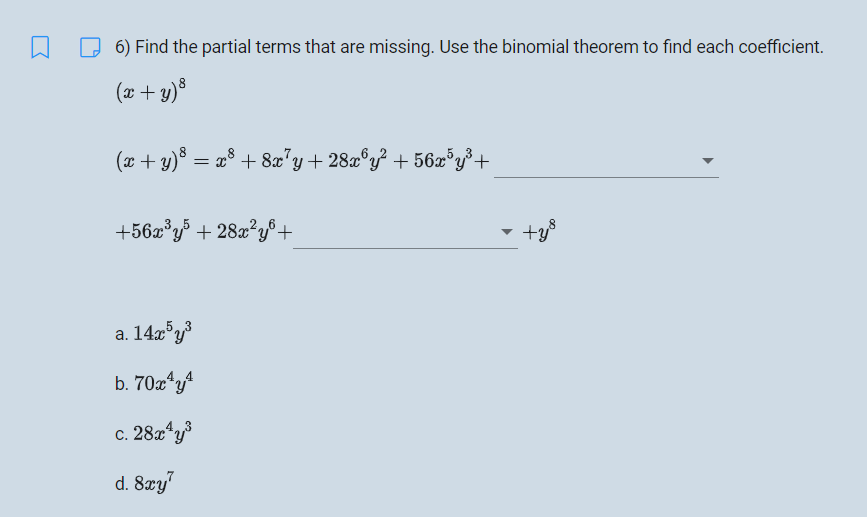
Vocabulary binomial an expression that contains the sum or difference of two terms 8 coefcient a number in front of a variable in an algebraic term, ex: 2x We have squared binomials before using the FOIL method, where the products of the rst terms, outer terms, inner terms, and last terms are combined together. (We normally don't write ts in front of variables. but for our purposes here we will.) {it+J,r}?=|[:lr+:,-')(M+y}|=1x'+1Jr1r+1Jty+1yf=1x=+2;iry+'l}r'=Jr=+2.19%}!a Expanding a binomial to a higher power is more difcult. We need to notice some patterns in the squared binomial expansion that we can apply to higher power binomial expansions. First, let's ignore the coefficients and concentrate on the variables. 1:2 + X}! + y?- : 12y\" + xy + xy2 Any number to the 0 power equals 1. so y\" and 1\" don't change the resulting expansion. ObservationsVariables 'l. The number ofterms {3) is one more than the value ofthe original exponent [2]. . Going from left to right, the power {exponent} ofx begins with the power of the binomial and decreases by one until it reaches zero and the power of y starts from zero and increases by one until it reaches the power of the original binomial. 3. The sum of the powers in each term is the same as the original exponent The exponent for the xterm '51\" 2 _ and the exponent for yterm is 1. {x+y_] 5 x2. xl'yLz. ya. {ya and it\" don't change the sum ofthe powers.) Added together, they equal 2. Let's look at the coefcients for the middle term. 1-1=2 ObservationsCoefficients 4. "he first two coefcients are 1 followed by the coefficient matching the value of the original binomial's exponent. 5. "he coefficients increase then decrease in a balanced pattern. indicating that the coefcient in front of the last term will match the one in front of the rst term. To f'nd the coefficient of each term in a binomial expansion. we can use the binomial theorem. Binomial Theorem (A quick way to raise a binomial to a power) Given a term x"-y' in an expansion where equals the exponent for y and n- r equals the exponent for x, the coefficient is found by: n! C, = 7 (n - r)!or! Example 1 Find the coefficient for each term in a theoretical expansion. a. x" ty' = xy+ r =1 n-r =4 If there is no exponent shown, it is considered to be 1. n-1=4 Compare the given term (x*y) to the general expression (x-ryn). n =4+1=5 Use the binomial theorem to find the coefficient that goes with xiy. n! (n- r)!or ! The coefficient for xy is 5 - 5xy 5! 5 41 75-1)! -1! 5! 4! .5 $ 1 4!-1! 41 -1 =5Kb. C. xi-dy' = xy* r =3 r=4 n-r =3 n-r =1 n-3=3 n-4=1 n =3+3=6 n =1+4=5 n! n! n , = (n- r)!-r! (n- r)!or! 6! 69 = 5! 6 -3)!-3! 5 4 = (5-4)!-4! 6! 3! . 4.5-6 120 41 -5 = 20 5 3!-3! 31 - 1-2-3 6 54 = 5 (1)!. 41 1 We should be able to find the answer to any binomial raised to a power using what we have learned.Example 2 Find the expansion for this binomial. a. ( x +y ) From observation 1, we know that the number of terms will be one more than the number of the exponent. So, we will have 4 terms. The terms will start with x having the exponent of the binomial (3) and y having the exponent 0. By observation 2, the power of x in each term decreases by one as the power of y increases by one. ( x+ y ) =_ xy+_ x y +_ xy?+ y3 The powers in each term add up to equal 3, so observation 3 is satisfied. We can begin to place some of the coefficients in our answer using observation 4. The first coefficient will be a 1 (which we don't show) and the next coefficient will be a 3 to match the value of the original exponent. Because of the balance indicated in observation 5, we know that the coefficient in front of the last term will match the one in front of the first term. We now have: x3 + 3x y +_ xy?+ y3 We need to use the binomial theorem to find the coefficient for the third term. xy? n! x"-y' = xy? nor (n - r)!or! r =2 3! 3 2 (3-2)!-2! n-r =1 3C, - 2!.3 3 n-2=1 (1)!- 21 1 = 3 n =1+2=3 We place the coefficient in front of the proper term and get the final answer for the whole binomial expansion:( x+ y) = x3 + 3x y+3xy?+y3 Observation 5 is satisfied by seeing that the coefficients go up from 1 to 3, then down from 3 back to 1. b. ( x+ y )* ( x + y ) =_ xy+_ xy'+_ xy+_xy+_xy" ( x + y ) =_ x+_xy+_xy +_xy+_y ( x+ y )* = x*+ 4x y+_xy? +_xy3 + y* xy 3 x-y' = x2y2 x-ry' = xy' r =2 r =3 n-r =2 n-r =1 n-2-2 n - 3=1 n =2+2=4 n =1+3=4 n! n! (n - r)!or! (n - r)!or! 4! 4! AC2 (4-2)!-2! 46'3 (4-3)!-3! C, - 2!.3-4 12 6 4Cq 3!.4 4 21 -2! 2 = 4 1!- 3! 1 (x+ y)* = x+4x'y+6x?y? + 4xy3 + y#Answer the following questions. 1) Find the coefficient for the term. O 15 45 O 32 O 20 [ 2) Find the coefficient for the term. 0 5 32 O 1 O 3W 3) Find the coefficient for the term. O 20 O 1 0 5 O 45 [ 4) Find the coefficient for the term. 32 O 10 O 1 O 455) Find the partial terms that are missing. Use the binomial theorem to find each coefficient. (a + y )" (xty) = 27+ 7agt + +35xBy4 + 21x2y + 7xy ty a. 35x473 b. 28x4 y' c. 14xy d. 21xye b C d6) Find the partial terms that are missing. Use the binomial theorem to find each coefficient. ( * + y ) 8 ( + y)8 = 28 + 8x y+28267 + 56x y'+ +56x34 + 28x-y' t a. 14x573 b. 70x424 c. 28x4y d. 8xy\f
Step by Step Solution
There are 3 Steps involved in it
1 Expert Approved Answer
Step: 1 Unlock
Question Has Been Solved by an Expert!
Get step-by-step solutions from verified subject matter experts
Step: 2 Unlock
Step: 3 Unlock
Students Have Also Explored These Related Mathematics Questions!











 Study Help