







Question: graph 3.1 Exercise 1: (a) Proof that (by an example with n 10) the number of terminal vertices in a binary tree with (b) Give
graph 3.1
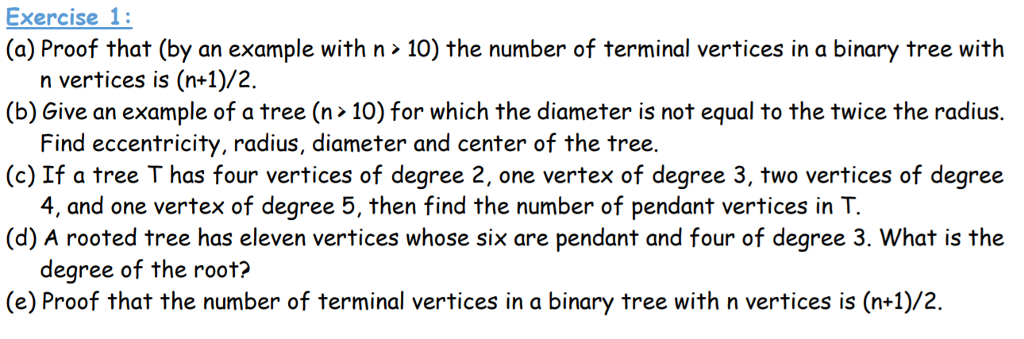
Exercise 1: (a) Proof that (by an example with n 10) the number of terminal vertices in a binary tree with (b) Give an example of a tree (n 10) for which the diameter is not equal to the twice the radius. (c) If a tree T has four vertices of degree 2, one vertex of degree 3, two vertices of degree (d) A rooted tree has eleven vertices whose six are pendant and four of degree 3. What is the (e) Proof that the number of terminal vertices in a binary tree with n vertices is (n+1)/2. n vertices is (n+1)/2. Find eccentricity, radius, diameter and center of the tree. 4, and one vertex of degree 5, then find the number of pendant vertices in T. degree of the root? Exercise 1: (a) Proof that (by an example with n 10) the number of terminal vertices in a binary tree with (b) Give an example of a tree (n 10) for which the diameter is not equal to the twice the radius. (c) If a tree T has four vertices of degree 2, one vertex of degree 3, two vertices of degree (d) A rooted tree has eleven vertices whose six are pendant and four of degree 3. What is the (e) Proof that the number of terminal vertices in a binary tree with n vertices is (n+1)/2. n vertices is (n+1)/2. Find eccentricity, radius, diameter and center of the tree. 4, and one vertex of degree 5, then find the number of pendant vertices in T. degree of the root
Step by Step Solution
There are 3 Steps involved in it

Get step-by-step solutions from verified subject matter experts
 Study Help