







Question: Graph II. N = {1, 2, 3, 4, 5, 6) No = {1} N, = {6} E = {(1,2), (2,3), (2,6), (3, 4), (3,5), (4,5),
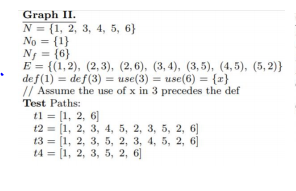
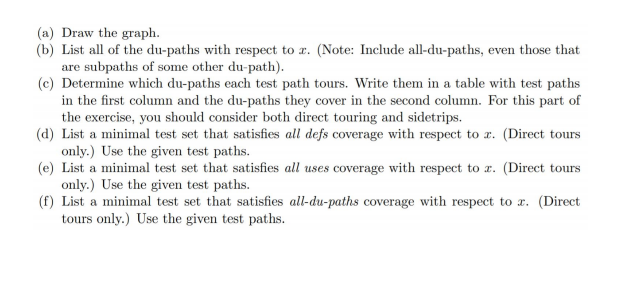
Graph II. N = {1, 2, 3, 4, 5, 6) No = {1} N, = {6} E = {(1,2), (2,3), (2,6), (3, 4), (3,5), (4,5), (5,2)} def(1) = def(3) = use(3) = use(6) = {x} // Assume the use of x in 3 precedes the def Test Paths: t1 = 1, 2, 6 t2 = [1, 2, 3, 4, 5, 2, 3, 5, 2, 6] 13 = [1, 2, 3, 5, 2, 3, 4, 5, 2, 6] 14 = (1, 2, 3, 5, 2, 6] (a) Draw the graph. (b) List all of the du-paths with respect to r. (Note: Include all-du-paths, even those that are subpaths of some other du-path). (c) Determine which du-paths each test path tours. Write them in a table with test paths in the first column and the du-paths they cover in the second column. For this part of the exercise, you should consider both direct touring and sidetrips. (d) List a minimal test set that satisfies all defs coverage with respect to r. (Direct tours only.) Use the given test paths. (e) List a minimal test set that satisfies all uses coverage with respect to I. (Direct tours only.) Use the given test paths. (f) List a minimal test set that satisfies all-du-paths coverage with respect to r. (Direct tours only.) Use the given test paths
Step by Step Solution
There are 3 Steps involved in it

Get step-by-step solutions from verified subject matter experts
 Study Help