







Question: Graphic Illustrations 490 CHAPTER 9 CHECK YOUR COMPREHENSION SELECTION Main Iden After reading the selection, answer the following questions with a, b, c, ord. To

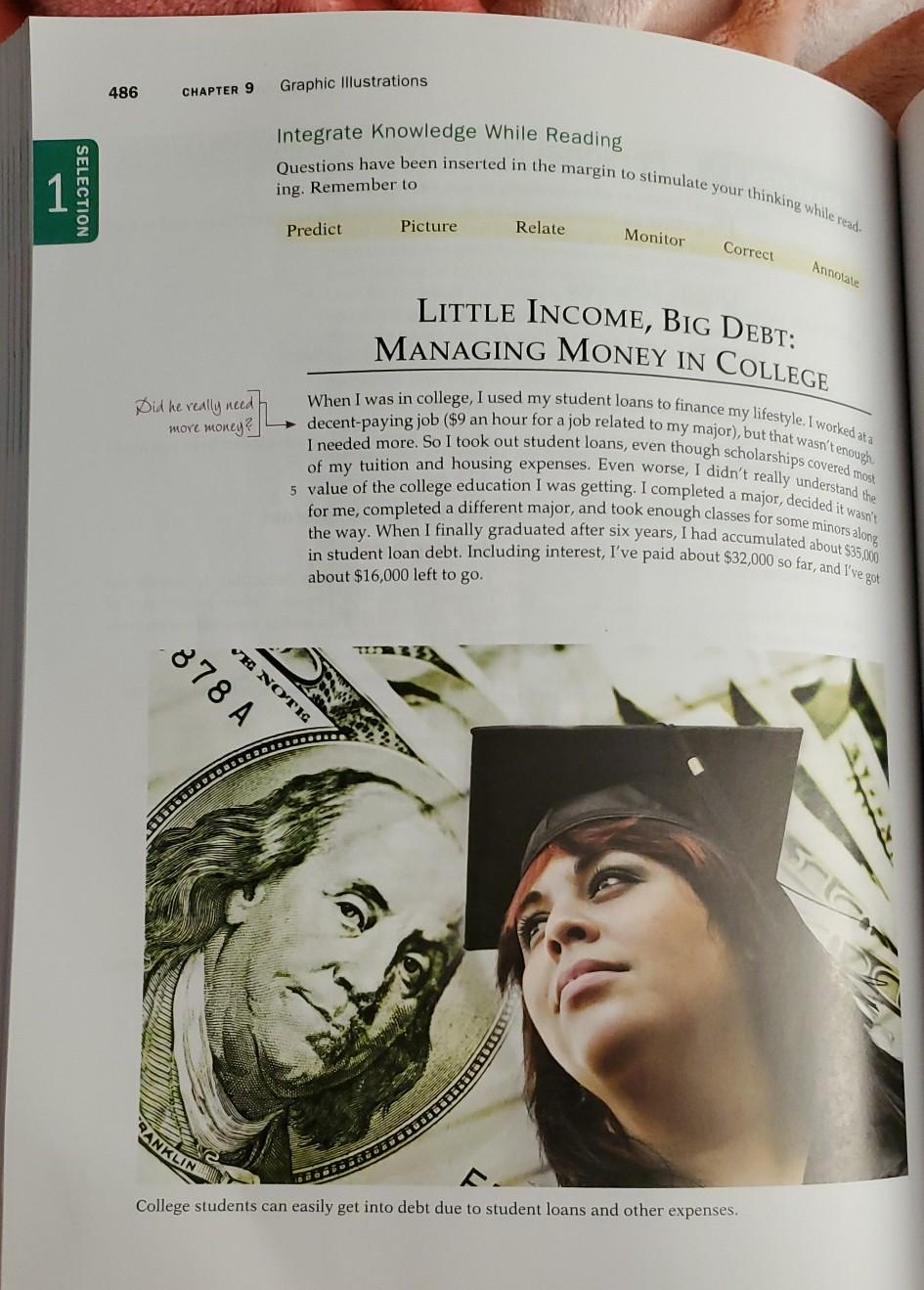

Graphic Illustrations 490 CHAPTER 9 CHECK YOUR COMPREHENSION SELECTION Main Iden After reading the selection, answer the following questions with a, b, c, ord. To help you analyze your strengths and weaknesses, the question types are indicated 1. Which is the best statement of the main idea of this selection? b. The author regrets accumulating $35,000 in student loans. a. Students should take their studies seriously. c. To get the most out of college financially, spend more time and energy on your studies and extracurricular activities, and spend d. Too many college students spend time on activities that do not contribute to the long-term value of their education. a. college students should use credit cards only when necessary. b. it is wise to invest in quality clothing for job interviews. less money. 2. The author states that c. his student loans and scholarships covered only half of his d. students should avoid taking a job if working would mean studying less. Detail expenses. Detail 3. Which of the following is not mentioned as a benefit of being involved in campus activities? a. You may make connections that lead to an on-campus job. b. It is a way to build a more impressive rsum. c. You will learn about yourself and your interests. d. It will provide opportunities for building leadership skills. Inference 4. We can infer from the selection that the author a. wasted time and money by making poor choices in college, b. settled on his career goals early in his college years. c. did not take his own advice about getting a job related to his major. d. has had no trouble paying his student loans. Inference 5. When the author says that college students have a negative income, he means a. they are building wealth for the future. b. they are spending more than they earn. c. they are spending too much and should cut back. d. they should use credit to pay living expenses. Main Idea 6. The main point of the section, "Take the Studies Seriously," is that a. students should study all the time and avoid socializing. b. a poor grade point average limits later job opportunities c. flunking out costs money. d. to get the most value out of their investment in college, students should concentrate on doing well in their studies. SELECTION 1 Personal Narrative 491 Main Idea 7. The main point of the section, "Take Advantage of the Other Oppor- tunities, Too," is a. college is the time to have fun and meet people. b. stay involved in lots of activities instead of just a few. c. focus on studying during the week and save the weekends for social activities. d. get involved in campus activities that provide opportunities to build employment-related skills as well as to have fun. SELECTION Detail 8. In calculating the cost of college, the author a. tallies the cost of tuition, books, fees, and entertainment b. considers the cost of tuition, living expenses, and the amount that the student could be earning if the student were not going to college. c. totals the amount spent on food, rent, and tuition. d. concludes that college is not worth the immense cost, Detail 9. Which of the following does the author not advise doing to save money? a. Eat only one big meal a day. b. Take advantage of free entertainment on campus. c. Get the best paying part-time job possible. d. Pay credit card bills in full immediately. Inference 10. The author believes that a. going into debt in college should be avoided. b. getting a job in your major is best as long as it pays well. c. students should wait until later to establish a solid credit rating. d. going into debt in college is okay as long as it provides greater opportunities after graduation. Answer the following with T (true) or F (false): Inference Detail Inference 11. The author's student loans ultimately cost him about $48,000. 12. The author states that students should get jobs to avoid borrowing more money for college. 13. The author believes that he made the most of his college education. 14. The author argues that a poor GPA reduces the value of your degree. 15. The author's intention is to help students to manage college expenses wisely. Detail Author's Purpose Integrate Knowledge While Reading Questions have been inserted in the margin to stimulate your thinking while read When I was in college, I used my student loans to finance my lifestyle. I worked at a decent-paying job ($9 an hour for a job related to my major), but that wasn't enough of my tuition and housing expenses. Even worse, I didn't really understand the I needed more. So I took out student loans, even though scholarships covered most 5 value of the college education I was getting. I completed a major, decided it wasn't for me, completed a different major, and took enough classes for some minors along the way. When I finally graduated after six years, I had accumulated about $35.000 in student loan debt. Including interest, I've paid about $32,000 so far, and I've got MANAGING MONEY IN COLLEGE 486 CHAPTER 9 Graphic Illustrations 1 SELECTION ing. Remember to Predict Picture Relate Monitor Correct Annotate LITTLE INCOME, BIG DEBT: Did he really need more money? about $16,000 left to go. 878 A JE NOTI PANKLIN College students can easily get into debt due to student loans and other expenses. SELECTION 1 Personal Narrative 487 SELECTION 1 WHAT DID I LEARN FROM THIS DISASTER, AND HOW CAN COLLEGE STUDENTS USE WHAT I LEARNED? 10 A lot of students entering college take out student loans to pay for it. The money they're spending, in the form of loans, far exceeds the money they're taking in. I know all about it. I was doing this very thing just a handful of years ago. I made some incredibly stupid mistakes along the way, and it takes a lot of hindsight to see the things I could have and should have done. If I had it to do all over again, if I 15 were a college student today with a big pile of student loans building up and not much income-here's what I would do. Take the Studies Seriously The cost of college is tremendous. During your years there, not only are you invest- ing the cost of tuition, but you're also investing the income you might have made doing something else, like becoming an electrician's apprentice or starting your own 20 business. If you're paying $10,000 for your tuition and other expenses and you're giving up $20,000 in income, that's $30,000 each year in college is costing you. That's ferent way of Ling at grades this improve job chances ? more than $500 every week. What's the best way to undermine that investment? To flunk out. To fail a class, > causing you to stay in school longer. Even a poor GPA undermines that investment. 25 You reduce the value of the degree by reducing your opportunities right after col- lege if you have a low GPA. Hit the books. If it's a choice between a side job and the books, choose the books every time. If you need to borrow more money because of it, borrow that money. Don't undermine the value of your big investment just to save a little bit of money. Take Advantage of the Other Opportunities, Too 30 College isn't just about hitting the books and partying. There are tons of opportunities on a college campus to start building your career and rsum, which will improve your opportunities and salary when you leave school (further improving the value of your student loan investment). That's not to say the experience should preclude fun, but you should put effort into joining groupsand spending social time with those 35 groupsthat build leadership skills or match the topics you're studying. You're also better off getting strongly involved in a small number of activities than getting superficially involved in a lot of activities. Try out a lot of things at first, find the ones that click for you, then get involved with those. Take on responsibili- ties with those groups and work toward leadership positions. You'll build valuable 40 relationships with people, learn new things about your areas of interest and about yourself, and build up your future rsum. You're a College Student-Live as Poor as You Can Don't spend your money dressing exceptionally well. There'll be plenty of time for that later on. Instead, do most of your clothes shopping at Goodwill and thrift stores. Don't think you're above it. Look at your checkbook and realize you're a person 45 with a negative incomethe exact person who should be utilizing such resources. Also, the typical college campus is teeming with free entertainment. Check the campus newspaper for ideas instead of spending money to have fun. Take advan- tage of the cheap food opportunities, too. For a while, I had a "one meal a day" meal plan in dining services. I'd eat a big meal, then snack the rest of the day on whatever 50 was available. Realize that each time you spend money in college, you're costing your future, especially when you're surrounded by opportunities for the most inex- pensive living you'll have in your adult life. Where can I cut expenses? 1 SELECTION this Use a Credit Card Only to Buy Books-Pay the Bill Immediately Don't listen to salespeople who insist you get their credit card. Research a good one, then use it only once a semester to buy your textbooks. Put that credit card some 55 where safe, then pay off the entire bill as soon as it comes in. Never use the card for anything else. This simple plan gives you the benefits that you can get from credit card use in college (mostly building credit) without the dangerous drawbacks of building high-interest debt that you'll have trouble paying off. Seek a Job (or Other Experiences) Related to Your Major, Even for Lower Pay If you're going to get a job in college (most people do), look for a part-time job that's 60 related to your major, even if it means sacrificing pay. A job that matches well with years of experience working with this material, then you look a lot better than most your studies is golden on your rsum when you graduate. If you already have some If you don't know where to begin, the first place to stop is at your departmental 65 office. Ask around for job opportunities within the major-research work, paperwork, whatever's available. If you can't find anything there, look for industries near the college that might relate to what you're doing. Make the effort to make a personal appearance, If none of the above applies to a decision, make the choice that results in the lowest 70 debt when you graduate. You're in college to build your future. Don't sacrifice that Response Suggestion: List the points on which you agree with the author and 488 CHAPTER 9 Graphic Illustrations people coming out of school. I hadn't thought of as it shows that you're serious. Anyone can pick up the phone and dial. Minimize Your Debt -Trent Hamm, The Simple Dollar, February 19, 2008. www.thesimpledollar.com Recall Stop to self-test, relate, and react. Your instructor may choose to give you a brief comprehension review. THINK CRITICALLY ABOUT THE SELECTION The author makes some assumptions about college students and paying for college that don't apply to all college students. In what ways might college students' situations differ from the author's? What are some ways to help pay college costs that the author does not include? WRITE ABOUT THE SELECTION From what point of view does this author write? What is your perspective on the points that he makes? future by piling on debt without improving your post-graduation opportunities. In a nutshell, maximize the value of what you're paying for, and minimize the level of debt. You're surrounded by valuable opportunities in college. Only by grab bing them by the horns can you really maximize the value of your college education (1,026 words those with which you disagree. Which advice will you follow? Explain
Step by Step Solution
There are 3 Steps involved in it

Get step-by-step solutions from verified subject matter experts
 Study Help