







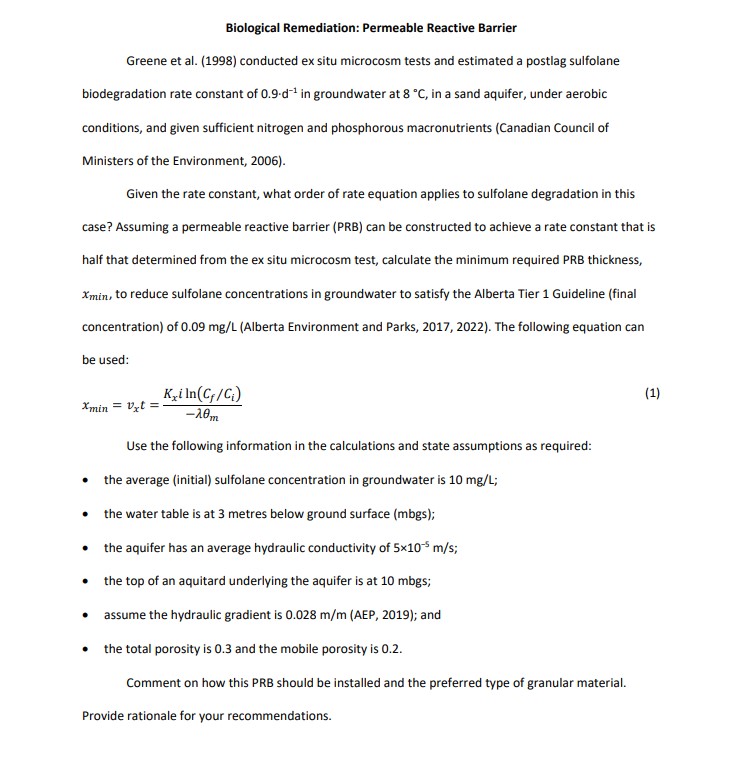
Question: Greene et al . ( 1 9 9 8 ) conducted ex situ microcosm tests and estimated a postlag sulfolane biodegradation rate constant of 0
Greene et al conducted ex situ microcosm tests and estimated a postlag sulfolane
biodegradation rate constant of d in groundwater at deg C in a sand aquifer, under aerobic
conditions, and given sufficient nitrogen and phosphorous macronutrients Canadian Council of
Ministers of the Environment,
Given the rate constant, what order of rate equation applies to sulfolane degradation in this
case? Assuming a permeable reactive barrier PRB can be constructed to achieve a rate constant that is
half that determined from the ex situ microcosm test, calculate the minimum required PRB thickness,
to reduce sulfolane concentrations in groundwater to satisfy the Alberta Tier Guideline final
concentration of mgL Alberta Environment and Parks, The following equation can
be used:
Biological Remediation: Permeable Reactive Barrier
Greene et al conducted ex situ microcosm tests and estimated a postlag sulfolane
biodegradation rate constant of in groundwater at in a sand aquifer, under aerobic
conditions, and given sufficient nitrogen and phosphorous macronutrients Canadian Council of
Ministers of the Environment,
Given the rate constant, what order of rate equation applies to sulfolane degradation in this
case? Assuming a permeable reactive barrier PRB can be constructed to achieve a rate constant that is
half that determined from the ex situ microcosm test, calculate the minimum required PRB thickness,
to reduce sulfolane concentrations in groundwater to satisfy the Alberta Tier Guideline final
concentration of Alberta Environment and Parks, The following equation can
be used:
Use the following information in the calculations and state assumptions as required:
the average initial sulfolane concentration in groundwater is ;
the water table is at metres below ground surface mbgs;
the aquifer has an average hydraulic conductivity of ;
the top of an aquitard underlying the aquifer is at ;
assume the hydraulic gradient is AEP; and
the total porosity is and the mobile porosity is
Comment on how this PRB should be installed and the preferred type of granular material.
Provide rationale for your recommendations.
Use the following information in the calculations and state assumptions as required:
the average initial sulfolane concentration in groundwater is mgL;
the water table is at metres below ground surface mbgs;
the aquifer has an average hydraulic conductivity of times ms;
the top of an aquitard underlying the aquifer is at mbgs;
assume the hydraulic gradient is mm AEP; and
the total porosity is and the mobile porosity is
Comment on how this PRB should be installed and the preferred type of granular material.
Provide rationale for your recommendations.
Step by Step Solution
There are 3 Steps involved in it
1 Expert Approved Answer
Step: 1 Unlock

Question Has Been Solved by an Expert!
Get step-by-step solutions from verified subject matter experts
Step: 2 Unlock
Step: 3 Unlock
 Study Help