







Question: Greetings, please explain the theorem and give your PROOF with steps so I may understand and follow your work. I cannot follow the proof given.
Greetings, please explain the theorem and give your PROOF with steps so I may understand and follow your work. I cannot follow the proof given. Thank you.
open Q-neighborhood, which is quasi-coincident with H at some point w. Since B C 4, B(x)
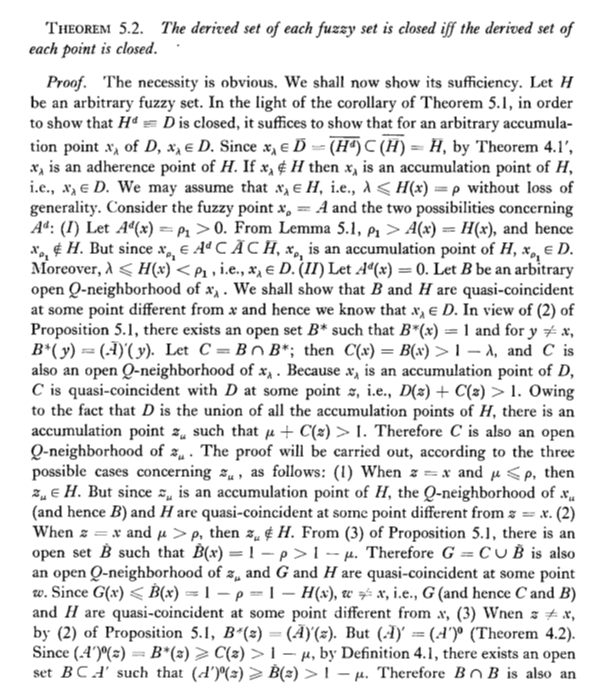
THEOREM 5.2. The derived set of each fuzzy set is closed iff the derived set of each point is closed. Proof. The necessity is obvious. We shall now show its sufficiency. Let H be an arbitrary fuzzy set. In the light of the corollary of Theorem 5.1, in order to show that H' =D is closed, it suffices to show that for an arbitrary accumula- tion point x; of D, x's D. Since x, E D = (HU)C(H) = H, by Theorem 4.1', X, is an adherence point of H. If x, H then x, is an accumulation point of H, i.e., d'y e D. We may assume that x; E H, i.e., ^ p, then H. From (3) of Proposition 5.1, there is an open set such that B(x) = 1 -p>I-. Therefore G =CU is also an open Q-neighborhood of %, and G and H are quasi-coincident at some point w. Since G(x) C(x) > 1 - u, by Definition 4.1, there exists an open set BC ' such that (1)() > B(x) > I - . Therefore Bn B is also an THEOREM 5.2. The derived set of each fuzzy set is closed iff the derived set of each point is closed. Proof. The necessity is obvious. We shall now show its sufficiency. Let H be an arbitrary fuzzy set. In the light of the corollary of Theorem 5.1, in order to show that H' =D is closed, it suffices to show that for an arbitrary accumula- tion point x; of D, x's D. Since x, E D = (HU)C(H) = H, by Theorem 4.1', X, is an adherence point of H. If x, H then x, is an accumulation point of H, i.e., d'y e D. We may assume that x; E H, i.e., ^ p, then H. From (3) of Proposition 5.1, there is an open set such that B(x) = 1 -p>I-. Therefore G =CU is also an open Q-neighborhood of %, and G and H are quasi-coincident at some point w. Since G(x) C(x) > 1 - u, by Definition 4.1, there exists an open set BC ' such that (1)() > B(x) > I - . Therefore Bn B is also an
Step by Step Solution
There are 3 Steps involved in it

Get step-by-step solutions from verified subject matter experts
 Study Help