







Question: Group Pretest Posttest Control 89 92 Control 95 105 Control 89 96 Control 120 115 Control 101 99 Control 85 95 Control 8 8 100
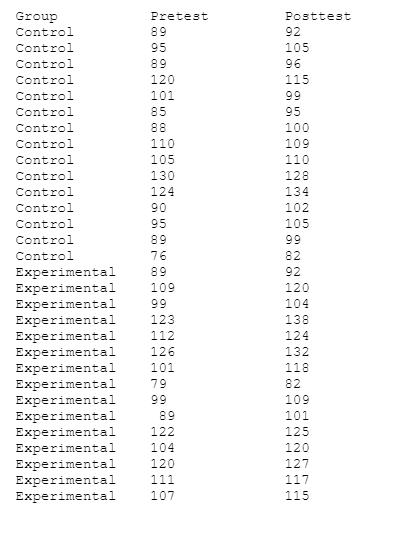
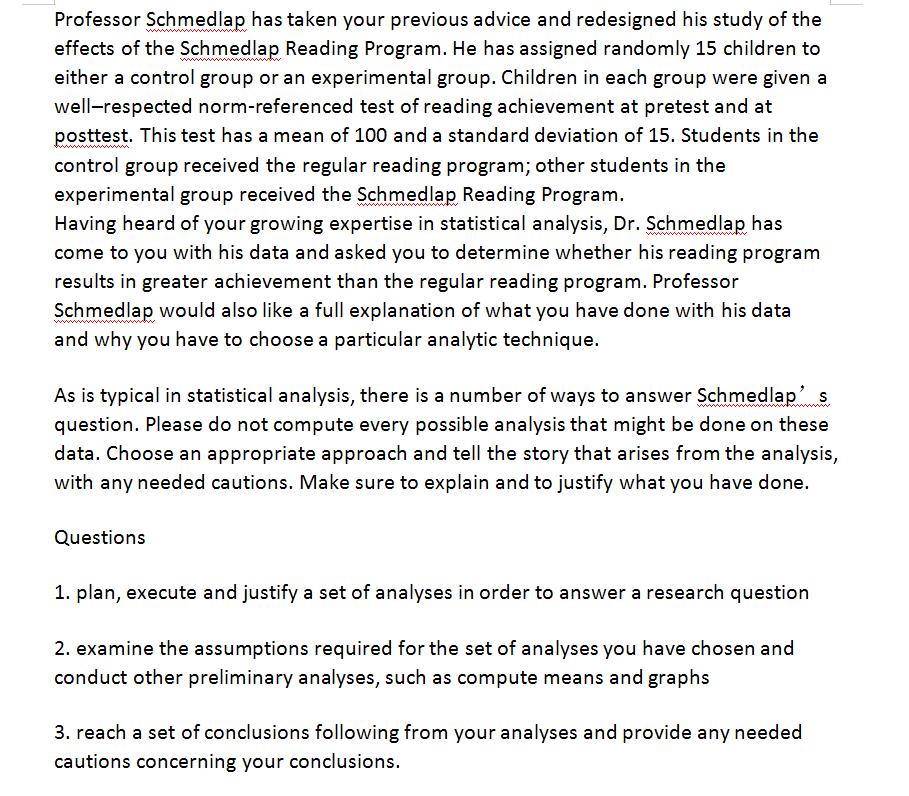
Group Pretest Posttest Control 89 92 Control 95 105 Control 89 96 Control 120 115 Control 101 99 Control 85 95 Control 8 8 100 Control 110 109 Control 105 110 Control 130 128 Control 124 134 Control 90 102 Control 95 105 Control 89 99 Control 76 82 Experimental 89 92 Experimental 109 120 Experimental 99 104 Experimental 123 138 Experimental 112 124 Experimental 126 132 Experimental 101 118 Experimental 79 82 Experimental 99 109 Experimental 89 101 Experimental 122 125 Experimental 104 120 Experimental 120 127 Experimental 111 117 Experimental 107 115Professor W has taken your previous advice and redesigned his study of the - effects of the m Reading Program. He has assigned randomly 15 children to either a control group or an experimental group. Children in each group were given a wellrespected norm-referenced test of reading achievement at pretest and at West. This test has a mean of 100 and a standard deviation of 15. Students in the control group received the regular reading program; other students in the experimental group received the m Reading Program. Having heard of your growing expertise in statistical analysis, Dr. Schmedlap has come to you with his data and asked you to determine whether his reading program results in greater achievement than the regular reading program. Professor mm would also like a full explanation of what you have done with his data and why you have to choose a particular analytic technique. As is typical in statistical analysis, there is a number of ways to answer Schmedlap' 5 question. Please do not compute every possible analysis that might be done on these data. Choose an appropriate approach and tell the story that arises from the analysis, with any needed cautions. Make sure to explain and tojustify what you have done. Questions 1. plan, execute and justify a set of analyses in order to answer a research question 2. examine the assumptions required for the set of analyses you have chosen and conduct other preliminary analyses, such as compute means and graphs 3. reach a set of conclusions following from your analyses and provide any needed cautions concerning your conclusions
Step by Step Solution
There are 3 Steps involved in it

Get step-by-step solutions from verified subject matter experts
 Study Help