Question: GROUP-BASED ASSIGNMENT This assignment is worth 20% of the final mark for LOG302 Supply Chain Information Management and Technology. The cut-off date for this assignment
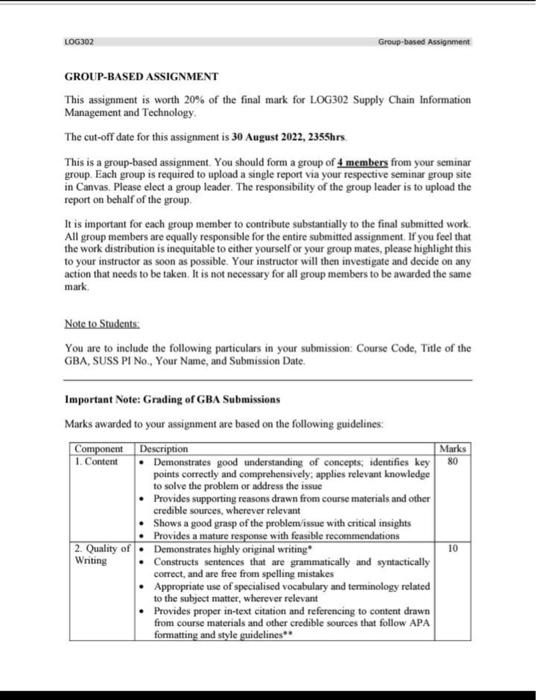
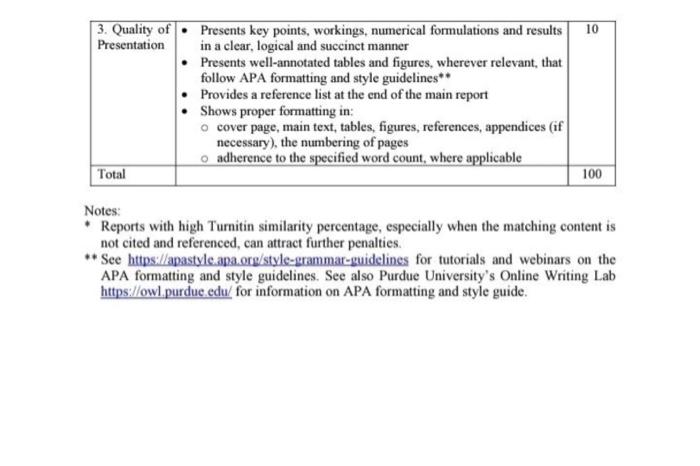
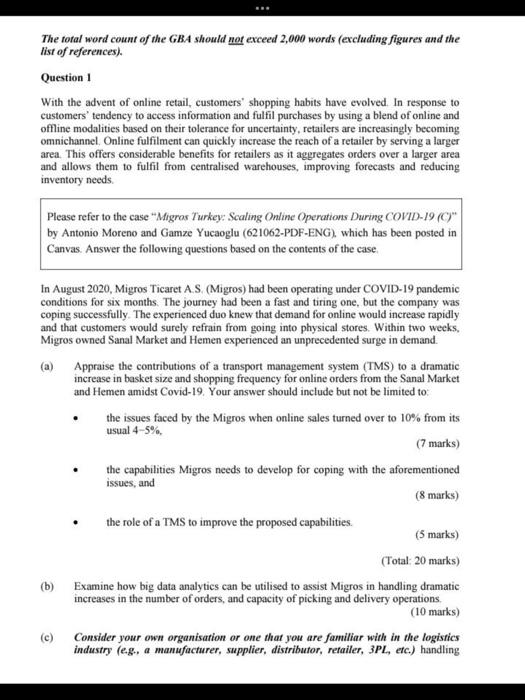
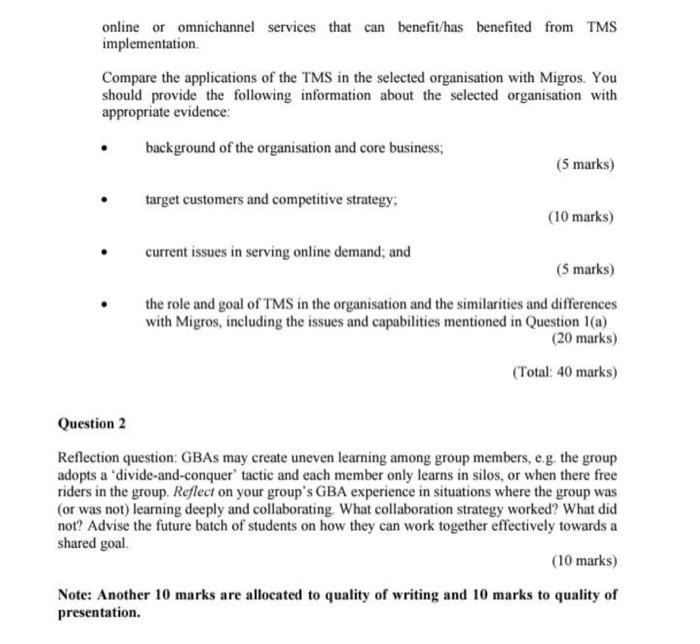
GROUP-BASED ASSIGNMENT This assignment is worth 20% of the final mark for LOG302 Supply Chain Information Management and Technology. The cut-off date for this assignment is 30 August 2022, 2355hrs. This is a group-based assignment. You should form a group of 4 members from your seminar group. Each group is required to upload a single report via your respective seminar group site in Canvas. Please elect a group leader. The responsibility of the group leader is to upload the report on behalf of the group. It is important for each group member to contribute substantially to the final subenitted work. All group members are cqually responsible for the entire submitted assignment. If you feel that the work distribution is inequitable to either yourself or your group mates, please highlight this to your instructor as soon as possible. Your instructor will then investigate and decide on any action that needs to be taken. It is not necessary for all group members to be awarded the same mark. Note to. Srudents: You are to include the following particulars in your submission: Course Code, Title of the GBA, SUSS PI No., Your Name, and Submission Date. Important Note: Grading of GBA Submissions Marks awarded to your assignment are based on the following guidelines: Notes: - Reports with high Turnitin similarity percentage, especially when the matching content is not cited and referenced, can attract further penalties. * See https://apastyle.apa.org/style-grammar-guidelines for tutorials and webinars on the APA formatting and style guidelines. See also Purdue University's Online Writing Lab hitps:/lowl purdue ede/ for information on APA formatting and style guide. The total word count of the GBA should not exceed 2,000 words (excluding figures and the list of references). Question 1 With the advent of online retail, customers" shopping habits have evolved. In response to customers' tendency to access information and fulfil purchases by using a blend of online and offline modalities based on their tolerance for uncertainty, retailers are increasingly becoming omnichannel. Online fulfilment can quickly increase the reach of a retailer by serving a larger area. This offers considerable benefits for retailers as it aggregates orders over a larger area and allows them to fulfil from centralised warehouses, improving forecasts and reducing inventory needs. Please refer to the case "Migros Turkey: Scaling Onfine Operations During COVID-19 (C by Antonio Moreno and Gamze Yucaoglu (621062-PDF-ENG), which has been posted in Canvas. Answer the following questions based on the contents of the case. In August 2020, Migros Ticaret A.S. (Migros) had been operating under COVID-19 pandemic conditions for six months. The journey had been a fast and tiring one, but the company was coping successfully. The experienced duo knew that demand for online would increase rapidly and that customers would surely refrain from going into physical stores. Within two weeks, Migros owned Sanal Market and Hemen experienced an unprecedented surge in demand. (a) Appraise the contributions of a transport management system (TMS) to a dramatic increase in basket size and shopping frequency for online orders from the Sanal Market and Hemen amidst Covid-19. Your answer should include but not be limited to: - the issues faced by the Migros when online sales turned over to 10% from its usual 4-5\%, (7 marks) the capabilities Migros needs to develop for coping with the aforementioned issues, and (8 marks) the role of a TMS to improve the proposed capabilities. (5 marks) (Total: 20 marks) (b) Examine how big data analytics can be utilised to assist Migros in handling dramatic increases in the number of orders, and capacity of picking and delivery operations. (10 marks) (c) Consider your own organisation or one that you are familiar with in the logisfics industry (e.g., a manufacturer, supplier, distributor, retailer, 3PL, efc.) handling online or omnichannel services that can benefit/has benefited from TMS implementation. Compare the applications of the TMS in the selected organisation with Migros. You should provide the following information about the selected organisation with appropriate evidence: - background of the organisation and core business; (5 marks) - target customers and competitive strategy; (10 marks) - current issues in serving online demand; and (5 marks) - the role and goal of TMS in the organisation and the similarities and differences with Migros, including the issues and capabilities mentioned in Question 1(a) (20 marks) (Total: 40 marks) Question 2 Reflection question: GBAs may create uneven learning among group members, e.g. the group adopts a 'divide-and-conquer' tactic and each member only learns in silos, or when there free riders in the group. Reflect on your group's GBA experience in situations where the group was (or was not) learning deeply and collaborating. What collaboration strategy worked? What did not? Advise the future batch of students on how they can work together effectively towards a shared goal. (10 marks) Note: Another 10 marks are allocated to quality of writing and 10 marks to quality of presentation









 Study Help