







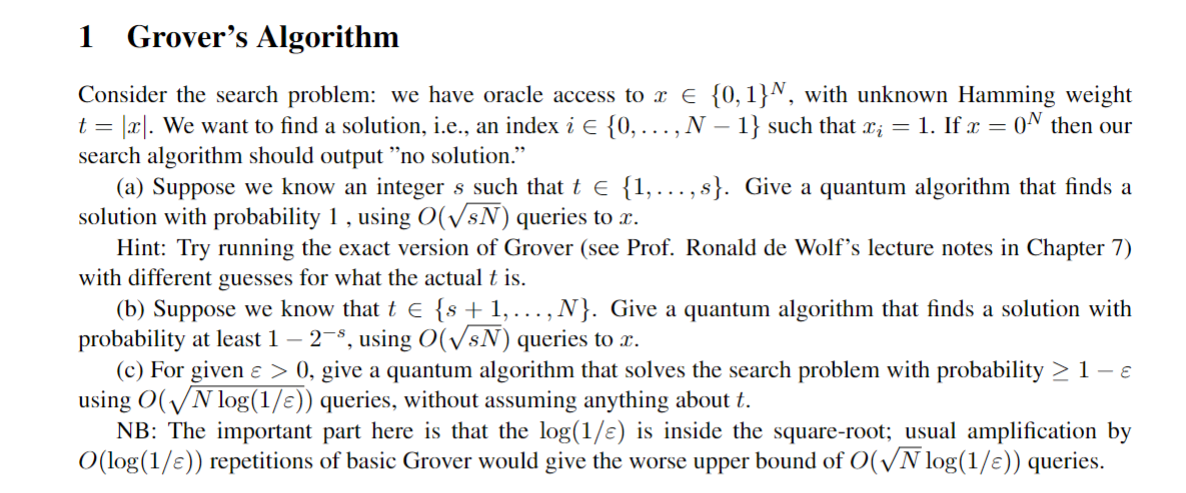
Question: Grover s Algorithm Consider the search problem: we have oracle access to x in { 0 , 1 } N , with unknown Hamming weight
Grovers Algorithm
Consider the search problem: we have oracle access to x in N with unknown Hamming weight
t x We want to find a solution, ie an index i in N such that xi If x N then our
search algorithm should output no solution.
a Suppose we know an integer s such that t in s Give a quantum algorithm that finds a
solution with probability using OsN queries to x
Hint: Try running the exact version of Grover see Prof. Ronald de Wolfs lecture notes in Chapter
with different guesses for what the actual t is
b Suppose we know that t in s N Give a quantum algorithm that finds a solution with
probability at least s using OsN queries to x
c For given epsi give a quantum algorithm that solves the search problem with probability epsi
using OpN logepsi queries, without assuming anything about t
NB: The important part here is that the logepsi is inside the squareroot; usual amplification by
Ologepsi repetitions of basic Grover would give the worse upper bound of ON logepsi queries Grover's Algorithm
Consider the search problem: we have oracle access to xin with unknown Hamming weight
We want to find a solution, ie an index iindots, such that If then our
search algorithm should output no solution."
a Suppose we know an integer such that tindots, Give a quantum algorithm that finds a
solution with probability using queries to
Hint: Try running the exact version of Grover see Prof. Ronald de Wolf's lecture notes in Chapter
with different guesses for what the actual is
b Suppose we know that tindots, Give a quantum algorithm that finds a solution with
probability at least using queries to
c For given give a quantum algorithm that solves the search problem with probability
using queries, without assuming anything about
NB: The important part here is that the is inside the squareroot; usual amplification by
repetitions of basic Grover would give the worse upper bound of queries.
Step by Step Solution
There are 3 Steps involved in it
1 Expert Approved Answer
Step: 1 Unlock

Question Has Been Solved by an Expert!
Get step-by-step solutions from verified subject matter experts
Step: 2 Unlock
Step: 3 Unlock
 Study Help