







Question: Growing Old Together in Japan : How does this example illustrate the trade-offs that have to be made between short-term versus long-term strategy and investment
- Growing Old Together in Japan: How does this example illustrate the trade-offs that have to be made between short-term versus long-term strategy and investment at both the organizational level and the national level? Ironically, although the average age of Japans equipment is very high, that country is also home to many advanced robotic factories. How might investments in robotic technology be leveraged to change Japans competitive position in the world?
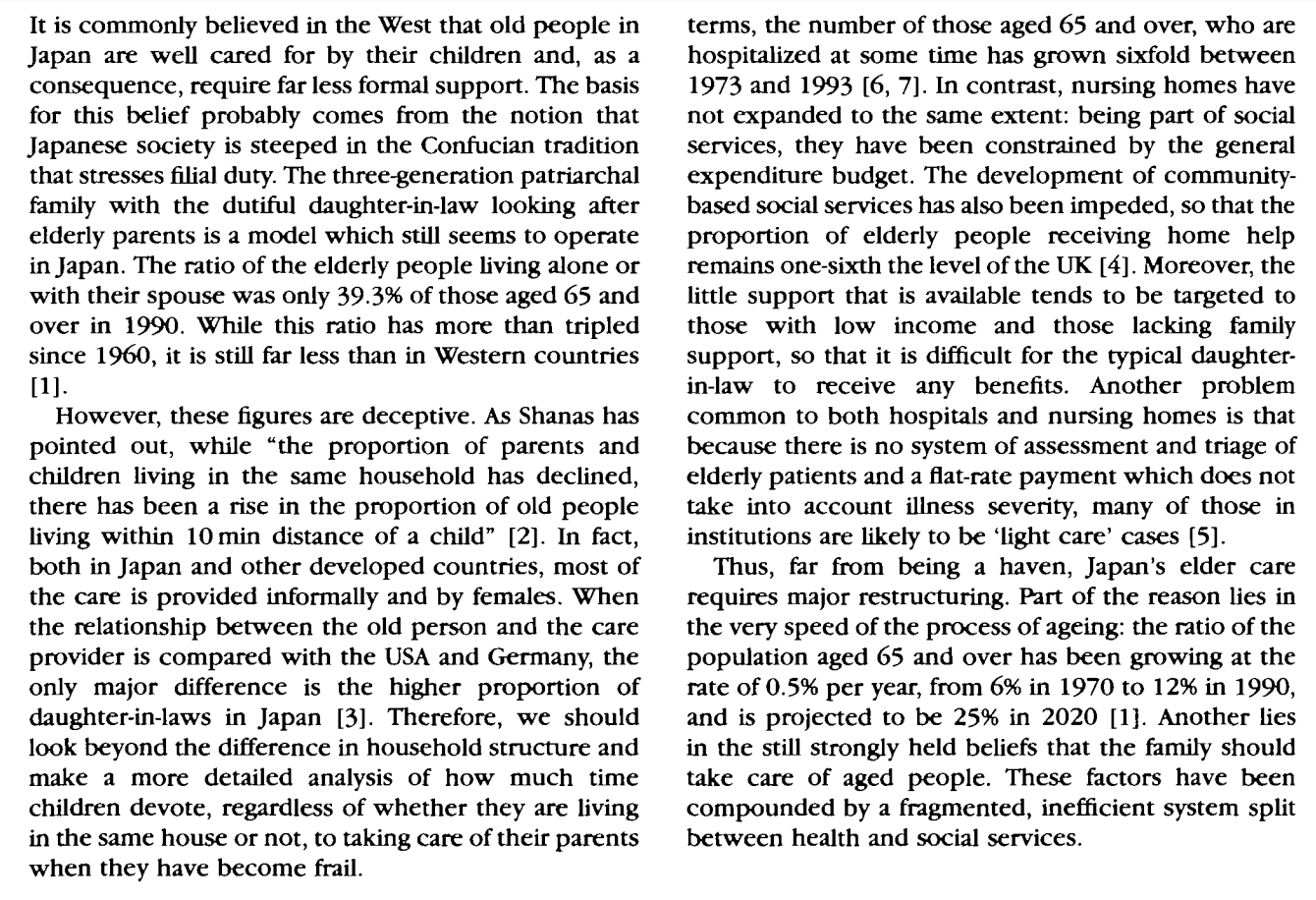
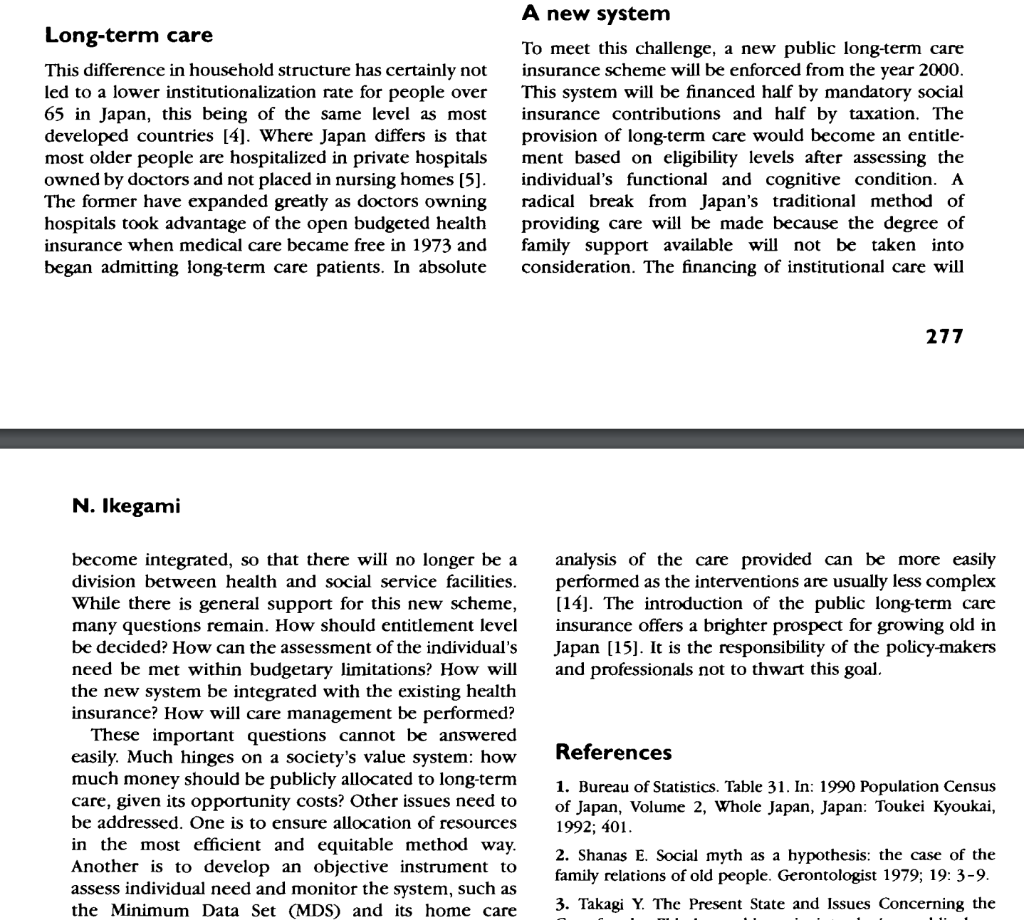
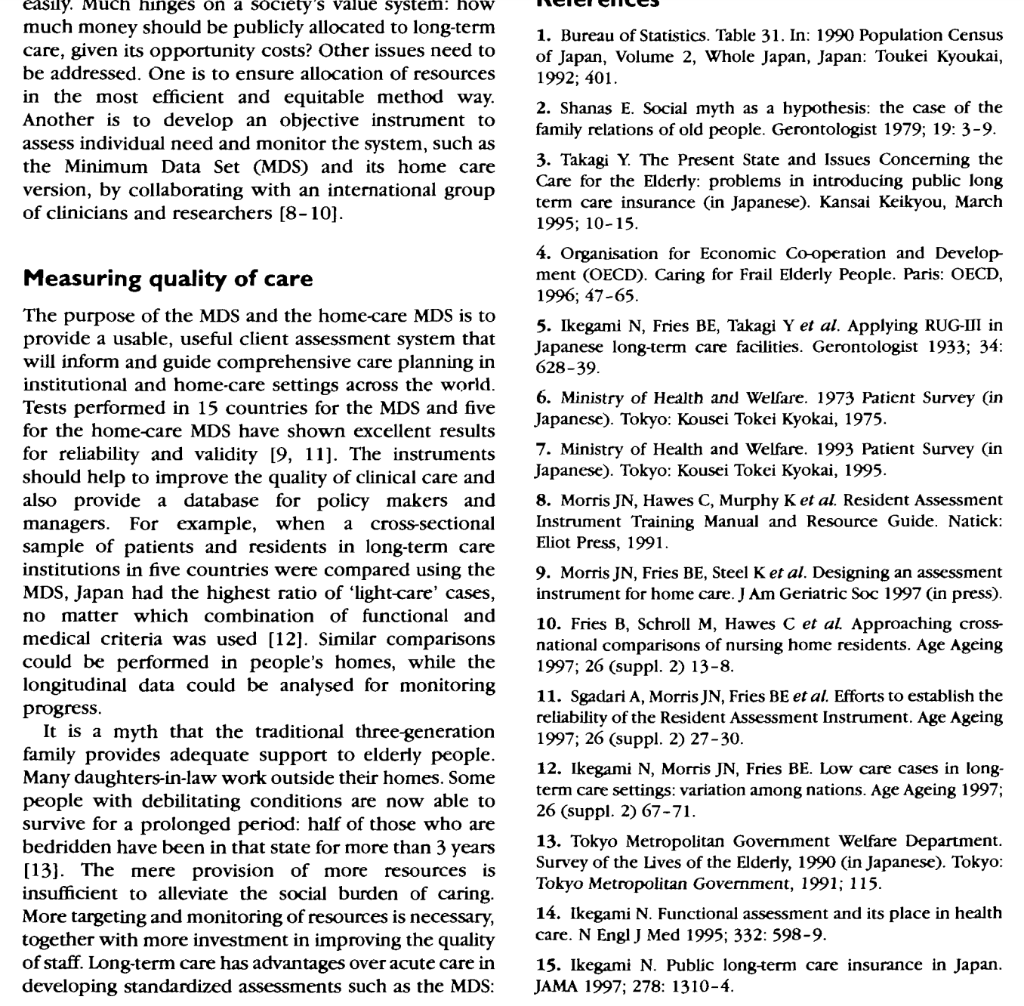
It is commonly believed in the West that old people in Japan are well cared for by their children and, as a consequence, require far less formal support. The basis for this belief probably comes from the notion that Japanese society is steeped in the Confucian tradition that stresses filial duty. The three-generation patriarchal family with the dutiful daughter-in-law looking after elderly parents is a model which still seems to operate in Japan. The ratio of the elderly people living alone or with their spouse was only 39.3% of those aged 65 and over in 1990. While this ratio has more than tripled since 1960, it is still far less than in Western countries [1]. However, these figures are deceptive. As Shanas has pointed out, while "the proportion of parents and children living in the same household has declined, there has been a rise in the proportion of old people living within 10 min distance of a child [2]. In fact, both in Japan and other developed countries, most of the care is provided informally and by females. When the relationship between the old person and the care provider is compared with the USA and Germany, the only major difference is the higher proportion of daughter-in-laws in Japan (3). Therefore, we should look beyond the difference in household structure and make a more detailed analysis of how much time children devote, regardless of whether they are living in the same house or not, to taking care of their parents when they have become frail. terms, the number of those aged 65 and over, who are hospitalized at some time has grown sixfold between 1973 and 1993 (6, 7). In contrast, nursing homes have not expanded to the same extent: being part of social services, they have been constrained by the general expenditure budget. The development of community- based social services has also been impeded, so that the proportion of elderly people receiving home help remains one-sixth the level of the UK [4]. Moreover, the little support that is available tends to be targeted to those with low income and those lacking family support, so that it is difficult for the typical daughter- in-law to receive any benefits. Another problem common to both hospitals and nursing homes is that because there is no system of assessment and triage of elderly patients and a flat-rate payment which does not take into account illness severity, many of those in institutions are likely to be light care' cases (5). Thus, far from being a haven, Japan's elder care requires major restructuring. Part of the reason lies in the very speed of the process of ageing: the ratio of the population aged 65 and over has been growing at the rate of 0.5% per year, from 6% in 1970 to 12% in 1990, and is projected to be 25% in 2020 [1]. Another lies in the still strongly held beliefs that the family should take care of aged people. These factors have been compounded by a fragmented, inefficient system split between health and social services. Long-term care This difference in household structure has certainly not led to a lower institutionalization rate for people over 65 in Japan, this being of the same level as most developed countries (4). Where Japan differs is that most older people are hospitalized in private hospitals owned by doctors and not placed in nursing homes (5). The former have expanded greatly as doctors owning hospitals took advantage of the open budgeted health insurance when medical care became free in 1973 and began admitting long-term care patients. In absolute A new system To meet this challenge, a new public long-term care insurance scheme will be enforced from the year 2000. This system will be financed half by mandatory social insurance contributions and half by taxation. The provision of long-term care would become an entitle- ment based on eligibility levels after assessing the individual's functional and cognitive condition. A radical break from Japan's traditional method of providing care will be made because the degree of family support available will not be taken into consideration. The financing of institutional care will 277 N. Ikegami analysis of the care provided can be more easily performed as the interventions are usually less complex [14]. The introduction of the public long-term care insurance offers a brighter prospect for growing old in Japan (15]. It is the responsibility of the policy-makers and professionals not to thwart this goal. become integrated, so that there will no longer be a division between health and social service facilities. While there is general support for this new scheme, many questions remain. How should entitlement level be decided? How can the assessment of the individual's need be met within budgetary limitations? How will the new system be integrated with the existing health insurance? How will care management be performed? These important questions cannot be answered easily. Much hinges on a society's value system: how much money should be publicly allocated to long-term care, given its opportunity costs? Other issues need to be addressed. One is to ensure allocation of resources in the most efficient and equitable method way. Another is to develop an objective instrument to assess individual need and monitor the system, such as the Minimum Data Set (MDS) and its home care References 1. Bureau of Statistics. Table 31. In: 1990 Population Census of Japan, Volume 2, Whole Japan, Japan: Toukei Kyoukai, 1992; 401. 2. Shanas E. Social myth as a hypothesis: the case of the family relations of old people. Gerontologist 1979; 19: 3-9. 3. Takagi Y. The Present State and Issues Concerning the easily. Much hinges on a society's value system: how much money should be publicly allocated to long-term care, given its opportunity costs? Other issues need to be addressed. One is to ensure allocation of resources in the most efficient and equitable method way. Another is to develop an objective instrument to assess individual need and monitor the system, such as the Minimum Data Set (MDS) and its home care version, by collaborating with an international group of clinicians and researchers (8-10]. Measuring quality of care The purpose of the MDS and the home-care MDS is to provide a usable, useful client assessment system that will inform and guide comprehensive care planning in institutional and home-care settings across the world. Tests performed in 15 countries for the MDS and five for the home-care MDS have shown excellent results for reliability and validity [9, 11). The instruments should help to improve the quality of clinical care and also provide a database for policy makers and managers. For example, when a cross-sectional sample of patients and residents in long-term care institutions in five countries were compared using the MDS, Japan had the highest ratio of 'light-care' cases, no matter which combination of functional and medical criteria was used (12]. Similar comparisons could be performed in people's homes, while the longitudinal data could be analysed for monitoring progress. It is a myth that the traditional three-generation family provides adequate support to elderly people. Many daughters-in-law work outside their homes. Some people with debilitating conditions are now able to survive for a prolonged period: half of those who are bedridden have been in that state for more than 3 years (13). The mere provision of more resources is insufficient to alleviate the social burden of caring. More targeting and monitoring of resources is necessary, together with more investment in improving the quality of staff. Long-term care has advantages over acute care in developing standardized assessments such as the MDS: 1. Bureau of Statistics. Table 31. In: 1990 Population Census of Japan, Volume 2, Whole Japan, Japan: Toukei Kyoukai, 1992; 401. 2. Shanas E. Social myth as a hypothesis: the case of the family relations of old people. Gerontologist 1979; 19:3-9. 3. Takagi Y. The Present State and Issues Concerning the Care for the Elderly: problems in introducing public long term care insurance (in Japanese). Kansai Keikyou, March 1995; 10-15. 4. Organisation for Economic Cooperation and Develop ment (OECD). Caring for Frail Elderly People. Paris: OECD, 1996; 47-65. 5. Ikegami N, Fries BE, Takagi Y et al. Applying RUG-III in Japanese long-term care facilities. Gerontologist 1933; 34: 628-39. 6. Ministry of Health and Welfare. 1973 Patient Survey (in Japanese). Tokyo: kousei Tokei Kyokai, 1975. 7. Ministry of Health and Welfare. 1993 Patient Survey (in Japanese). Tokyo: kousei Tokei Kyokai, 1995. 8. Morris JN, Hawes C, Murphy K et al. Resident Assessment Instrument Training Manual and Resource Guide. Natick: Eliot Press, 1991. 9. Morris JN, Fries BE, Steel K et al. Designing an assessment instrument for home care. J Am Geriatric Soc 1997 (in press). 10. Fries B, Schroll M, Hawes C et al. Approaching cross- national comparisons of nursing home residents. Age Ageing 1997; 26 (suppl. 2) 13-8. 11. Sgadari A, Morris JN, Fries BE et al. Efforts to establish the reliability of the Resident Assessment Instrument. Age Ageing 1997; 26 (suppl. 2) 27-30. 12. Ikegami N, Morris JN, Fries BE. Low care cases in long- term care settings: variation among nations. Age Ageing 1997; 26 (suppl. 2) 67-71. 13. Tokyo Metropolitan Government Welfare Department. Survey of the Lives of the Elderly, 1990 (in Japanese). Tokyo: Tokyo Metropolitan Government, 1991; 115. 14. Ikegami N. Functional assessment and its place in health care. N Engl J Med 1995; 332: 598-9. 15. Ikegami N. Public long-term care insurance in Japan. JAMA 1997; 278: 1310-4
Step by Step Solution
There are 3 Steps involved in it
1 Expert Approved Answer
Step: 1 Unlock

Question Has Been Solved by an Expert!
Get step-by-step solutions from verified subject matter experts
Step: 2 Unlock
Step: 3 Unlock
 Study Help