







Question: G(s) = 1 As + Bs + C The best way to do this is to make a mathematical model of the transfer function
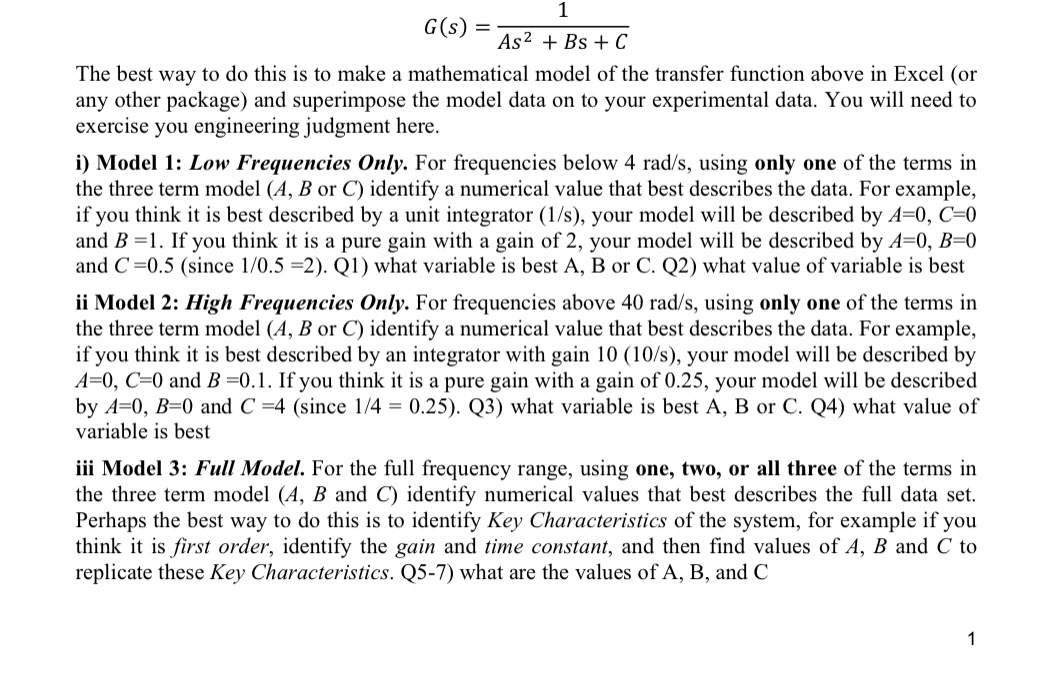
G(s) = 1 As + Bs + C The best way to do this is to make a mathematical model of the transfer function above in Excel (or any other package) and superimpose the model data on to your experimental data. You will need to exercise you engineering judgment here. i) Model 1: Low Frequencies Only. For frequencies below 4 rad/s, using only one of the terms in the three term model (A, B or C) identify a numerical value that best describes the data. For example, if you think it is best described by a unit integrator (1/s), your model will be described by A=0, C=0 and B 1. If you think it is a pure gain with a gain of 2, your model will be described by A=0, B=0 and C=0.5 (since 1/0.5 =2). Q1) what variable is best A, B or C. Q2) what value of variable is best ii Model 2: High Frequencies Only. For frequencies above 40 rad/s, using only one of the terms in the three term model (A, B or C) identify a numerical value that best describes the data. For example, if you think it is best described by an integrator with gain 10 (10/s), your model will be described by A=0, C=0 and B =0.1. If you think it is a pure gain with a gain of 0.25, your model will be described by A=0, B=0 and C =4 (since 1/4 = 0.25). Q3) what variable is best A, B or C. Q4) what value of variable is best iii Model 3: Full Model. For the full frequency range, using one, two, or all three of the terms in the three term model (A, B and C) identify numerical values that best describes the full data set. Perhaps the best way to do this is to identify Key Characteristics of the system, for example if you think it is first order, identify the gain and time constant, and then find values of A, B and C to replicate these Key Characteristics. Q5-7) what are the values of A, B, and C 1
Step by Step Solution
There are 3 Steps involved in it
We need to determine the values of A B and C for different frequency ranges based on the given trans... View full answer

Get step-by-step solutions from verified subject matter experts
 Study Help