







Question: GSDL Case Analysis on Distribution Management Identify three (3) major problems related to Channel Management that the GSDL company is experiencing in this case. What
GSDL Case Analysis on Distribution Management
- Identify three (3) major problems related to Channel Management that the GSDL company is experiencing in this case.
- What do you think is the future for GSDL distribution in the City?
- What should GSDL do to resolve the channel conflicts and also ensure the successful marketing of shampoos?
- Could the problem be resolved without appointing distributor "C"?
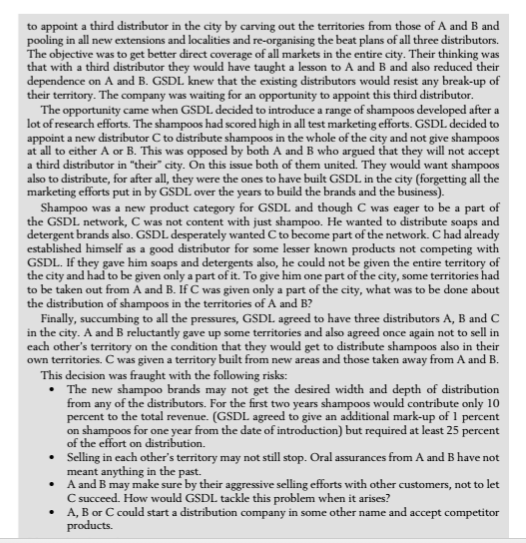
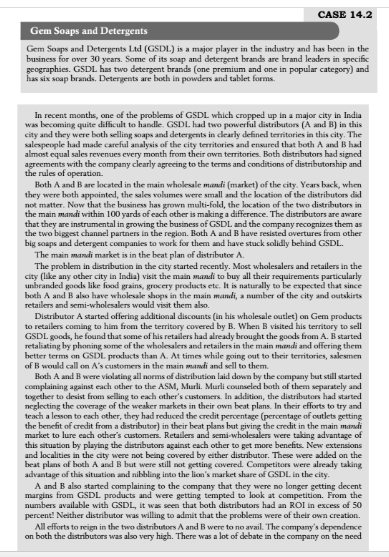
to appoint a third distributor in the city by carving out the territories from those of A and B and pooling in all new extensions and localities and re-organising the beat plans of all three distributors. The objective was to get better direct coverage of all markets in the entire city. Their thinking was that with a third distributor they would have taught a lesson to A and B and also reduced their dependence on A and B. GSDL knew that the existing distributors would resist any break-up of their territory. The company was waiting for an opportunity to appoint this third distributor. The opportunity came when GSDL decided to introduce a range of shampoos developed after a lot of research efforts. The shampoos had scored high in all test marketing efforts. GSDL decided to appoint a new distributor C to distribute shampoos in the whole of the city and not give shampoos at all to either A or B. This was opposed by both A and B who argued that they will not accept a third distributor in "their" city. On this issue both of them united. They would want shampoos also to distribute, for after all, they were the ones to have built GSDL in the city (forgetting all the marketing efforts put in by GSDL over the years to build the brands and the business). Shampoo was a new product category for GSDL and though C was eager to be a part of the GSDL network, C was not content with just shampoo. He wanted to distribute soaps and detergent brands also. GSDL desperately wanted C to become part of the network. C had already established himself as a good distributor for some lesser known products not competing with GSDL. If they gave him soaps and detergents also, he could not be given the entire territory of the city and had to be given only a part of it. To give him one part of the city, some territories had to be taken out from A and B. If C was given only a part of the city, what was to be done about the distribution of shampoos in the territories of A and B? Finally, succumbing to all the pressures, GSDL agreed to have three distributors A, B and C in the city. A and B reluctantly gave up some territories and also agreed once again not to sell in each other's territory on the condition that they would get to distribute shampoos also in their own territories. C was given a territory built from new areas and those taken away from A and B. This decision was fraught with the following risks: . The new shampoo brands may not get the desired width and depth of distribution from any of the distributors. For the first two years shampoos would contribute only 10 percent to the total revenue. (GSDL agreed to give an additional mark-up of 1 percent on shampoos for one year from the date of introduction] but required at least 25 percent of the effort on distribution. Selling in each other's territory may not still stop. Oral assurances from A and B have not meant anything in the past. . A and B may make sure by their aggressive selling efforts with other customers, not to let C succeed. How would GSDL tackle this problem when it arises? . A, B or C could start a distribution company in some other name and accept competitor products.CASE 14.2 Gem Soaps and Detergents Gem Soaps and Detergents Lid (GSDL) is a major player in the industry and has been in the business for over 30 years. Some of its soap and detergent brands are brand leaders in specific geographies. GSDL has two detergent brands (one premium and one in popular category) and has six soap brands. Detergents are both in powders and tablet forms. In recent months, one of the problems of GSDL which cropped up in a major city in India was becoming quite difficult to handle. GSDL had two powerful distributors (A and #] in this city and they were both selling soaps and detergents in clearly defined territories in this city, The salespeople had made careful analysis of the city territories and ensured that both A and B had almost equal sales revenues every month from their own territories. Both distributors had signed agreements with the company clearly agreeing to the terms and conditions of distributorship and the rules of operation. Hoth A and B are located in the main wholesale mandi (market) of the city. Years back, when they were both appointed, the sales volumes were small and the location of the distributors did not matter. Now that the business has grown multi-fold, the location of the two distributors in the main mamai within 100 yards of each other is making a difference. The distributors are aware that they are instrumental in growing the business of GSDL and the company recognizes them as the two biggest channel partners in the region. Both A and B have resisted overtures from other big soups and detergent companies to work for them and have stuck solidly behind GSDL. The main mandi market is in the beat plan of distributor A. The problem in distribution in the city started recently. Most wholesalers and retailers in the city (like any other city in India] visit the main mandi to buy all their requirements particularly unbranded goods like food grains, grocery products etc. It is naturally to be expected that since both A and B also have wholesale shops in the main mandi, a number of the city and outskirts retailers and semi-wholesalers would visit them also. Distributor A started offering additional discounts (in his wholesale outlet] on Gem products to retailers coming to him from the territory covered by B. When B visited his territory to sell GSDL goods, he found that some of his retailers had already brought the goods from A. B started retaliating by phoning some of the wholesalers and retailers in the main mandi and offering them better terms on GSDL products than A. At times while going out to their territories, sakamen of B would call on A's customers in the main mandi and sell to them. Both A and B were violating all norms of distribution laid down by the company but still started complaining against each other to the ASM, Murli. Murli counseled bath of them separately and together to desist from selling to each other's customers. In addition, the distributors had started neglecting the coverage of the weaker markets in their own beat plans. In their efforts to try and teach a lesson to each other, they had reduced the credit percentage (percentage of outlets getting the benefit of credit from a distributor) in their beat plans but giving the credit in the main mamai market to lure each other's customers. Retailers and semi-wholesalers were taking advantage of this situation by playing the distributors against each other to get more benefits. New extensions and localities in the city were not being covered by either distributor. These were added on the beat plans of both A and B but were still not getting covered Competitor were already taking advantage of this situation and nibbling into the lion's market share of GSDL. in the city. A and B also started complaining to the company that they were no longer getting decent margins from GSDL products and were getting tempted to look at competition. From the numbers available with GSDL, it was seen that both distributors had an ROI in excess of 50 percent! Neither distributor was willing to admit that the problems were of their own creation. All efforts to reign in the two distributors A and B were to no avail. The company's dependence on both the distributors was also very high. There was a lot of debate in the company on the need
Step by Step Solution
There are 3 Steps involved in it

Get step-by-step solutions from verified subject matter experts
 Study Help