





Question: (Guenin, A Gentle Introduction to Optimization) Chapter 4, Section 4.2, exercise 2 Update: There is a typo. The LP should be max{ c^(T)x: Ax =
(Guenin, A Gentle Introduction to Optimization) Chapter 4, Section 4.2, exercise 2
Update: There is a typo. The LP should be max{ c^(T)x: Ax = b, x >= 0}, and for part (b), Ax = b becomes MAx = b.
In regards to the comment, all information is given. Not too sure what else to add to the problem.
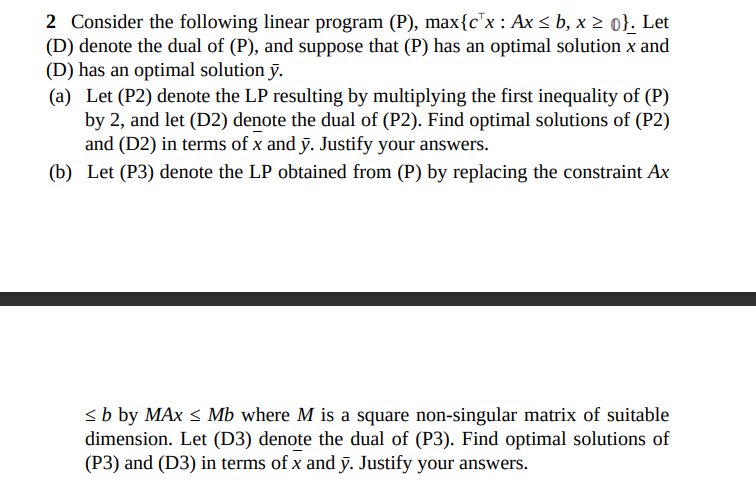
2 Consider the following linear program (P), max{c'x : Ax sb, x 2 0}. Let (D) denote the dual of (P), and suppose that (P) has an optimal solution x and (D) has an optimal solution y. (a) Let (P2) denote the LP resulting by multiplying the first inequality of (P) by 2, and let (D2) denote the dual of (P2). Find optimal solutions of (P2) and (D2) in terms of x and 5. Justify your answers. (b) Let (P3) denote the LP obtained from (P) by replacing the constraint Ax sb by MAX 5 Mb where M is a square non-singular matrix of suitable dimension. Let (D3) denote the dual of (P3). Find optimal solutions of (P3) and (D3) in terms of x and y. Justify your answers. 2 Consider the following linear program (P), max{c'x : Ax sb, x 2 0}. Let (D) denote the dual of (P), and suppose that (P) has an optimal solution x and (D) has an optimal solution y. (a) Let (P2) denote the LP resulting by multiplying the first inequality of (P) by 2, and let (D2) denote the dual of (P2). Find optimal solutions of (P2) and (D2) in terms of x and 5. Justify your answers. (b) Let (P3) denote the LP obtained from (P) by replacing the constraint Ax sb by MAX 5 Mb where M is a square non-singular matrix of suitable dimension. Let (D3) denote the dual of (P3). Find optimal solutions of (P3) and (D3) in terms of x and y. Justify your answers

