







Question: Guidelines: Read the case study provided below and respond to the questions that follow. Title: Joses Authentic Mexican Restaurant Two bean tacos, a chicken burrito
Guidelines: Read the case study provided below and respond to the questions that follow.
Title: Joses Authentic Mexican Restaurant
Two bean tacos, a chicken burrito grande, and a side order of Spanish rice, please. Ivan Karetski called his tables order into the kitchen as he pre- pared the beverage orders. Business was brisk. Karetski liked it that way. Lots of customers meant lots of tips and, as a struggling graduate student, the extra income was greatly appreciated. Lately, however, his tips had been declining.
Joses is a small, 58-seat restaurant that offers a reasonably broad range of Mexican food prepared and presented in a traditional Mexican style. It is located in New England in a mature business district on the edge of a large metropolitan area. The site is adjacent to a central artery and offers limited free off-street parking. The restaurants interior decoration promotes the Mexican theme: The walls appear to be made of adobe and are draped with serapes, the furniture is SpanishMexican style, and flamenco guitar and mariachi alternate as background music.
Patrons enter the restaurant through a small vestibule that opens di- rectly into the dining area; there is no separate waiting area. Upon arrival, patrons are greeted by a hostess and either seated directly or apprised of the expected wait. Seating at Joses is usually immediate except for Friday and Saturday nights when waits of as long as 45 minutes can be encountered. Because space inside for waiting is very limited, patrons must remain outside until their party is called. Joses does not take reservations.
After seating patrons, the hostess distributes menus and fills glasses with water. If standards are being met, the waiter assigned to the table greets the patrons within one minute of their being seated. (Being a traditional Mexican restaurant, its entire wait staff is male.) The waiter introduces himself, announces the daily specials, and takes the beverage orders. After delivering the beverages, the waiter takes the meal orders.
The menu consists of 23 main entrees assembled from eight basic stocks (chicken, beef, beans, rice, corn tortillas, flour tortillas, tomatoes, and lettuce) and a variety of
other ingredients (fruits, vegetables, sauces, herbs, and spices). Before the dining hours begin, the cook prepares the basic stocks so that they can be quickly combined and finished off to com- plete the requested meals. The typical amount of time needed to complete a meal once it has been ordered is 12 minutes. A good portion of this time is for final cooking, so several meals may be in preparation at the same time. As can be imagined, one of the skills a good cook needs is to be able to schedule production of the various meals ordered at a table so that they are ready at approximately the same time. Once all the meals and any side dishes have been completed by the cook, the waiter checks to see that all meals are correct and pleasing to the eye, corrects any mistakes, and adds any finishing touches. When everything is in order, he assembles them on a tray and delivers them to the table. From this point on, the waiter keeps an eye on the table to detect when any additional service or assistance is needed.
When the diners at the table appear to be substantially finished with their main meal, the waiter approaches, asks if he can clear away any dishes, and takes any requests for dessert or coffee. When the entire meal has been completed, the waiter presents the bill and shortly thereafter collects payment. Joses accepts cash or major credit card but no checks.
Karetski feels that his relationship with the cook is important. As the cook largely controls the quality of the food, Karetski wants to stay on good terms with him. He treats the cook with respect, tries to place the items on his order slip in the sequence of longest preparation time, and makes sure to write clearly so that the orders are easy to read. Although it is not his job, he helps out by fetching food stocks from the refrigerator or the storage area when the cook is busy and by doing some of the food preparation himself. The cook has been irritable lately, complaining of the poor quality of some of the ingredients that have been delivered. Last week, for example, he received lettuce that appeared wilted and chicken that was tough and more bone than meat. During peak times, it can take more than 20 minutes to get good meals delivered to the table.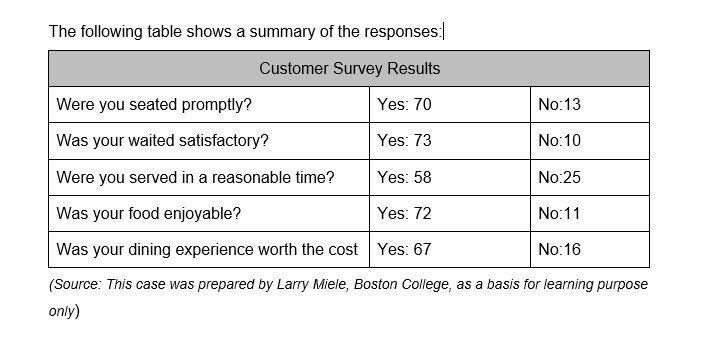
Please respond to the following questions:
1) How should the outcomes of the process be defined in this particular restaurant? Make a list of five (5) process outcomes and explain them. ( 10 marks )
2) Identify the restaurants costs of a process failure and explain each of them clearly. ( 10 marks )
[ Note: The above can be seen from both the restaurant's and Ivan's perspectives.]
The following table shows a summary of the responses:| Customer Survey Results Were you seated promptly? Yes: 70 No:13 Was your waited satisfactory? Yes: 73 No:10 Were you served in a reasonable time? Yes: 58 No:25 Was your food enjoyable? Yes: 72 No:11 Was your dining experience worth the cost Yes: 67 No:16 (Source: This case was prepared by Larry Miele, Boston College, as a basis for learning purpose only)
Step by Step Solution
There are 3 Steps involved in it

Get step-by-step solutions from verified subject matter experts
 Study Help