







Question: Haier Group: Internationalization Strategy: Read the case study to identify the key issues and underlying issues. These issues are the principles and concepts of the
Haier Group: Internationalization Strategy: 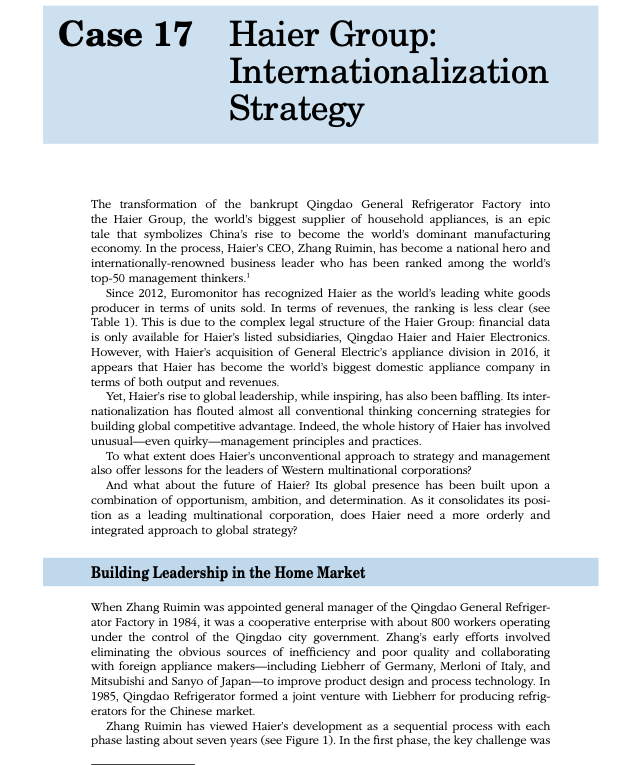
- Read the case study to identify the key issues and underlying issues. These issues are the principles and concepts of the course area which apply to the situation described in the case study.
- Record the facts from the case study which are relevant to the principles and concepts of the course area issues. The case may have extraneous information not relevant to the current course area. Your ability to differentiate between relevant and irrelevant information is an important aspect of case analysis, as it will inform the focus of your answers.
- Describe in some detail the actions that would address or correct the situation.
- Consider how you would support your solution with examples from experience or current real-life examples or cases from textbooks.
- Complete this initial analysis and then read the discussion questions. Typically, you will already have the answers to the questions but with a broader consideration. At this point, you can add the details and/or analytical tools required to solve the case.
Case Study Questions:
- Compare and contrast the appliance strategies used by another multinational appliance company such as LG, Samsung, Bosch-Siemens, Electrolux, Whirlpool, etc. and Haier.
- What is Haiers internationalization strategy?
- Does Haiers international strategy appear to be effective?
- Is it likely that Haiers success and management practices can be applied outside of China? Why or why not?
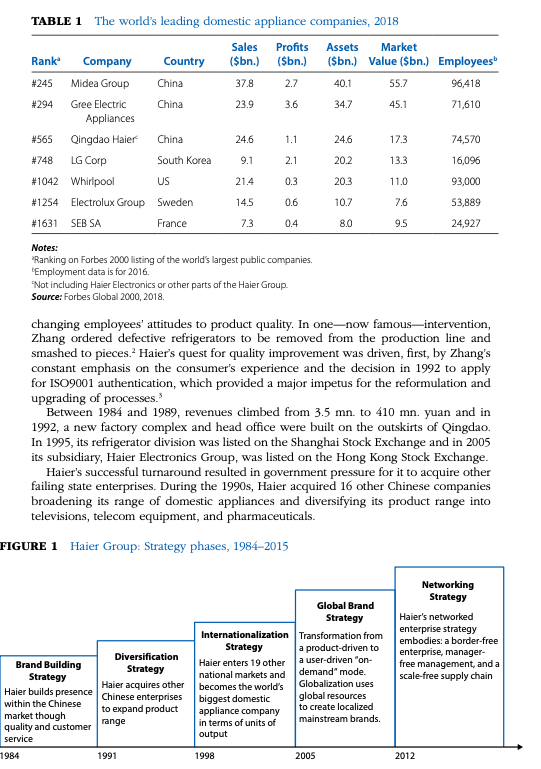
Case 17 Haier Group: Internationalization Strategy The transformation of the bankrupt Qingdao General Refrigerator Factory into the Haier Group, the world's biggest supplier of household appliances, is an epic tale that symbolizes China's rise to become the world's dominant manufacturing economy. In the process, Haier's CEO, Zhang Ruimin, has become a national hero and internationally-renowned business leader who has been ranked among the world's top-50 management thinkers Since 2012, Euromonitor has recognized Haier as the world's leading white goods producer in terms of units sold. In terms of revenues, the ranking is less clear (see Table 1). This is due to the complex legal structure of the Haier Group: financial data is only available for Haier's listed subsidiaries, Qingdao Haier and Haier Electronics. However, with Haier's acquisition of General Electric's appliance division in 2016, it appears that Haier has become the world's biggest domestic appliance company in terms of both output and revenues. Yet, Haier's rise to global leadership, while inspiring, has also been baffling. Its inter- nationalization has flouted almost all conventional thinking concerning strategies for building global competitive advantage. Indeed, the whole history of Haier has involved unusual-even quirky-management principles and practices. To what extent does Haier's unconventional approach to strategy and management also offer lessons for the leaders of Western multinational corporations? And what about the future of Haier? Its global presence has been built upon a combination of opportunism, ambition, and determination. As it consolidates its posi- tion as a leading multinational corporation, does Haier need a more orderly and integrated approach to global strategy? Building Leadership in the Home Market When Zhang Ruimin was appointed general manager of the Qingdao General Refriger- ator Factory in 1984, it was a cooperative enterprise with about 800 workers operating under the control of the Qingdao city government. Zhang's early efforts involved eliminating the obvious sources of inefficiency and poor quality and collaborating with foreign appliance makersincluding Liebherr of Germany, Merloni of Italy, and Mitsubishi and Sanyo of Japanto improve product design and process technology. In 1985, Qingdao Refrigerator formed a joint venture with Liebherr for producing refrig- erators for the Chinese market. Zhang Ruimin has viewed Haier's development as a sequential process with each phase lasting about seven years (see Figure 1). In the first phase, the key challenge was TABLE 1 The world's leading domestic appliance companies, 2018 Sales Profits Assets Market ($bn.) ($bn.) ($bn.) Value ($bn.) Employees 37.8 2.7 40.1 55.7 96,418 23.9 3.6 34.7 45.1 71,610 Rank Company Country #245 Midea Group China #294 Gree Electric China Appliances #565 Qingdao Haier China #748 LG Corp South Korea #1042 Whirlpool US #1254 Electrolux Group Sweden #1631 SEB SA France 24.6 1.1 24.6 17.3 74,570 9.1 2.1 20.2 133 16,096 21.4 0.3 20.3 11.0 93,000 14.5 0.6 10.7 7.6 53,889 7.3 0.4 8.0 9.5 24,927 Notes: Ranking on Forbes 2000 listing of the world's largest public companies. Employment data is for 2016. Not including Haier Electronics or other parts of the Haier Group Source: Forbes Global 2000, 2018. changing employees' attitudes to product quality. In onenow famous-intervention, Zhang ordered defective refrigerators to be removed from the production line and smashed to pieces. Haier's quest for quality improvement was driven, first, by Zhang's constant emphasis on the consumer's experience and the decision in 1992 to apply for ISO9001 authentication, which provided a major impetus for the reformulation and upgrading of processes. Between 1984 and 1989, revenues climbed from 35 mn. to 410 mn. yuan and in 1992, a new factory complex and head office were built on the outskirts of Qingdao. In 1995, its refrigerator division was listed on the Shanghai Stock Exchange and in 2005 its subsidiary, Haier Electronics Group, was listed on the Hong Kong Stock Exchange. Haier's successful turnaround resulted in government pressure for it to acquire other failing state enterprises. During the 1990s, Haier acquired 16 other Chinese companies broadening its range of domestic appliances and diversifying its product range into televisions, telecom equipment, and pharmaceuticals. FIGURE 1 Haier Group: Strategy phases, 1984-2015 Networking Strategy Haier's networked enterprise strategy embodies: a border-free enterprise, manager- free management, and a scale-free supply chain Global Brand Strategy Internationalization Transformation from Strategy a product-driven to Haier enters 19 other a user-driven 'on- national markets and demand" mode. becomes the world's Globalization uses biggest domestic global resources appliance company to create localized in terms of units of mainstream brands. output Diversification Brand Building Strategy Strategy Haier acquires other Haier builds presence Chinese enterprises within the Chinese to expand product market though range quality and customer service 1984 1991 1998 2005 2012
Step by Step Solution
There are 3 Steps involved in it
1 Expert Approved Answer
Step: 1 Unlock

Question Has Been Solved by an Expert!
Get step-by-step solutions from verified subject matter experts
Step: 2 Unlock
Step: 3 Unlock
 Study Help