







Question: Hand Calculations. financial mathematics 1) Consider two bonds that differ only in their maturity. One is 10-years and the other is 30-years to maturity. Their
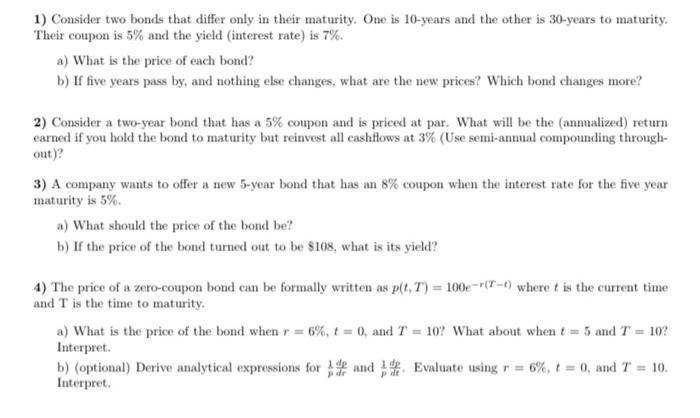
1) Consider two bonds that differ only in their maturity. One is 10-years and the other is 30-years to maturity. Their coupon is 5% and the yield (interest rate) is 7%. a) What is the price of each bond? b) If five years pass by, and nothing else changes, what are the new prices? Which bond changes more? 2) Consider a two-year bond that has a 5% coupon and is priced at par. What will be the (anmalized) return earned if you hold the bond to maturity but reinvest all cashflows at 3% (Use semi-annual compounding through- out)? 3) A company wants to offer a new 5-year bond that has an 8% coupon when the interest rate for the five year maturity is 5% a) What should the price of the bond be? b) If the price of the bond turned out to be $108, what is its yield? 4) The price of a zero-coupon bond can be formally written as p(t, T) = 100e --(7-6) where is the current time and T is the time to maturity. a) What is the price of the bond when r = 6%, t = 0, and T = 107 What about when t = 5 and T = 10? Interpret. b) (optional) Derive analytical expressions for and Evaluate using r = 6%, * = 0, and T = 10. Interpret
Step by Step Solution
There are 3 Steps involved in it

Get step-by-step solutions from verified subject matter experts
 Study Help