







Question: Happy Patients Network ABC Analysis Case Study Happy Patients Network (the Network), which consists of five medical group practices, is a subsidiary of not-for-profit Metro
Happy Patients Network
ABC Analysis
Case Study
Happy Patients Network (the Network), which consists of five medical group practices, is a subsidiary of not-for-profit Metro Health System (the System). The Network includes both primary care and specialty physicians, with an emphasis on obstetrics/gynecology, eldercare, and pediatrics. Prior to the founding of the Network, the five practices operated independently. The Network has three practice locations, each staffed with a mix of primary care and specialist physicians. Although the Network itself is only marginally profitable, it is an important contributor to the System profitability because it generates a large amount of revenues for other System's components from referrals for both inpatient admissions and inpatient and outpatient ancillary services. In fact, it has been estimated that each $1 of revenue generated within the Network leads to $8 of inpatient and ancillary revenues to the System. By limiting the amount of ancillary services provided at the three Network locations, patients are forced (or at least encouraged) to use other System's facilities for such services.
Still, some ancillary services are best performed at the Network locations for one or more of the following reasons: lower costs, increased physician efficiency, or improved patient convenience and hence better CAHPS (Consumer Assessment of Healthcare Providers and Systems) scores. For example, one of the practice locations now has a diagnostic imaging capability. When the scanner was moved from another facility to the Network location, volume increased, costs decreased, and both physician and patient satisfaction improved.
The proposal now being considered by the Network is to provide ultrasound services at the Network locations. Preliminary analysis indicates that two approaches are most suitable. Alternative 1 involves the purchase of one ultrasound machine for each of the Network's three locations. Patients would schedule appointments, generally at the clinic they are using, during preset times on specified days of the week. Then, the full-time ultrasound technician would travel from one location to another to administer the tests as scheduled.
In Alternative 2, patient scheduling would be the same, but only one ultrasound machine would be purchased. It would be mounted in a van that the technician would drive to each of the three Network locations. Most of the operating costs of the two alternatives are identical, but Alternative 2 has the added cost of operating the van and setting up the machine after each move.
The two alternatives differ substantially in capital investment costs because Alternative 1 requires three ultrasound machines, at a cost of $100,000 each, while Alternative 2 requires only one. However, Alternative 2 requires a van, which with necessary modifications would cost $40,000. Thus, the capital costs for Alternative 1 total 3 x $100,000 = $300,000, while those for Alternative 2 amount to only $100,000 + $40,000 = $140,000. There is an expected machine/van life of five years.
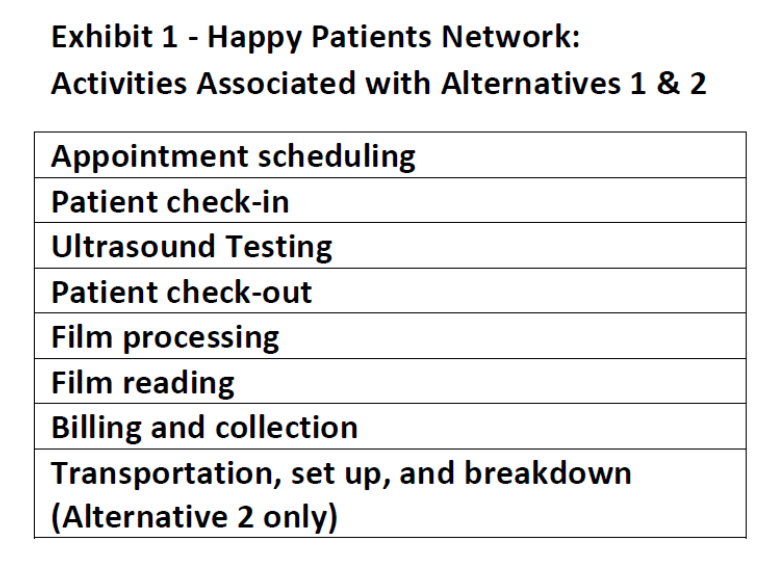
Note, though, that because the two alternatives have different operating costs, a proper cost analysis of the two alternatives must include operating costs. The Network financial staff, which in reality is the System financial staff, considered several methods for estimating the operating costs of each alternative. After much discussion, the chief financial officer (CFO) decided that the activity-based costing (ABC) method would be best. Furthermore, an ad-hoc task force was assigned to perform the cost analysis. To begin the ABC analysis, the task force had to develop the activities involved in the two alternatives. This was accomplished by conducting walk-throughs of the entire process from the standpoints of the patient, the ultrasound technician, and the billing and collections department. The results are shown in Exhibit 1. A review of the activities confirms that all except one-consisting of transportation, setup, and breakdown-are applicable to both alternatives.
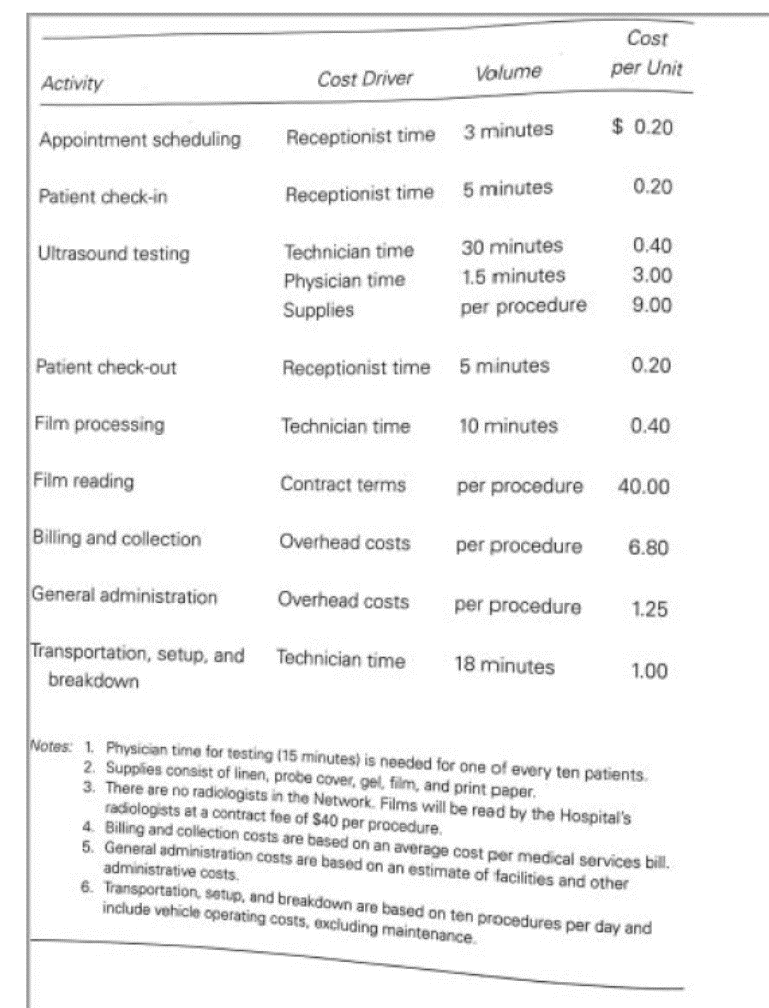
The next step in the ABC process is to detail the costs associated with each activity. This step uses operational and volume data, along with the appropriate cost driver for each activity, to estimate resource consumption. Note that traditional costing, which often focuses on department-level costs, typically first deals with direct costs and then allocates indirect (overhead) costs proportionally according to a predetermined allocation rate. In ABC costing, the activities required to produce some service, including both direct and indirect, are estimated simultaneously. For example, Exhibit 1 contains activities that entail direct costs (such as technician time) and activities that entail indirect costs (such as billing and collection). Although the ABC method is more complex and hence costlier than the traditional method, it is the only way to accurately (more or less) estimate the costs of individual services.
Activity cost detail on a per procedure basis is contained in Exhibit 2. In essence, each activity is assigned a cost driver that is most highly correlated with the actual utilization of resources. Then, the number of driver units, along with the cost per unit, is estimated for each activity. The product of the number of units and the cost per unit gives the cost of each activity. Finally, the activity costs are summed to obtain the total per procedure cost. Many of the activity costs cannot be estimated without an estimate of the number of ultrasounds that will be performed. The best estimate is that 50 procedures would be done each week, regardless of which alternative is chosen. Assuming the technician works 48 weeks per year, the annual volume estimate is 2,400 procedures. Of course, one factor that complicates the analysis is that a much greater total volume can be accommodated under Alternative 1, with three machines, than with Alternative 2, with only one machine. However, to keep the initial analysis manageable, the decision was made to assume the same annual volume regardless of the alternative chosen. In addition to the costs mentioned so far, some other costs are thought to be relevant to the decision. First, in addition to the obvious costs of purchasing and operating (primarily fuel expenses) the van, it is estimated that annual vehicle maintenance costs will run about $1,000. Furthermore, annual maintenance costs on each of the three machines under Alternative I are estimated at $1,000, while the annual maintenance costs for the single machine under Alternative 2 are estimated higher, at $1,500, because of added wear and tear. Also, the manufacturer of the ultrasound machines has indicated that a discount may be available if three machines, as opposed to only one, are purchased. The amount of the discount is somewhat uncertain, although 5 percent has been mentioned.
Assume that you are the chairperson of the ad-hoc task force. Your charge is to evaluate the two alternatives and to make a recommendation on which one to accept, assuming that revenues would be identical for the two alternatives and, hence, the decision can be made solely on the basis of costs. In addition, to keep the analysis manageable, the task force was instructed to assume that operating costs remain constant over the useful life of the equipment. For comparative purposes, this assumption is not too egregious because the activities are roughly the same for both alternatives and, hence, inflation would have a somewhat neutral impact on the cost comparison.
The analysis will include the following tasks:
(1) It will be necessary to estimate the total costs of the two alternatives on a per procedure and an annual basis using the ABC Cost Allocation Theory. Explain using the studied cost management theory.
(2) In addition to the base case ABC Cost Allocation analysis, the System CFO has asked the task force to perform some scenario analyses. First, he is concerned about the accuracy of the cost detail inputs. Although there is some confidence in many of the estimates, others are more arbitrary. Thus, the task force has been asked to redo the analysis assuming that these inputs are higher than the base case values by (Explain using the studied cost management theory.)
i.10 percent (scenario 1)
ii. 20 percent (scenario 2)
(3) The task force was asked to assess the impact of a purchase discount in Alternative I, would the discount amount influence the ultimate decision? Explain using the studied cost management theory.
(4)The task force is interested to use the CVP model as forecasting tool so that all activity cost items can be interpreted as fixed and variable expenses on a cost per procedure basis. The task force was asked produce total cost functions for alternative 1 & 2, and to forecast total costs for volumes 800, 1,500 and 2,400 procedures for each alternative. How these CVP total cost estimates for 800, 1,500 and 2,400 procedures compare to the ABC total cost estimates for 800, 1,500, 2,400 procedures for both alternatives? Explain using the studied cost management theory.
Step by Step Solution
There are 3 Steps involved in it

Get step-by-step solutions from verified subject matter experts
 Study Help