







Question: Hardware Adder For this lab, you will be creating a circuit which takes a pair of two bit values from the input switches in the
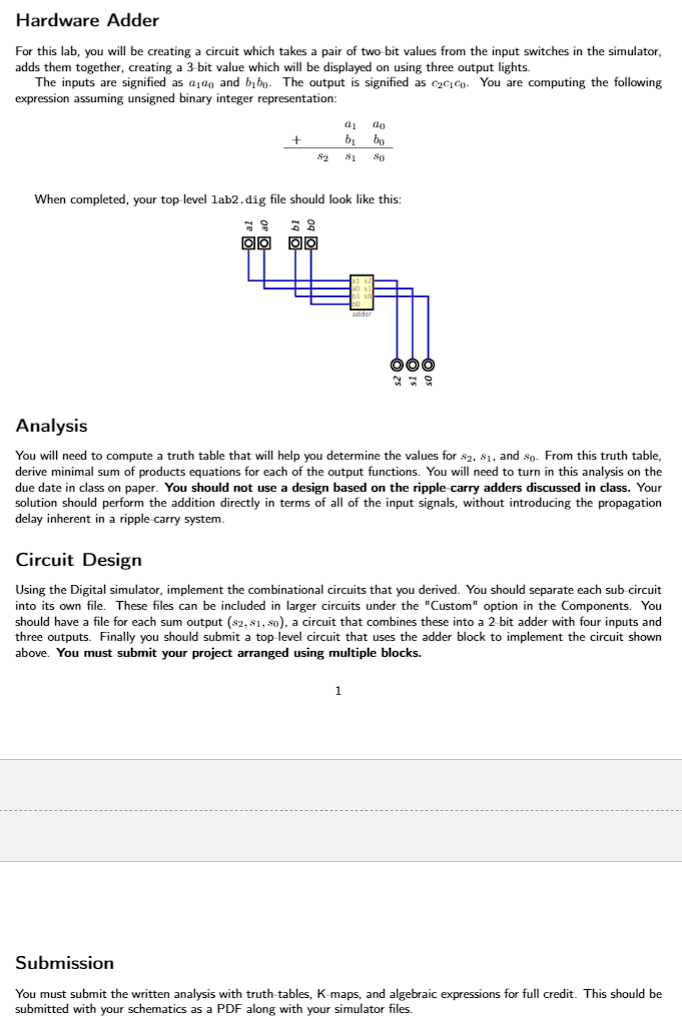
Hardware Adder For this lab, you will be creating a circuit which takes a pair of two bit values from the input switches in the simulator, adds them together, creating a 3 bit value which will be displayed on using three output lights. The inputs are signified as ago and b bo. The output is signified as CC.Co. You are computing the following expression assuming unsigned binary integer representation: + do bo bi 82 Si so When completed, your top level lab2.dig file should look like this: 00 09 OOO Analysis You will need to compute a truth table that will help you determine the values for S2, S1, and so. From this truth table, derive minimal sum of products equations for each of the output functions. You will need to turn in this analysis on the due date in class on paper. You should not use a design based on the ripple carry adders discussed in class. Your solution should perform the addition directly in terms of all of the input signals, without introducing the propagation delay inherent in a ripple carry system Circuit Design Using the Digital simulator, implement the combinational circuits that you derived. You should separate each sub circuit into its own file. These files can be included in larger circuits under the "Custom" option in the Components. You should have a file for each sum output (S2,S1, so), a circuit that combines these into a 2 bit adder with four inputs and three outputs. Finally you should submit top level circuit that uses the adder block to implement the circuit shown above. You must submit your project arranged using multiple blocks. 1 Submission You must submit the written analysis with truth tables, K-maps, and algebraic expressions for full credit. This should be submitted with your schematics as a PDF along with your simulator files. Hardware Adder For this lab, you will be creating a circuit which takes a pair of two bit values from the input switches in the simulator, adds them together, creating a 3 bit value which will be displayed on using three output lights. The inputs are signified as ago and b bo. The output is signified as CC.Co. You are computing the following expression assuming unsigned binary integer representation: + do bo bi 82 Si so When completed, your top level lab2.dig file should look like this: 00 09 OOO Analysis You will need to compute a truth table that will help you determine the values for S2, S1, and so. From this truth table, derive minimal sum of products equations for each of the output functions. You will need to turn in this analysis on the due date in class on paper. You should not use a design based on the ripple carry adders discussed in class. Your solution should perform the addition directly in terms of all of the input signals, without introducing the propagation delay inherent in a ripple carry system Circuit Design Using the Digital simulator, implement the combinational circuits that you derived. You should separate each sub circuit into its own file. These files can be included in larger circuits under the "Custom" option in the Components. You should have a file for each sum output (S2,S1, so), a circuit that combines these into a 2 bit adder with four inputs and three outputs. Finally you should submit top level circuit that uses the adder block to implement the circuit shown above. You must submit your project arranged using multiple blocks. 1 Submission You must submit the written analysis with truth tables, K-maps, and algebraic expressions for full credit. This should be submitted with your schematics as a PDF along with your simulator files
Step by Step Solution
There are 3 Steps involved in it

Get step-by-step solutions from verified subject matter experts
 Study Help