



Question: Hashing distributes keys uniformly among a one-dimensional array ht[0,m) called a hash table [2] . Keys are distributed as follows: a value is assigned to
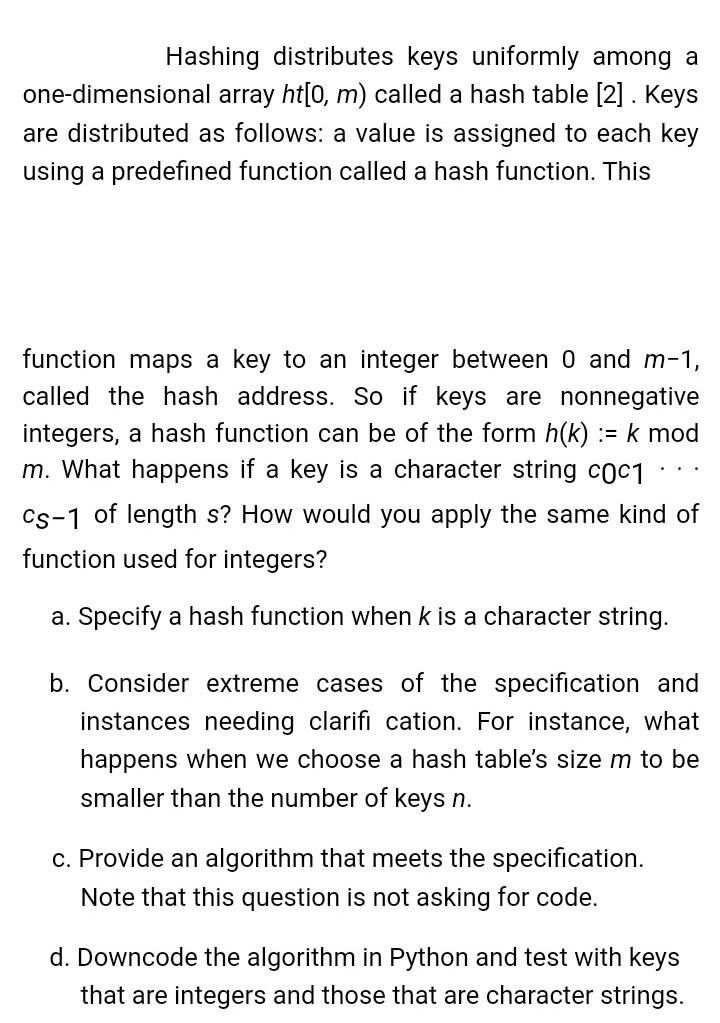
Hashing distributes keys uniformly among a one-dimensional array ht[0,m) called a hash table [2] . Keys are distributed as follows: a value is assigned to each key using a predefined function called a hash function. This function maps a key to an integer between 0 and m1, called the hash address. So if keys are nonnegative integers, a hash function can be of the form h(k):=k mod m. What happens if a key is a character string coc1 cs1 of length s ? How would you apply the same kind of function used for integers? a. Specify a hash function when k is a character string. b. Consider extreme cases of the specification and instances needing clarifi cation. For instance, what happens when we choose a hash table's size m to be smaller than the number of keys n. c. Provide an algorithm that meets the specification. Note that this question is not asking for code. d. Downcode the algorithm in Python and test with keys that are integers and those that are character strings
Step by Step Solution
There are 3 Steps involved in it

Get step-by-step solutions from verified subject matter experts