







Question: Haskell Programming - Code Do it in Haskell GHCI 1. [15 = 5 * 3 pts] In ghci, what happens on the inputs below? Give
Haskell Programming - Code
Do it in Haskell GHCI
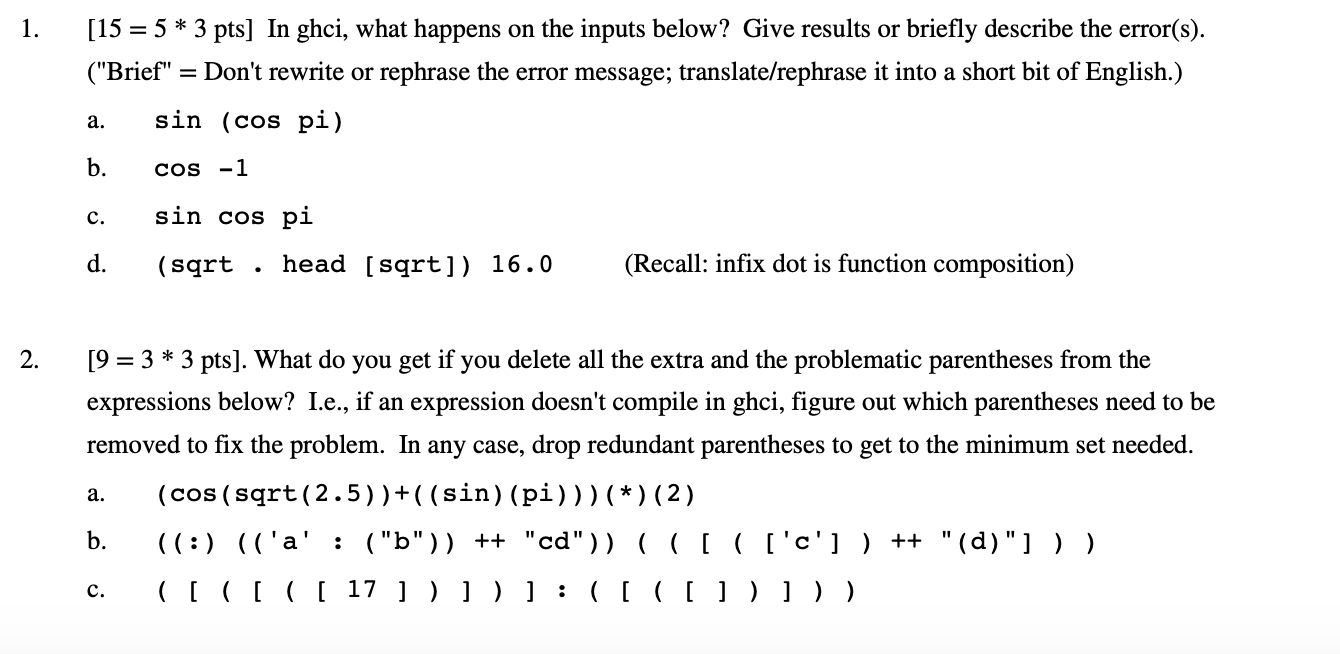
1. [15 = 5 * 3 pts] In ghci, what happens on the inputs below? Give results or briefly describe the error(s). ("Brief" = Don't rewrite or rephrase the error message; translate/rephrase it into a short bit of English.) a. sin (cos pi) b. cos -1 c. sin cos pi (sqrt . head [sqrtl) 16.0 (Recall: infix dot is function composition) 2. [9 = 3 * 3 pts). What do you get if you delete all the extra and the problematic parentheses from the expressions below? I.e., if an expression doesn't compile in ghci, figure out which parentheses need to be removed to fix the problem. In any case, drop redundant parentheses to get to the minimum set needed. a. (cos(sqrt(2.5))+((sin) (pi))) (*)(2) b. (1:) (('a': ("b")) ++ "cd")) ((((['c'] ) ++ "(d)"] ) ) c. ([ [l[ 17 ] ) ) )] :((( [])))) 1. [15 = 5 * 3 pts] In ghci, what happens on the inputs below? Give results or briefly describe the error(s). ("Brief" = Don't rewrite or rephrase the error message; translate/rephrase it into a short bit of English.) a. sin (cos pi) b. cos -1 c. sin cos pi (sqrt . head [sqrtl) 16.0 (Recall: infix dot is function composition) 2. [9 = 3 * 3 pts). What do you get if you delete all the extra and the problematic parentheses from the expressions below? I.e., if an expression doesn't compile in ghci, figure out which parentheses need to be removed to fix the problem. In any case, drop redundant parentheses to get to the minimum set needed. a. (cos(sqrt(2.5))+((sin) (pi))) (*)(2) b. (1:) (('a': ("b")) ++ "cd")) ((((['c'] ) ++ "(d)"] ) ) c. ([ [l[ 17 ] ) ) )] :((( []))))
Step by Step Solution
There are 3 Steps involved in it

Get step-by-step solutions from verified subject matter experts
 Study Help