







Question: Haskell Programming (Needs to be done with Haskell) . (Types of various functions) fla (b, a) -> (a, b) fla-(x, y) (y, x) flb a
Haskell Programming (Needs to be done with Haskell)
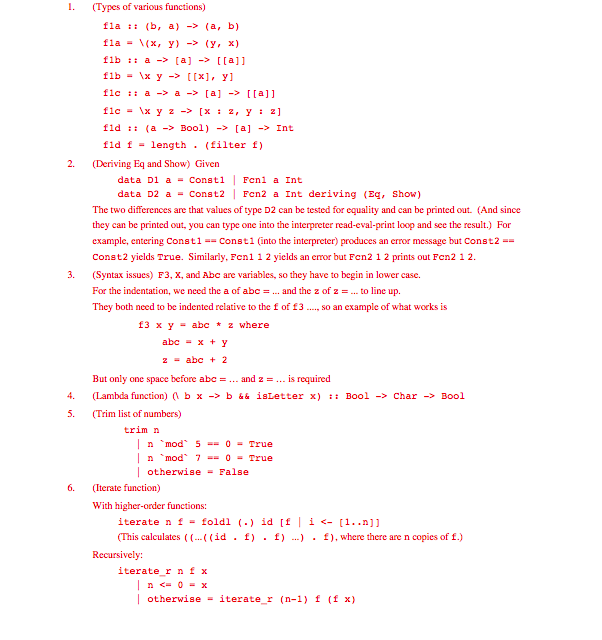
. (Types of various functions) fla (b, a) -> (a, b) fla-\(x, y) (y, x) flb a -> [a] [[a]] fic :: a-> a-> [a] -> [[a]] fld (a -> Bool) [a] -> Int fld flength . (filter f) 2 Deriving Eq and Show) Given data D1 a - Constl Fcnl a Int data D2 a-Const2 Fen2 a Int deriving (Eq, Show) The two differences are that values of type D2 can be tested for equality and can be printed out. (And since they can be printed out, you can type one into the interpreter read-eval-print loop and see the result.) For example, entering const!--const 1 (into the interpreter) produces an error message but Const 2- Const2 yields True. Similarly. Fenl 1 2 yields an emor but Fen2 1 2 prints out Fen2 12. 3. (Syntax issues) F3, x, ad Abc are variables, so they have to begin in lower case. For the indentation, we need the a of abcand the z of z-to line up. They both need to be indented relative to the f of f3 so an example of what works is f3 x yabcz where abc-x +Y But only one space before abc. andz -... is required 4. (Lambda function) b x -> b &&isLetter x)Bool-Char -> Bool 5 (Trim list of numbers) trim n mod 50 True n mod, 7--0. True otherwise False 6. Iterate function) With higher-order functions: iterate n f-fold! (-) id [f I (a, b) fla-\(x, y) (y, x) flb a -> [a] [[a]] fic :: a-> a-> [a] -> [[a]] fld (a -> Bool) [a] -> Int fld flength . (filter f) 2 Deriving Eq and Show) Given data D1 a - Constl Fcnl a Int data D2 a-Const2 Fen2 a Int deriving (Eq, Show) The two differences are that values of type D2 can be tested for equality and can be printed out. (And since they can be printed out, you can type one into the interpreter read-eval-print loop and see the result.) For example, entering const!--const 1 (into the interpreter) produces an error message but Const 2- Const2 yields True. Similarly. Fenl 1 2 yields an emor but Fen2 1 2 prints out Fen2 12. 3. (Syntax issues) F3, x, ad Abc are variables, so they have to begin in lower case. For the indentation, we need the a of abcand the z of z-to line up. They both need to be indented relative to the f of f3 so an example of what works is f3 x yabcz where abc-x +Y But only one space before abc. andz -... is required 4. (Lambda function) b x -> b &&isLetter x)Bool-Char -> Bool 5 (Trim list of numbers) trim n mod 50 True n mod, 7--0. True otherwise False 6. Iterate function) With higher-order functions: iterate n f-fold! (-) id [f I
Step by Step Solution
There are 3 Steps involved in it

Get step-by-step solutions from verified subject matter experts
 Study Help