







Question: HEED THESE RULES: It should be noted that: 1. You should always use DECiMALS (not fractions!) to express metric measurements. 2. If a metric measurement
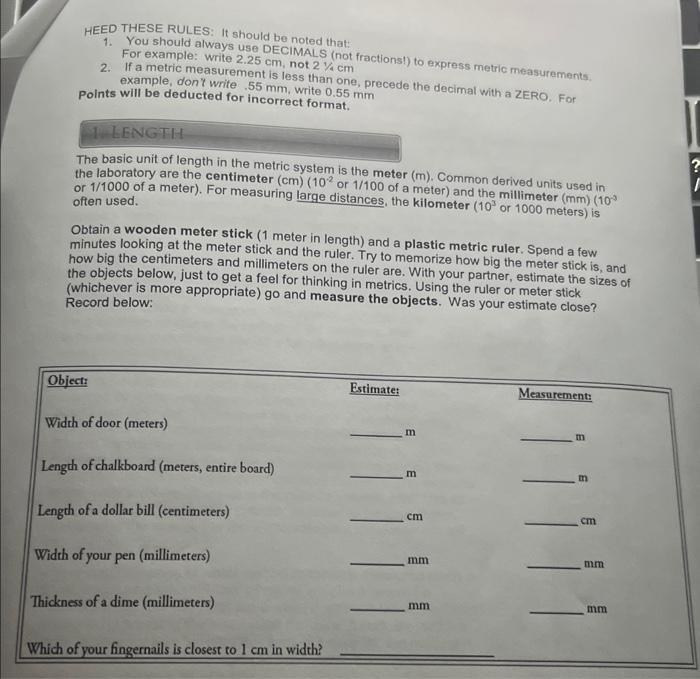
HEED THESE RULES: It should be noted that: 1. You should always use DECiMALS (not fractions!) to express metric measurements. 2. If a metric measurement is less than one, precede the decimal with a ZERO. For example, don ' write .55mm, write 0.55. 1. EENGTH The basic unit of length in the metric system is the meter (m). Common derived units used in the laboratory are the centimeter (cm)(102 or 1/100 of a meter) and the millimeter (mm)(103 or 1/1000 of a meter). For measuring large distances, the kilometer ( 103 or 1000 meters) is often used. Obtain a wooden meter stick ( 1 meter in length) and a plastic metric ruler. Spend a few minutes looking at the meter stick and the ruler. Try to memorize how big the meter stick is, and how big the centimeters and millimeters on the ruler are. With your partner, estimate the sizes of (whichever is more appropriate) go and minking in metrics. Using the ruler or meter stick Record below
Step by Step Solution
There are 3 Steps involved in it

Get step-by-step solutions from verified subject matter experts
 Study Help