







Question: hello can you help me solving it and use matlab to calculate. thank you in advance. Problem 4 The way proteins adsorb onto the surface
hello can you help me solving it and use matlab to calculate. thank you in advance.
Problem
The way proteins adsorb onto the surface of implant materials can be important for control of cell
attachment. In some cases, such as a dental implant, it is desirable to have proteins adsorb to support
attachment of bone cells to the implant to help hold the implant in place. In other cases such as in an
artificial blood vessel, protein adsorption leading to attachment of cells is not desirable since this can
lead to vessel occlusion or blockage.
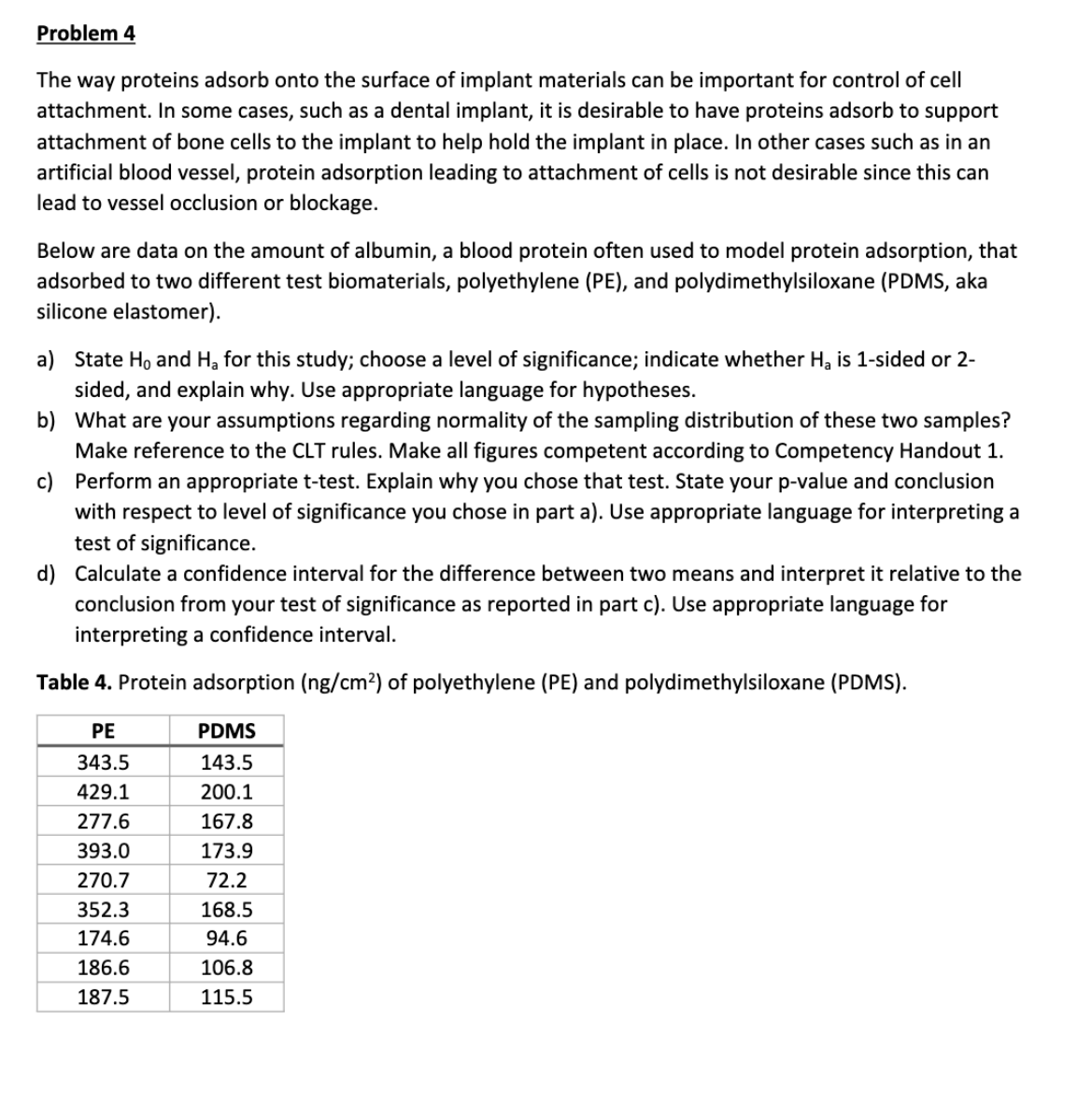
Below are data on the amount of albumin, a blood protein often used to model protein adsorption, that
adsorbed to two different test biomaterials, polyethylene PE and polydimethylsiloxane PDMS aka
silicone elastomer
a State and for this study; choose a level of significance; indicate whether is sided or
sided, and explain why. Use appropriate language for hypotheses.
b What are your assumptions regarding normality of the sampling distribution of these two samples?
Make reference to the CLT rules. Make all figures competent according to Competency Handout
c Perform an appropriate ttest. Explain why you chose that test. State your pvalue and conclusion
with respect to level of significance you chose in part a Use appropriate language for interpreting a
test of significance.
d Calculate a confidence interval for the difference between two means and interpret it relative to the
conclusion from your test of significance as reported in part c Use appropriate language for
interpreting a confidence interval.
Table Protein adsorption of polyethylene PE and polydimethylsiloxane PDMS
Step by Step Solution
There are 3 Steps involved in it
1 Expert Approved Answer
Step: 1 Unlock

Question Has Been Solved by an Expert!
Get step-by-step solutions from verified subject matter experts
Step: 2 Unlock
Step: 3 Unlock
 Study Help