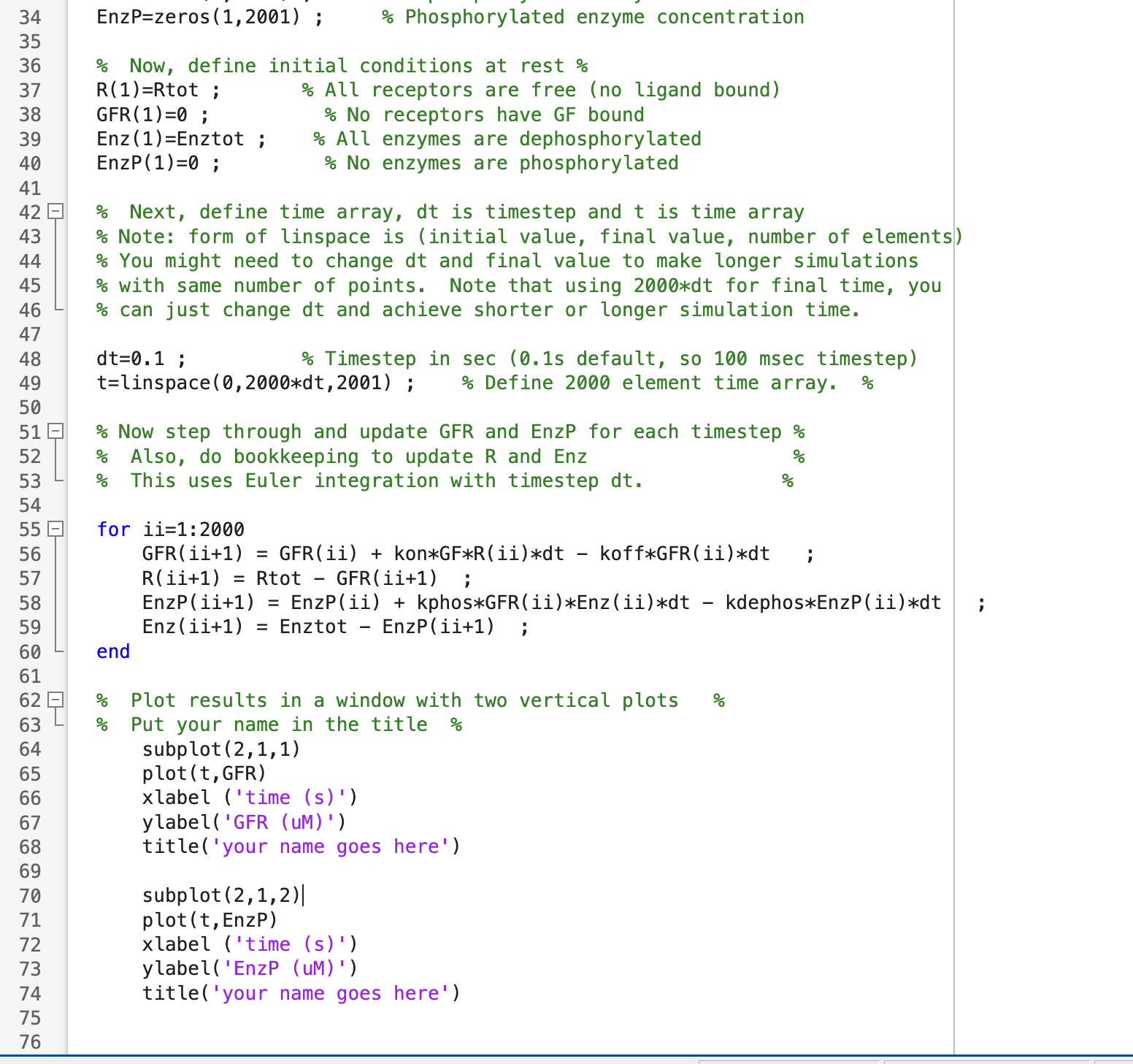
Question: Hello, Can you help me with this biomedical engineering class homework. There is also a MATLAB code provided. I'd appreciate if you could answer the
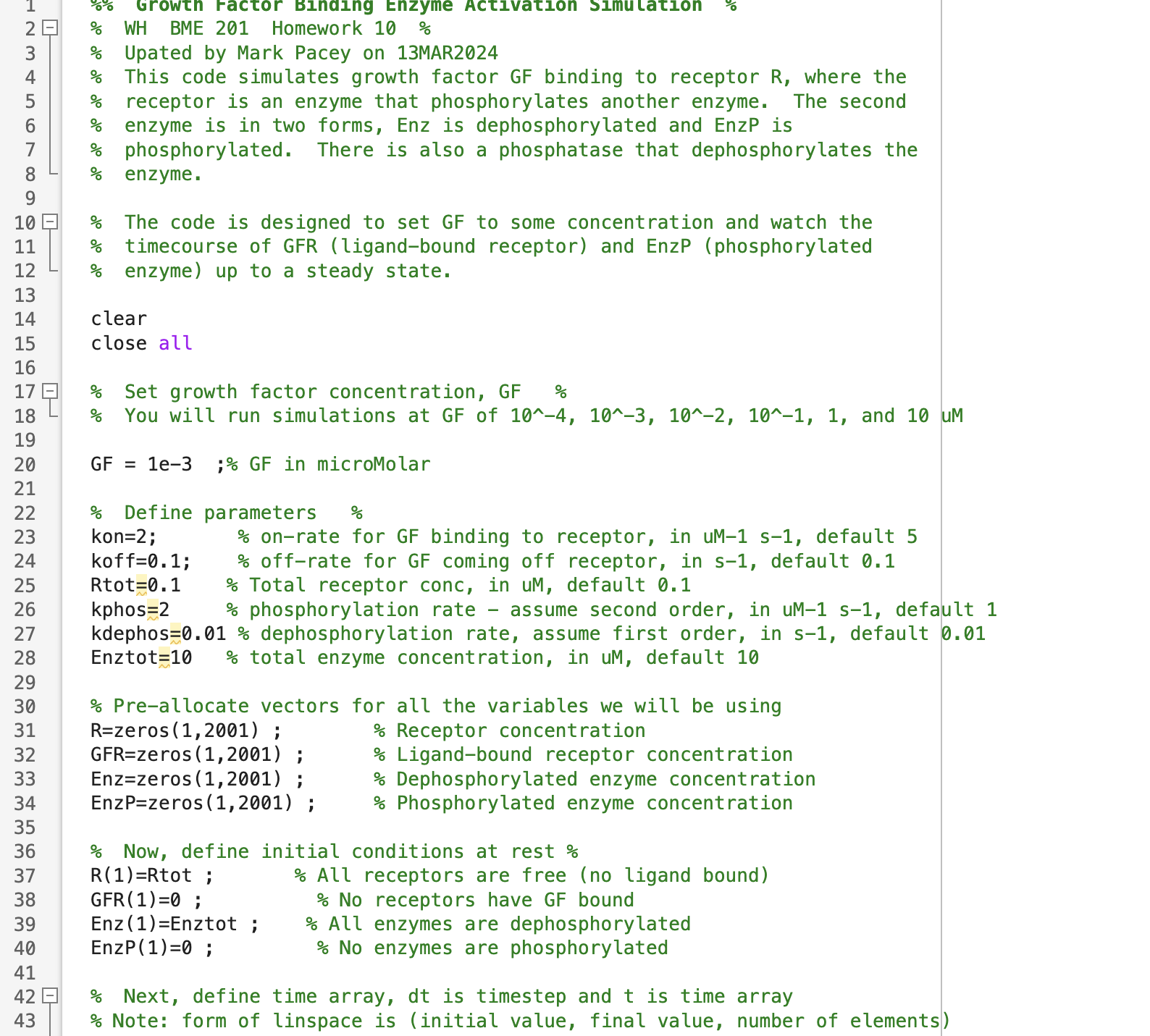
Hello, Can you help me with this biomedical engineering class homework. There is also a MATLAB code provided. I'd appreciate if you could answer the question on the document. I have attached the homework and the MATLAB code. Thank you!
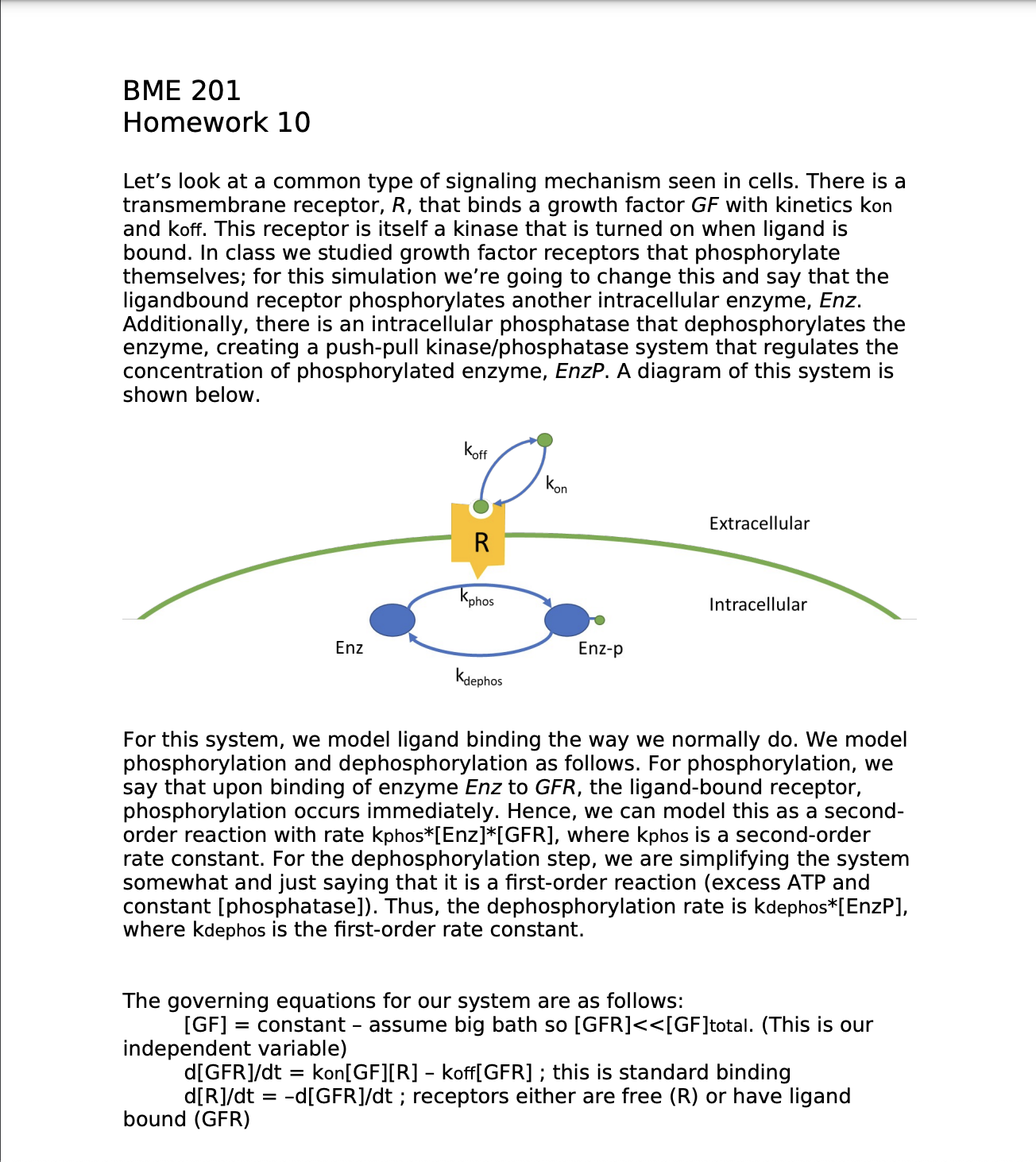
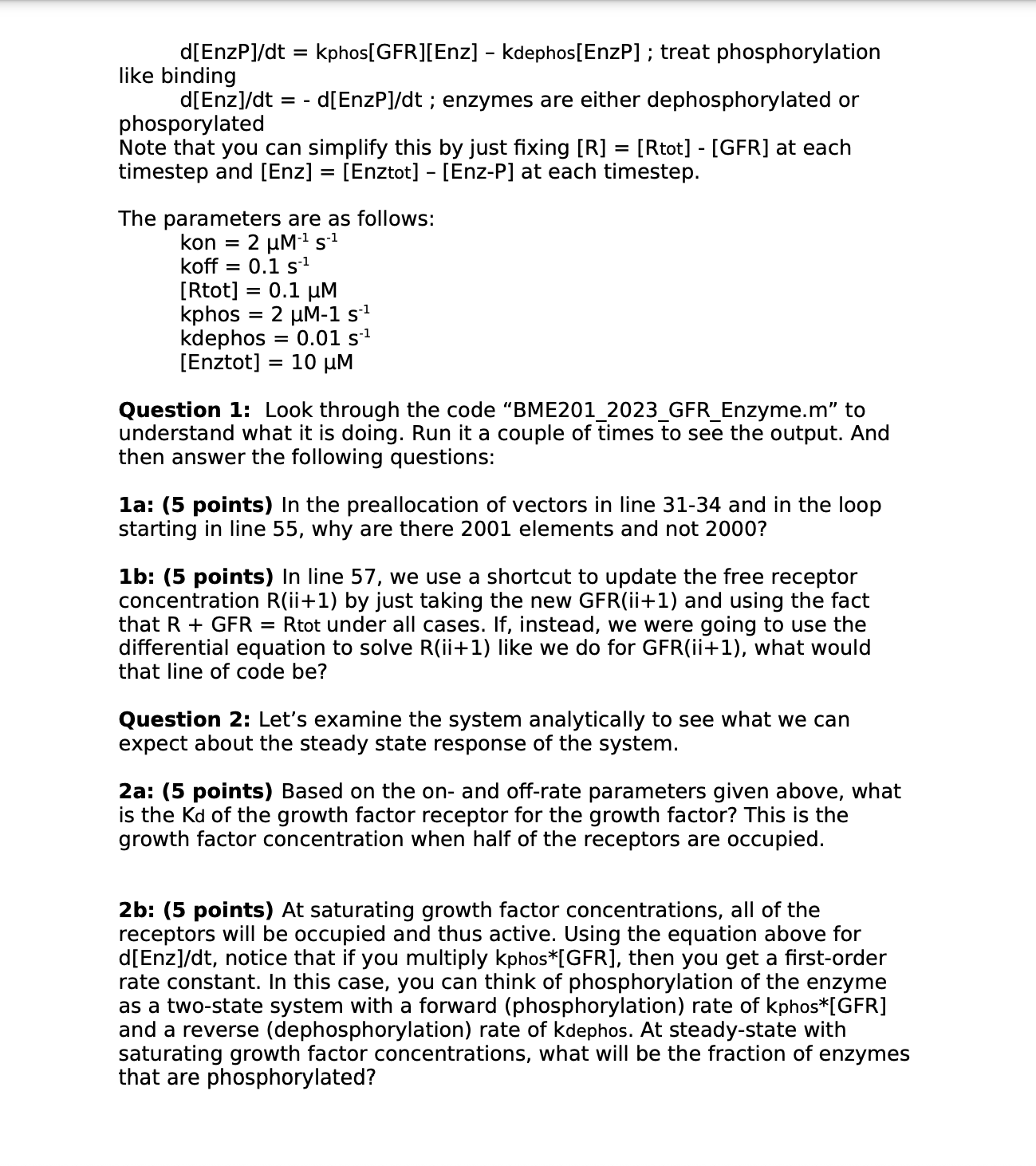
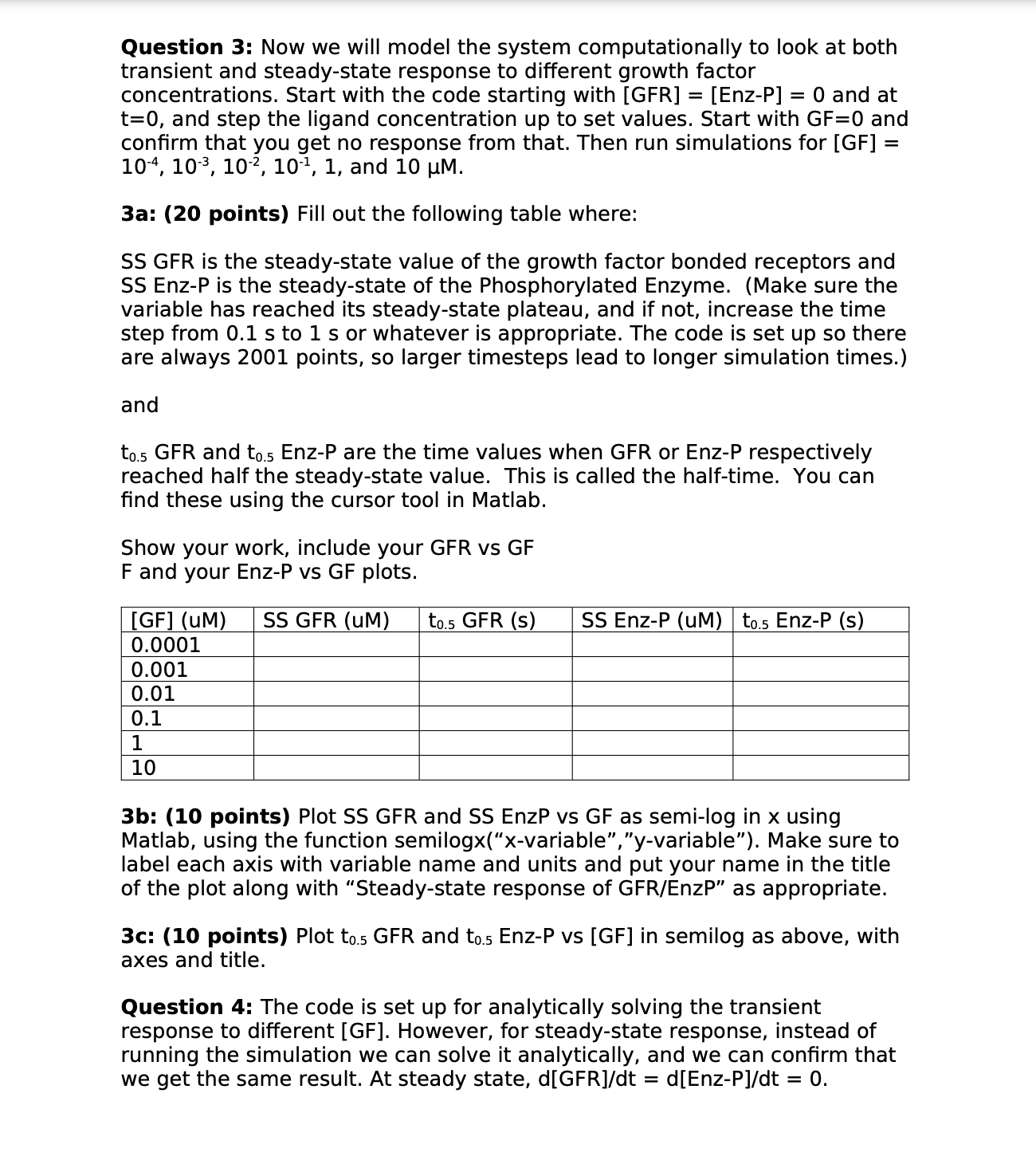
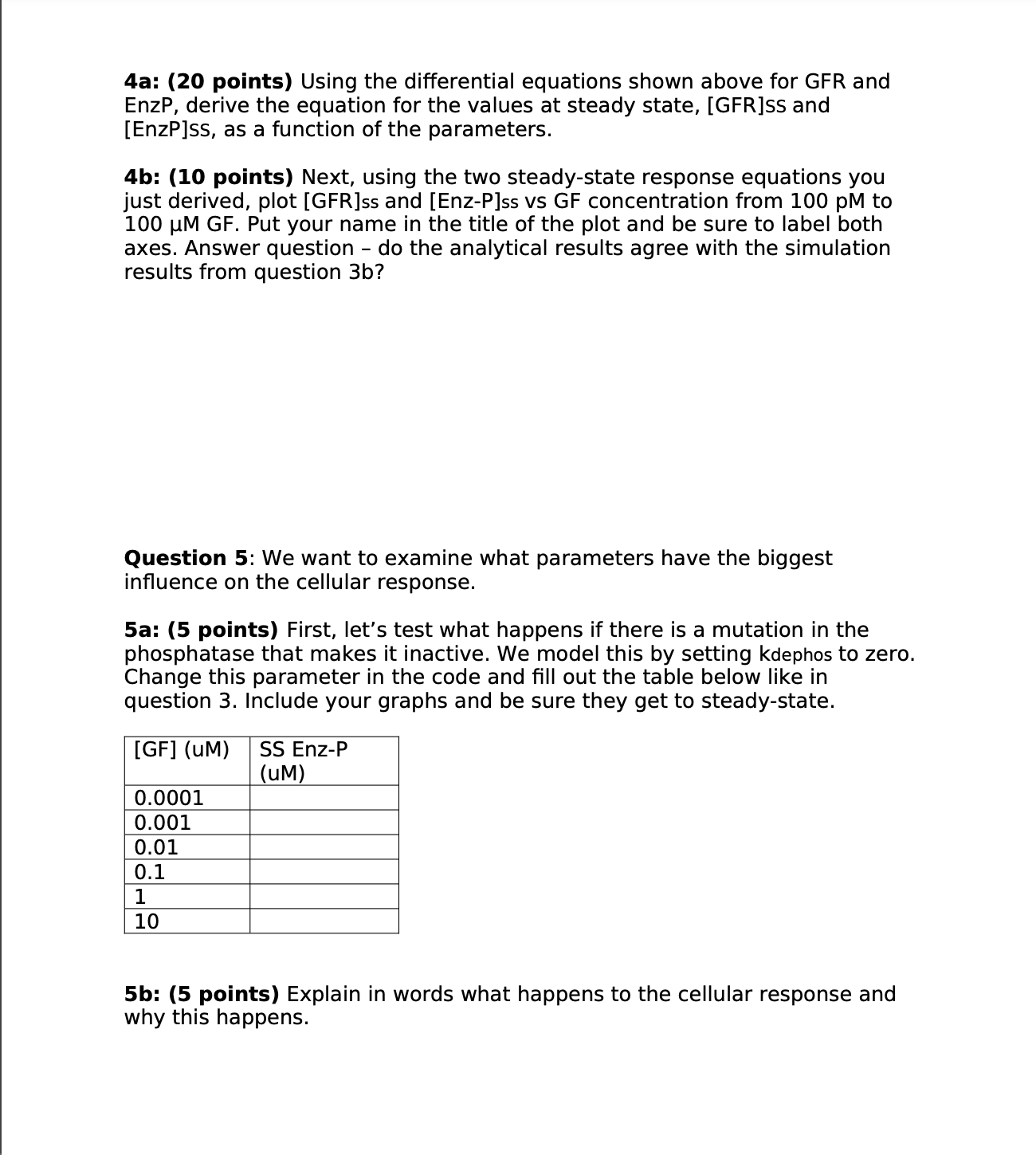
BME 201 Homework 10 Let's look at a common type of signaling mechanism seen in cells. There is a transmembrane receptor, R, that binds a growth factor GF with kinetics Kon and koff. This receptor is itself a kinase that is turned on when ligand is bound. In class we studied growth factor receptors that phosphorylate themselves; for this simulation we're going to change this and say that the ligandbound receptor phosphorylates another intracellular enzyme, Enz. Additionally, there is an intracellular phosphatase that dephosphorylates the enzyme, creating a push-pull kinase/phosphatase system that regulates the concentration of phosphorylated enzyme, EnzP. A diagram of this system is shown below. Koff Kon Extracellular R Kphos Intracellular Enz Enz-p Kdephos For this system, we model ligand binding the way we normally do. We model phosphorylation and dephosphorylation as follows. For phosphorylation, we say that upon binding of enzyme Enz to GFR, the ligand-bound receptor, phosphorylation occurs immediately. Hence, we can model this as a second- order reaction with rate Kphos*[Enz]*[GFR], where Kphos is a second-order rate constant. For the dephosphorylation step, we are simplifying the system somewhat and just saying that it is a first-order reaction (excess ATP and constant [phosphatase]). Thus, the dephosphorylation rate is kdephos*[EnzP], where Kdephos is the first-order rate constant. The governing equations for our system are as follows: [GF] = constant - assume big bath so [GFR]
Step by Step Solution
There are 3 Steps involved in it
1 Expert Approved Answer
Step: 1 Unlock

Question Has Been Solved by an Expert!
Get step-by-step solutions from verified subject matter experts
Step: 2 Unlock
Step: 3 Unlock

Students Have Also Explored These Related Law Questions!