







Question: Hello ..can you please solve to problem and show the calculations' details made on excel Thank you SPREADSHEET PROBLEMS (9-18) Build a Model: WACC resource
Hello ..can you please solve to problem and show the calculations' details made on excel
Thank you
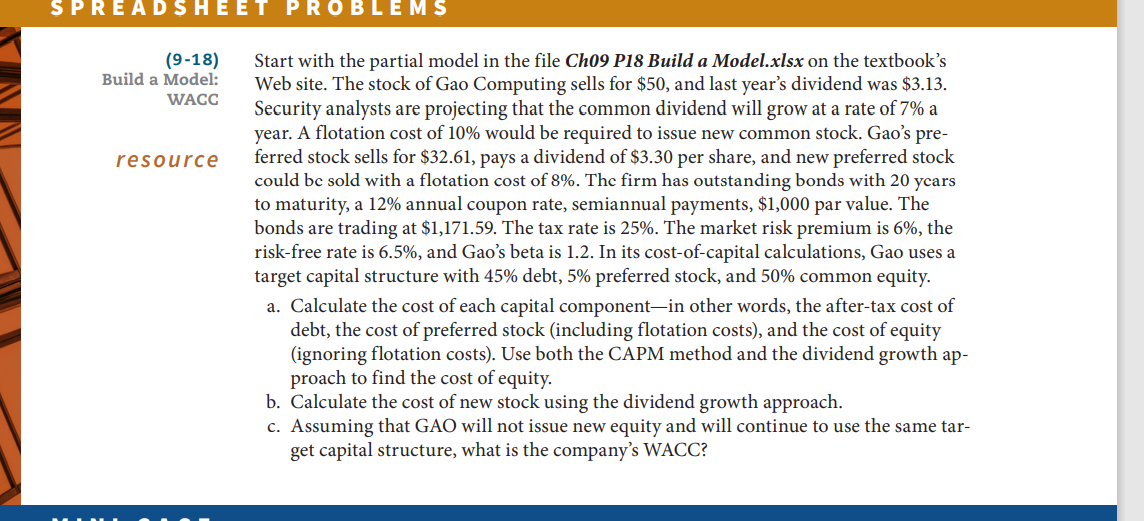
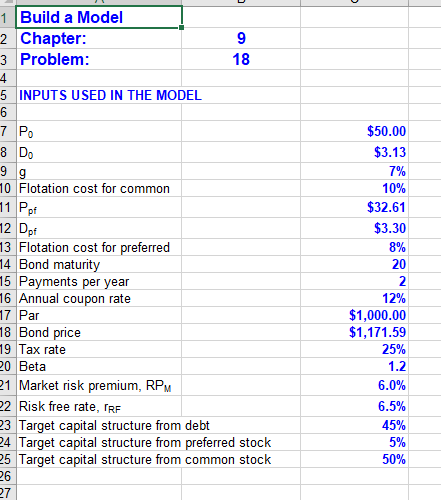
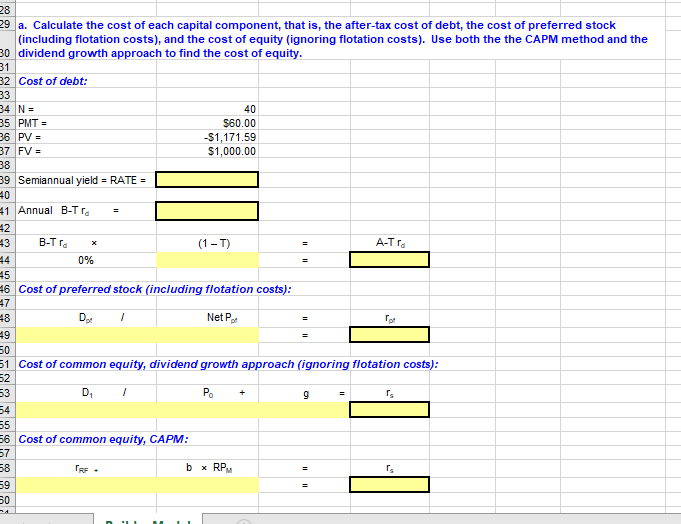
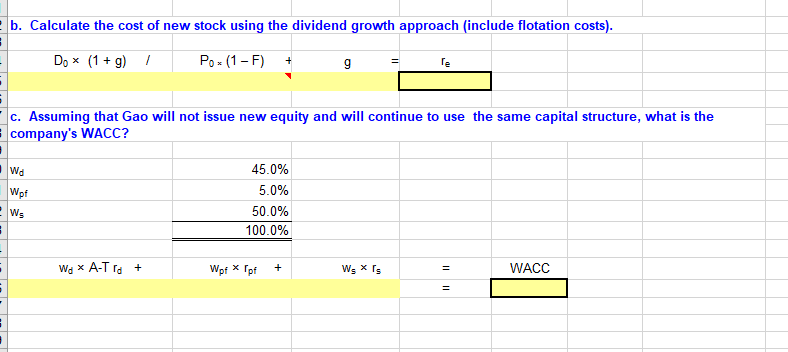
SPREADSHEET PROBLEMS (9-18) Build a Model: WACC resource Start with the partial model in the file Ch09 P18 Build a Model.xlsx on the textbook's Web site. The stock of Gao Computing sells for $50, and last year's dividend was $3.13. Security analysts are projecting that the common dividend will grow at a rate of 7% a year. A flotation cost of 10% would be required to issue new common stock. Gao's pre- ferred stock sells for $32.61, pays a dividend of $3.30 per share, and new preferred stock could be sold with a flotation cost of 8%. The firm has outstanding bonds with 20 years to maturity, a 12% annual coupon rate, semiannual payments, $1,000 par value. The bonds are trading at $1,171.59. The tax rate is 25%. The market risk premium is 6%, the risk-free rate is 6.5%, and Gao's beta is 1.2. In its cost-of-capital calculations, Gao uses a target capital structure with 45% debt, 5% preferred stock, and 50% common equity. a. Calculate the cost of each capital component-in other words, the after-tax cost of debt, the cost of preferred stock (including flotation costs), and the cost of equity (ignoring flotation costs). Use both the CAPM method and the dividend growth ap- proach to find the cost of equity. b. Calculate the cost of new stock using the dividend growth approach. c. Assuming that GAO will not issue new equity and will continue to use the same tar- get capital structure, what is the company's WACC? 1 Build a Model 2 Chapter: 3 Problem: 4 5 INPUTS USED IN THE MODEL 6 7 Po 8 Do 9 g 10 Flotation cost for common 11 Ppf 12 Dpf 13 Flotation cost for preferred 14 Bond maturity 15 Payments per year 16 Annual coupon rate 17 Par 18 Bond price 19 Tax rate 20 Beta 21 Market risk premium, RPM 22 Risk free rate, TRF 23 Target capital structure from debt 24 Target capital structure from preferred stock 25 Target capital structure from common stock 26 27 980 18 $50.00 $3.13 7% 10% $32.61 $3.30 8% 20 12% $1,000.00 $1,171.59 25% 1.2 6.0% 6.5% 45% 5% 50% 28 29 a. Calculate the cost of each capital component, that is, the after-tax cost of debt, the cost of preferred stock (including flotation costs), and the cost of equity (ignoring flotation costs). Use both the the CAPM method and the 30 dividend growth approach to find the cost of equity. 31 32 Cost of debt: 33 34 |N= 40 $60.00 35 PMT= 36 PV= -$1,171.59 $1,000.00 37 FV = 38 39 Semiannual yield = RATE= 40 41 Annual B-T ra 42 43 B-Tra x (1-T) A-Tra 44 0% = 45 46 Cost of preferred stock (including flotation costs): 47 48 = Dpt 1 Net Pr 49 = 50 51 Cost of common equity, dividend growth approach (ignoring flotation costs): 52 53 D 1 P 9 r 54 55 56 Cost of common equity, CAPM: 57 58 T 59 50 bx RPM = - b. Calculate the cost of new stock using the dividend growth approach (include flotation costs). Dox (1 + g) / Pox (1-F) + = 9 c. Assuming that Gao will not issue new equity and will continue to use the same capital structure, what is the company's WACC? Wa 45.0% 5.0% Wpf Ws 50.0% 100.0% Wdx A-T rd + + Ws X rs WACC Wpf x [pf || || = =
Step by Step Solution
There are 3 Steps involved in it

Get step-by-step solutions from verified subject matter experts
 Study Help