







Question: Hello, could anyone help with this please? Any help would be greatly appreciated and rewarded with thumbs up automatically. Question 9 Private agents form rational
Hello, could anyone help with this please? Any help would be greatly appreciated and rewarded with thumbs up automatically.
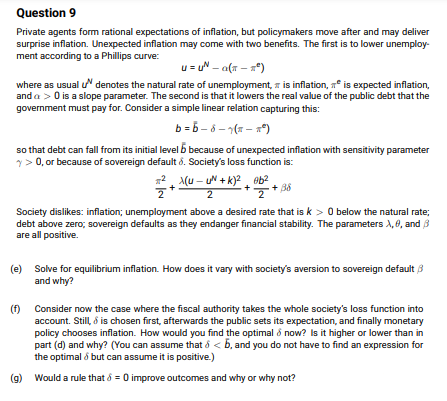
Question 9 Private agents form rational expectations of inflation, but policymakers move after and may deliver surprise inflation. Unexpected inflation may come with two benefits. The first is to lower unemploy- ment according to a Phillips curve: where as usual " denotes the natural rate of unemployment, * is inflation, " is expected inflation, and a > 0 is a slope parameter. The second is that it lowers the real value of the public debt that the government must pay for. Consider a simple linear relation capturing this: b =6-6 - 7(x - *") so that debt can fall from its initial level b because of unexpected inflation with sensitivity parameter > 0, or because of sovereign default 6. Society's loss function is: A(u - UN + k)2 062 2 2 + 86 Society dislikes: inflation; unemployment above a desired rate that is k > 0 below the natural rate; debt above zero; sovereign defaults as they endanger financial stability. The parameters A, 0, and @ are all positive. (e) Solve for equilibrium inflation. How does it vary with society's aversion to sovereign default and why? (f) Consider now the case where the fiscal authority takes the whole society's loss function into account. Still of is chosen first, afterwards the public sets its expectation, and finally monetary policy chooses inflation. How would you find the optimal o now? Is it higher or lower than in part (d) and why? (You can assume that &
Step by Step Solution
There are 3 Steps involved in it

Get step-by-step solutions from verified subject matter experts
 Study Help