



Question: Hello, could you help me with the answer in the above lines, please? A supplier for the chemical industry sells sulphuric acid to two customers.
Hello, could you help me with the answer in the above lines, please?
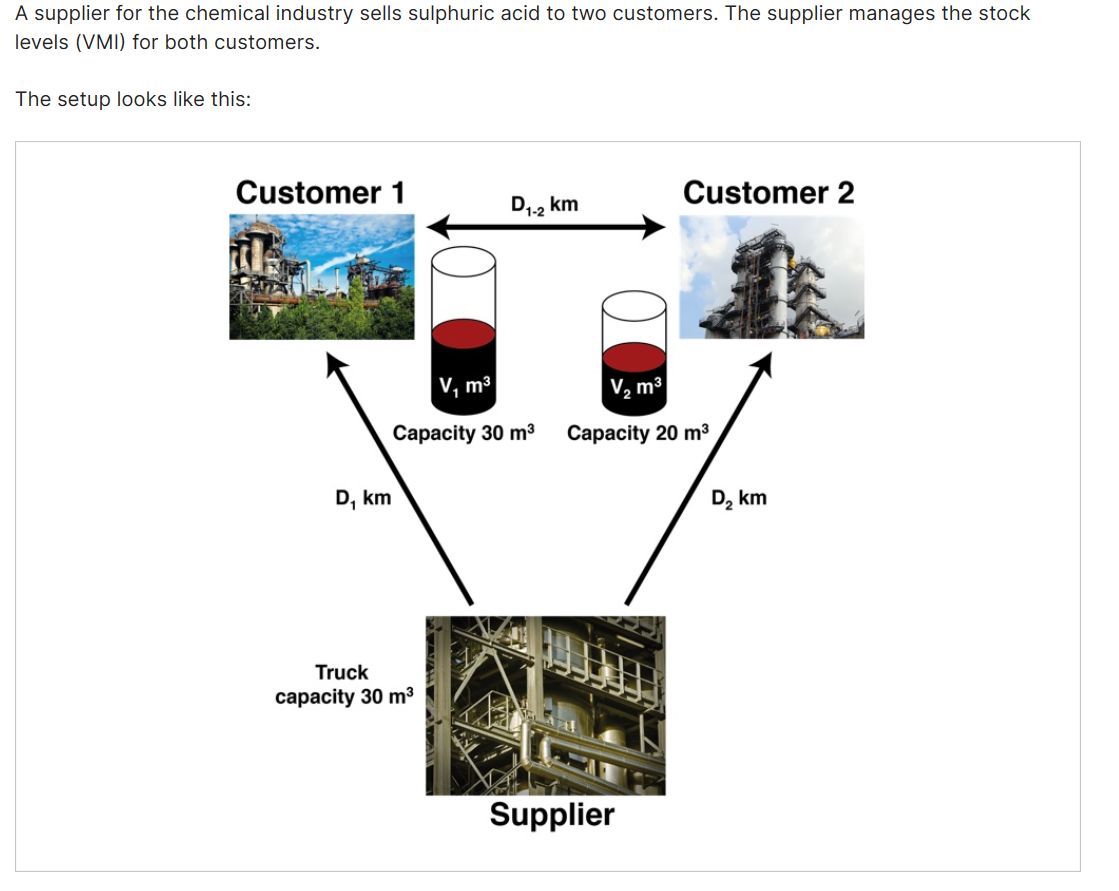
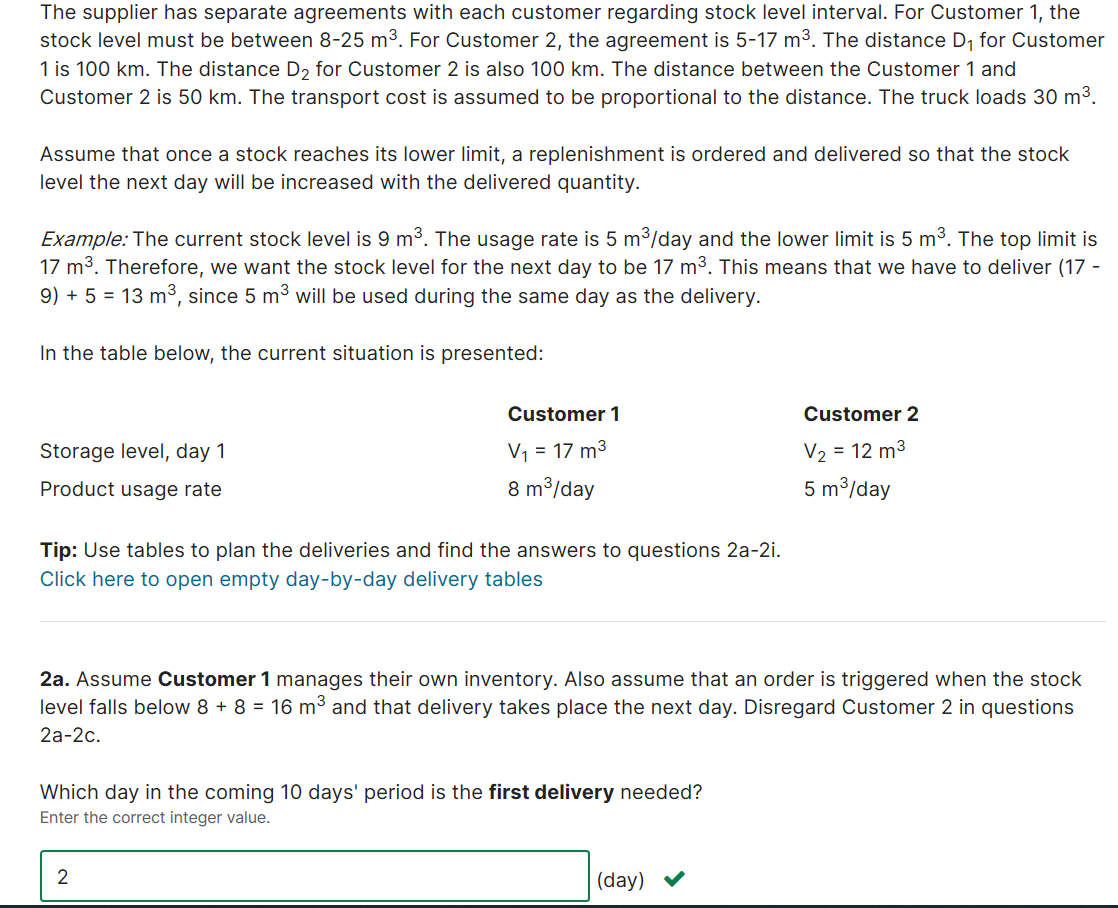
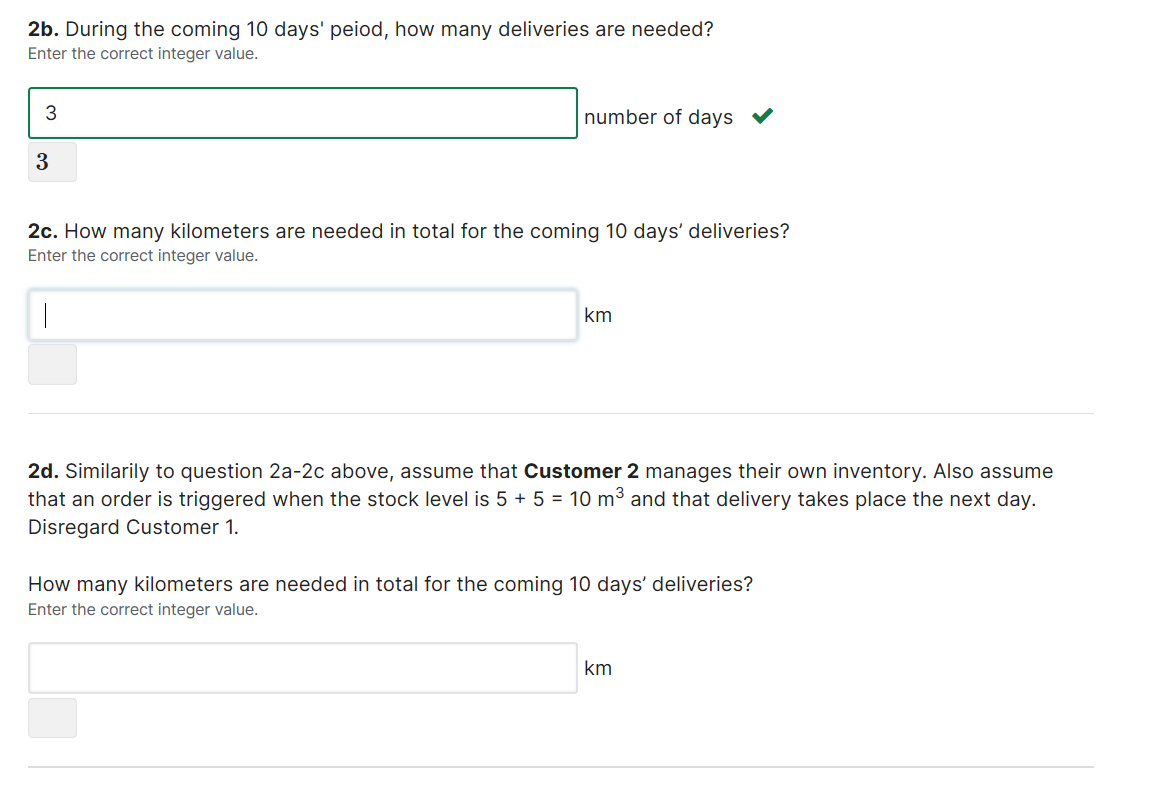
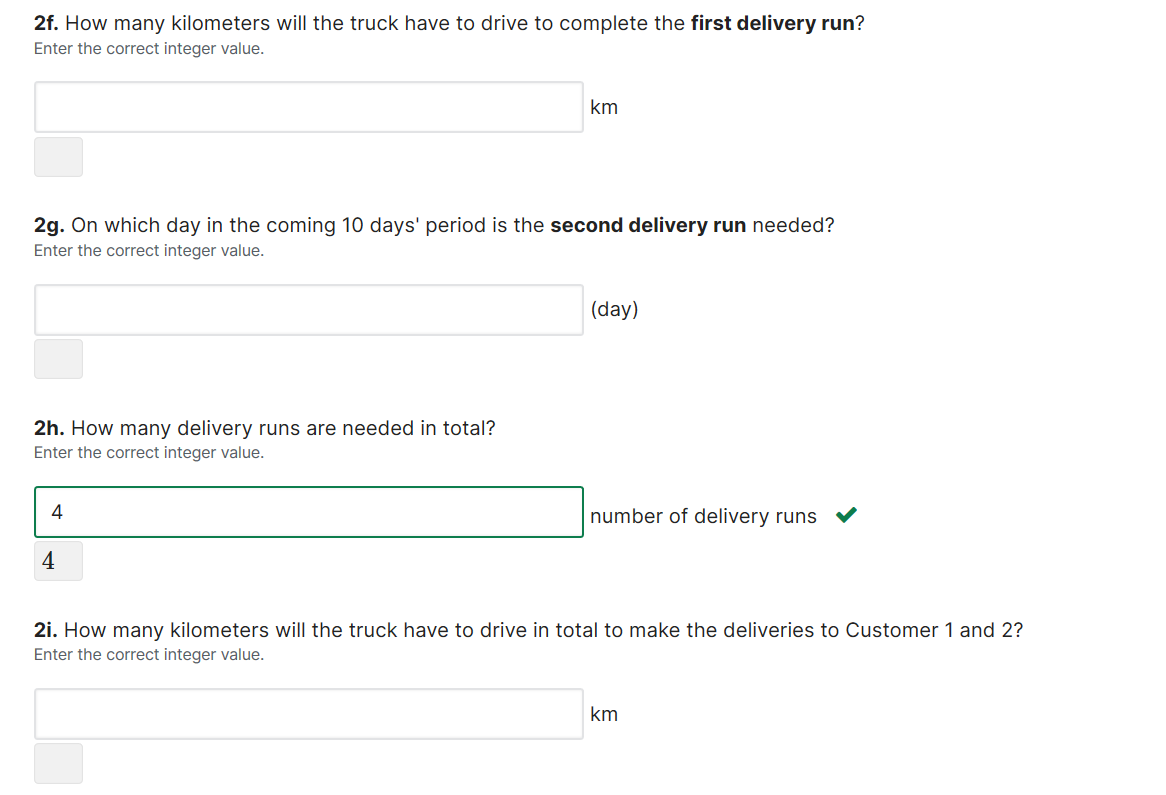
A supplier for the chemical industry sells sulphuric acid to two customers. The supplier manages the stock levels (VMI) for both customers. The setup looks like this: Customer 1 D.2 km Customer 2 FT | V, m V, m Capacity 30 m3 Capacity 20 m D, km D, km Truck capacity 30 m3 Supplier The supplier has separate agreements with each customer regarding stock level interval. For Customer 1, the stock level must be between 8-25 m3. For Customer 2, the agreement is 5-17 m3. The distance Dfor Customer 1 is 100 km. The distance D2 for Customer 2 is also 100 km. The distance between the Customer 1 and Customer 2 is 50 km. The transport cost is assumed to be proportional to the distance. The truck loads 30 m. Assume that once a stock reaches its lower limit, a replenishment is ordered and delivered so that the stock level the next day will be increased with the delivered quantity. Example: The current stock level is 9 m3. The usage rate is 5 m3/day and the lower limit is 5 m3. The top limit is 17 m. Therefore, we want the stock level for the next day to be 17 m3. This means that we have to deliver (17 - 9) + 5 = 13 m3, since 5 m3 will be used during the same day as the delivery. In the table below, the current situation is presented: Customer 1 Customer 2 Storage level, day 1 V2 = 12 m3 V1 = 17 m3 8 m3/day Product usage rate 5 m3/day Tip: Use tables to plan the deliveries and find the answers to questions 2a-2i. Click here to open empty day-by-day delivery tables 2a. Assume Customer 1 manages their own inventory. Also assume that an order is triggered when the stock level falls below 8 + 8 = 16 m3 and that delivery takes place the next day. Disregard Customer 2 in questions 2a-2c. Which day in the coming 10 days' period is the first delivery needed? Enter the correct integer value. 2 (day) 2b. During the coming 10 days' peiod, how many deliveries are needed? Enter the correct integer value. 3 number of days 3 2c. How many kilometers are needed in total for the coming 10 days' deliveries? Enter the correct integer value. | km 2d. Similarily to question 2a-2c above, assume that Customer 2 manages their own inventory. Also assume that an order is triggered when the stock level is 5 + 5 = 10 m3 and that delivery takes place the next day. Disregard Customer 1. How many kilometers are needed in total for the coming 10 days' deliveries? Enter the correct integer value. km 2f. How many kilometers will the truck have to drive to complete the first delivery run? Enter the correct integer value. km 2g. On which day in the coming 10 days' period is the second delivery run needed? Enter the correct integer value. (day) 2h. How many delivery runs are needed in total? Enter the correct integer value. 4 number of delivery runs 4 2i. How many kilometers will the truck have to drive in total to make the deliveries to Customer 1 and 2? Enter the correct integer value. kmStep by Step Solution
There are 3 Steps involved in it
1 Expert Approved Answer
Step: 1 Unlock

Question Has Been Solved by an Expert!
Get step-by-step solutions from verified subject matter experts
Step: 2 Unlock
Step: 3 Unlock