







Question: Hello! could you please answer this problem in the attachment? I posted it yesterday but the tutor answered the reference instead of answering what's in
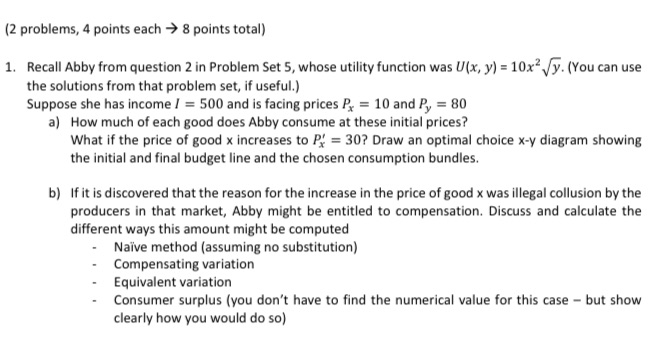
Hello! could you please answer this problem in the attachment? I posted it yesterday but the tutor answered the reference instead of answering what's in the attachment. as you see in the beginning of the problem, they refer to abby from a previous problem that i did before. I am going to post the reference below but you dont have to do it, i just need answers to the problem that is find in the picture! thank you so much. FOR REFERENCE ONLY (question 2 in problem set 5)2. Consider a consumer (Abby), whose preferences are described by utility ?(?, ?) = 10?2??a) Solve the utility maximization problem to find the ordinary demand functions and the indirectutility function. How much of the budget is spent on each good?b) Solve the expenditure minimization problem to find the compensated demand functions??(? , ? , ?) and ??(? , ? , ?). ?? ??c) Show that the elasticities-based Slutsky equation holds for good x, in both the own-price and the cross-price formulations:??,?? =???,?? ?????,???,?? =???,?? ?????,?where ?? is the share of the budget spent on x, and ?? is the share spent on y.
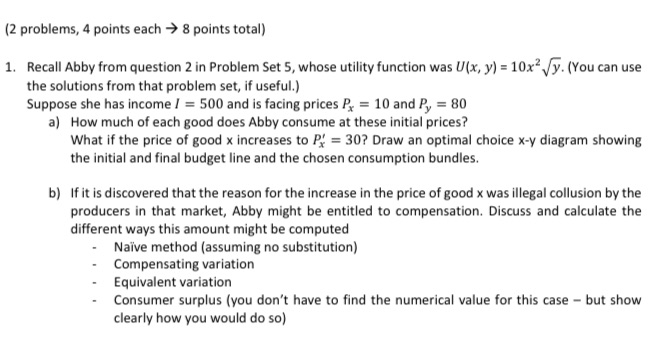
(2 problems, 4 points each > 8 points total) 1. Recall Abby from question 2 in Problem Set 5, whose utility function was U(x, y) = 10xy. (You can use the solutions from that problem set, if useful.) Suppose she has income / = 500 and is facing prices PX = 10 and Py = 80 a) How much of each good does Abby consume at these initial prices? What if the price of good x increases to P = 30? Draw an optimal choice x-y diagram showing the initial and final budget line and the chosen consumption bundles. b) If it is discovered that the reason for the increase in the price of good x was illegal collusion by the producers in that market, Abby might be entitled to compensation. Discuss and calculate the different ways this amount might be computed Naive method (assuming no substitution) Compensating variation Equivalent variation - Consumer surplus (you don't have to find the numerical value for this case - but show clearly how you would do so)
Step by Step Solution
There are 3 Steps involved in it

Get step-by-step solutions from verified subject matter experts
 Study Help