







Question: Hello, expert tutors. Problem 1. The MIT soccer team has 2 games scheduled for one weekend. It has a 0.4 probability of not losing the


Hello, expert tutors.
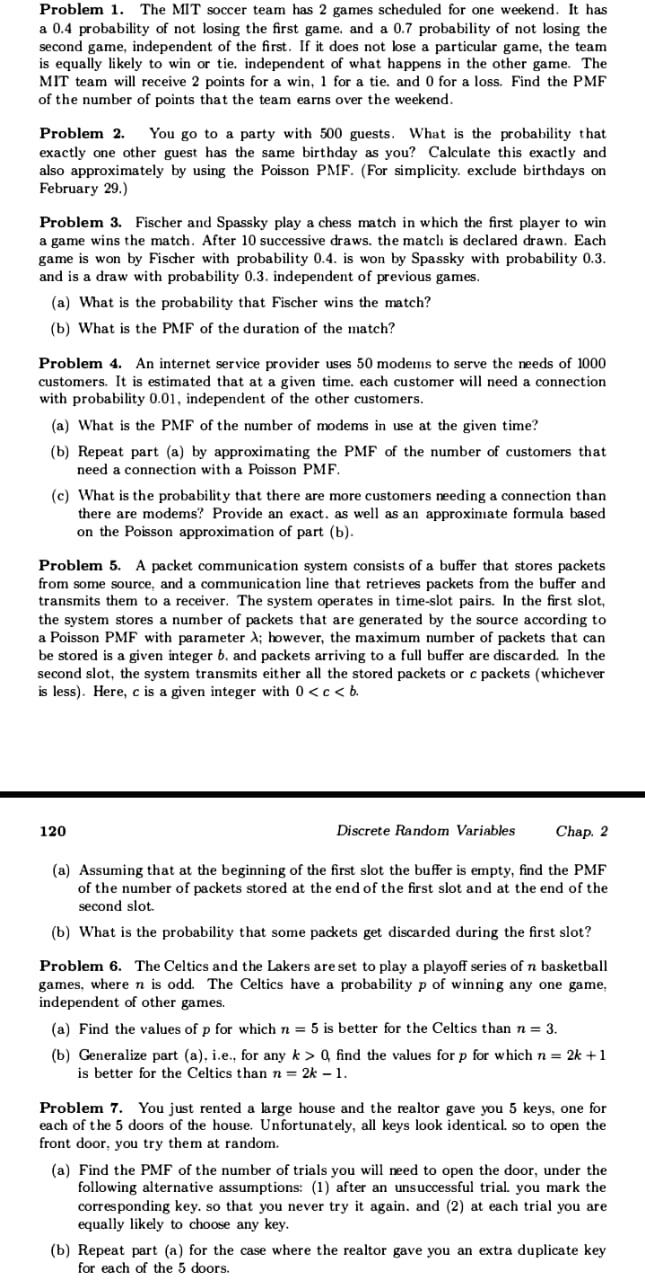
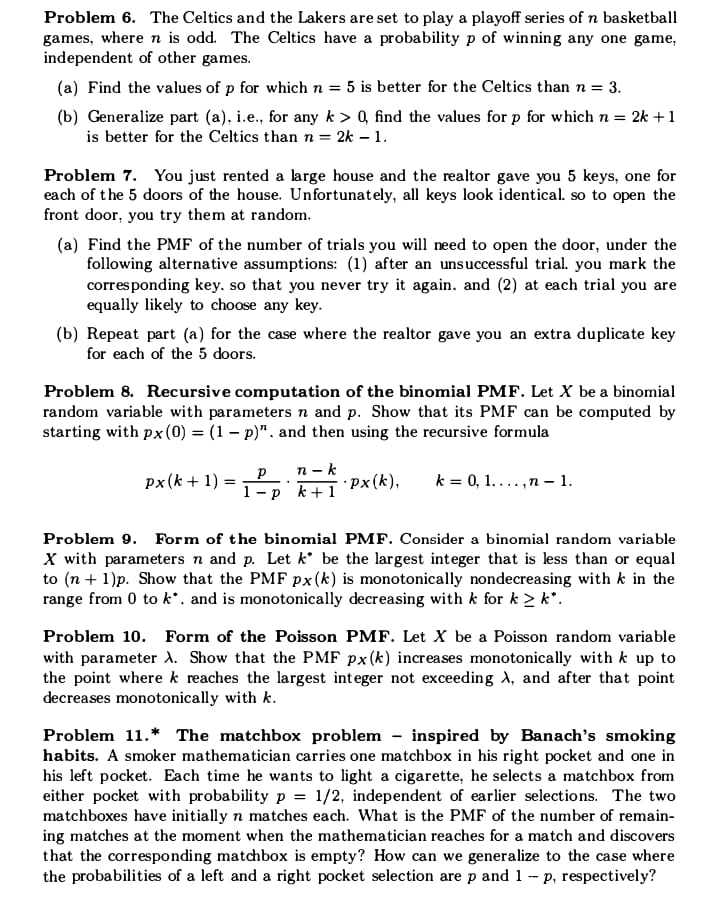

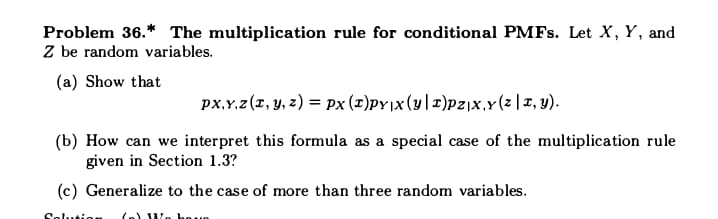

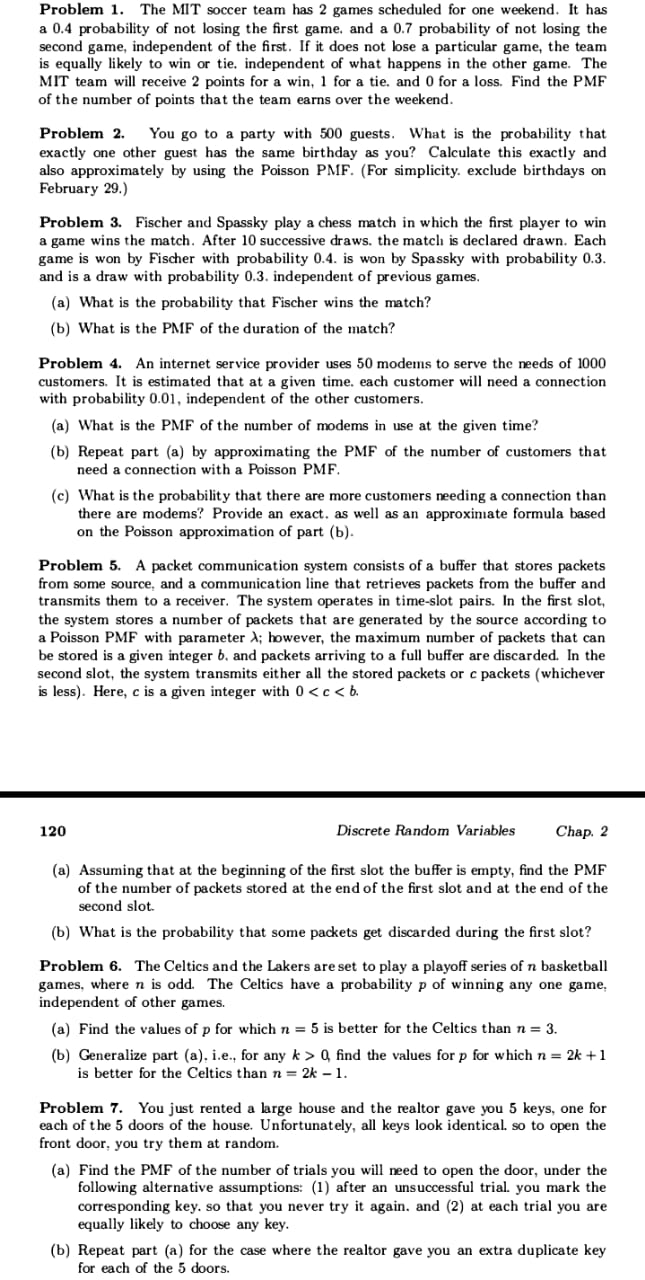
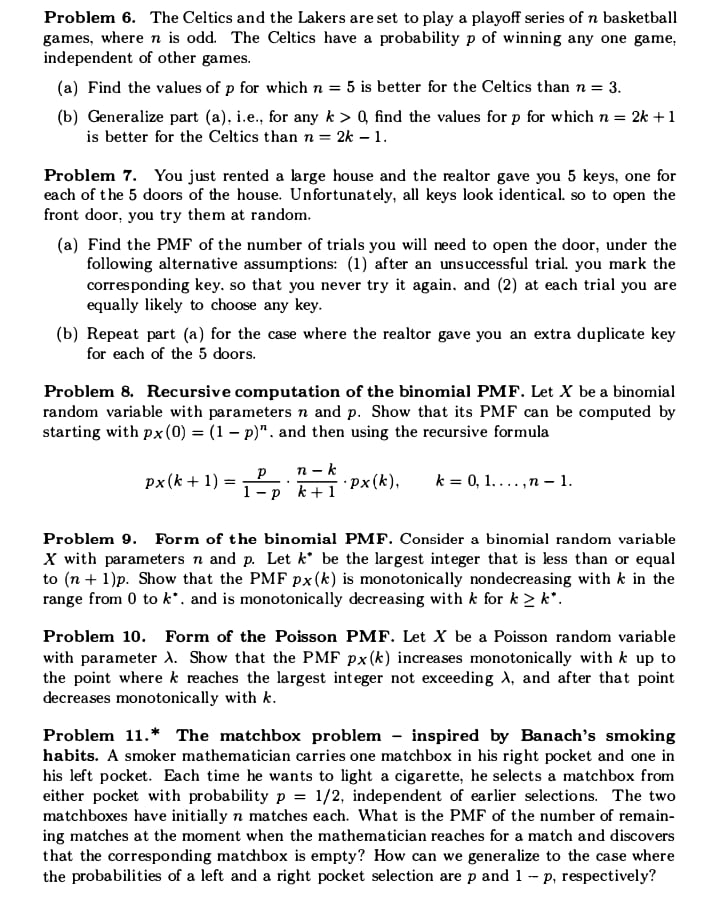
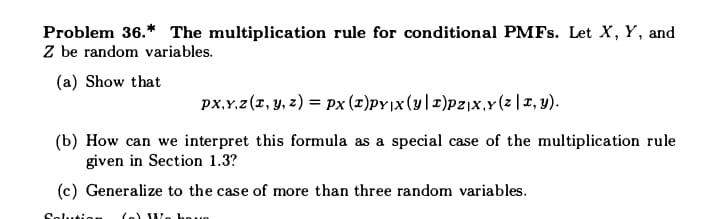
Problem 1. The MIT soccer team has 2 games scheduled for one weekend. It has a 0.4 probability of not losing the first game. and a 0.7 probability of not losing the second game, independent of the first. If it does not lose a particular game, the team is equally likely to win or tie. independent of what happens in the other game. The MIT team will receive 2 points for a win, I for a tie. and 0 for a loss. Find the PMF of the number of points that the team earns over the weekend. Problem 2. You go to a party with 500 guests. What is the probability that exactly one other guest has the same birthday as you? Calculate this exactly and also approximately by using the Poisson PMF. (For simplicity. exclude birthdays on February 29.) Problem 3. Fischer and Spassky play a chess match in which the first player to win a game wins the match. After 10 successive draws. the match is declared drawn. Each game is won by Fischer with probability 0.4. is won by Spassky with probability 0.3. and is a draw with probability 0.3. independent of previous games. (a) What is the probability that Fischer wins the match? (b) What is the PMF of the duration of the match? Problem 4. An internet service provider uses 50 modems to serve the needs of 1000 customers. It is estimated that at a given time. each customer will need a connection with probability 0.01, independent of the other customers. (a) What is the PMF of the number of modems in use at the given time? (b) Repeat part (a) by approximationg the PMF of the number of customers that need a connection with a Poisson PMF. (c) What is the probability that there are more customers needing a connection than there are modems?" Provide an exact. as well as an approximate formula based on the Poisson approximation of part (b). Problem 5. A packet communication system consists of a buffer that stores packets from some source, and a communication line that retrieves packets from the buffer and transmits them to a receiver. The system operates in time-slot pairs. In the first slot, the system stores a number of packets that are generated by the source according to a Poisson PMF with parameter A; however, the maximum number of packets that can be stored is a given integer b. and packets arriving to a full buffer are discarded. In the second slot, the system transmits either all the stored packets or c packets (whichever is less). Here, c is a given integer with 0 0, find the values for p for which n = 2k + 1 is better for the Celtics than n = 2k - 1. Problem 7. You just rented a large house and the realtor gave you 5 keys, one for each of the 5 doors of the house. Unfortunately, all keys look identical, so to open the front door, you try them at random. (a) Find the PMF of the number of trials you will need to open the door, under the following alternative assumptions: (1) after an unsuccessful trial. you mark the corresponding key. so that you never try it again. and (2) at each trial you are equally likely to choose any key. (b) Repeat part (a) for the case where the realtor gave you an extra duplicate key for each of the 5 doors.Problem E. The Celtics and the Lakers are set to play a playoff series of n basketball games, where n is odd. The Celtics have a probability p of winning any one game, independent of other games. {a} Find the values of p for which n = .5 is better for the Celtics than n = 3. [b] Generaliae part fa], i.e., for any it 3:- 0, nd the values forp for which n = 2.3: + 1 is better for the Celtics than n = 2k 1. Problem 1". You jmt rented a large house and the realtor gave you 5 keys, one for each of the 5 doors of the house. Unfortunately, all keys look identicaL so to open the front door, you try them at random. {a} Find the PMF of the number of trials you will reed to open the door, under the following alternative assumptions: (1] after an unsuccessful triaL you mark the corresponding key. so that you never try it again. and (2] at each trial you are equally likely to choose any key. {b} Repeat part {a} for the case where the realtor gave you an extra duplicate key for each of the 5 doors. Problem 3. Recursive computation of the binomial PMF. Let X be a binomial random variable with parameters 11 and p. Show that its PMF can be computed by starting with p 3([1] = {1 p)". and then using the recursive formula pxtk+1]=--px(k]. k=D,1....,n1. Problem Ii. Form of the binomial PMF. Consider a binomial random variable X with parameters a and 3:. Let k' be the largest integer that is less than or equal to (n + llp. Show that the PMF pxik] is monotonically nondecreasing with is: in the range from ii to k'. and is monotonically decreasing with it for it E Jr'. Problem 10. Form of the Poisson PMF. Let X be a Poimon random variable with parameter A. Show that the PMF pxk] increases monotonically with it up to the point where it reaches the largest integer not exceeding A, and after that point decreases monotonically with in. Problem 11."' The matchbox problem inspired by Banach's smoking habits. A smoker mathematician carries one matchbox in his right pocket and one in his left pocket. Each time he wants to light a cigarette, he selects a matchbox from either pocket with probability p = 1,?2, independent of earlier selections. The two matchboxes have initially 11 matches each. 'What is the PMF of the number of remain- ing matches at the moment when the mathematician reaches for a match and discovers that the corrmponding matd'rbox is empty? How can we generalize to the case where the probabilities of a left and a right pocket selection are p and 1 .. 1:, respectively? Problem 37.* Splitting a Poisson random variable. A transmitter sends out either a I with probability p. or a 0 with probability 1 - p. independent of earlier transmissions. If the number of transmissions within a given time interval has a Poisson PMF with parameter A, show that the number of Is transmitted in that same time interval has a Poisson PMF with parameter pl.Problem 36.' The: multiplication rule for conditional Phil's. Let X, l", and Z be random variables. {a} Show that Px.v.z{1.y.=}= 31.x (1}Pr|x{H|=)Ps|x.Y{= I1. all (b) How can we interpret this formula as a special case of the multiplication rule given in Section 1.3\"? {c} Generalize to the case of more than three random variables. D..l..a..*.._ 1-1 1."- L--. Problem 30.* Alvin's database of friends contains n entries, but due to a software glitch, the addresses correspond to the names in a totally random fashion. Alvin writes a holiday card to each of his friends and sends it to the (software-corrupted) address. What is the probability that at least one of his friends will get the correct card? Hint: Use the inclusion-exclusion formula
Step by Step Solution
There are 3 Steps involved in it

Get step-by-step solutions from verified subject matter experts
 Study Help