



Question: hello explain It has been said that Southeast Asian countries like China, Singapore, and Taiwan, have been better able to address the COVID-19 pandemic than
hello explain
It has been said that Southeast Asian countries like China, Singapore, and Taiwan, have been better able to address the COVID-19 pandemic than other countries because of their experience with SARS. Does this make sense if humans behaved like homo economicus? What biases have we studied that might explain why that experience may actually have helped those countries address COVID-19?
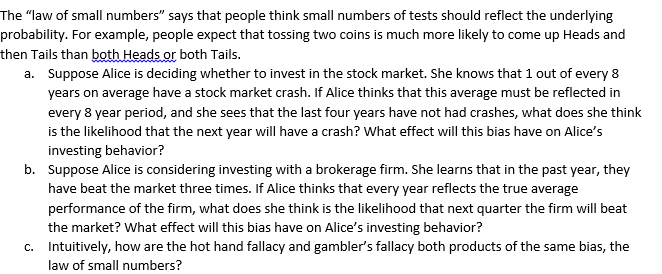
The "law of small numbers" says that people think small numbers of tests should reect the underlying probability. For example, people expect that tossing two coins is much more likely to come up Heads and then Tails than both Heads or both Tails. a. Suppose Alice is deciding whether to invest in the stock market She knows that 1 out of every 3 years on average have a stock market crash. If Alice thinks that this average must be reected in every 3 year period, and she sees that the last four years have not had crashes, what does she think is the likelihood that the next year will have a crash? What effect will this bias have on Alice's investing behavior? b. Suppose Alice is considering investing with a brokerage rm. She learns that in the past year, they have beat the market three times. If Alice thinks that every year reects the true average performance of the rm, what does she think is the likelihood that next quarter the rm will beat the market? What effect will this bias have on Alice's investing behavior? c. lntuitively, how are the hot hand fallacy and gambler's fallacy both products of the same bias, the law of small numbers
Step by Step Solution
There are 3 Steps involved in it

Get step-by-step solutions from verified subject matter experts