







Question: hello help me with this pleaseeee *Activity Title: Weighing the Market International Financial Institutions Introduction The social institution that has one of the biggest impacts
hello help me with this pleaseeee
*Activity Title: Weighing the Market
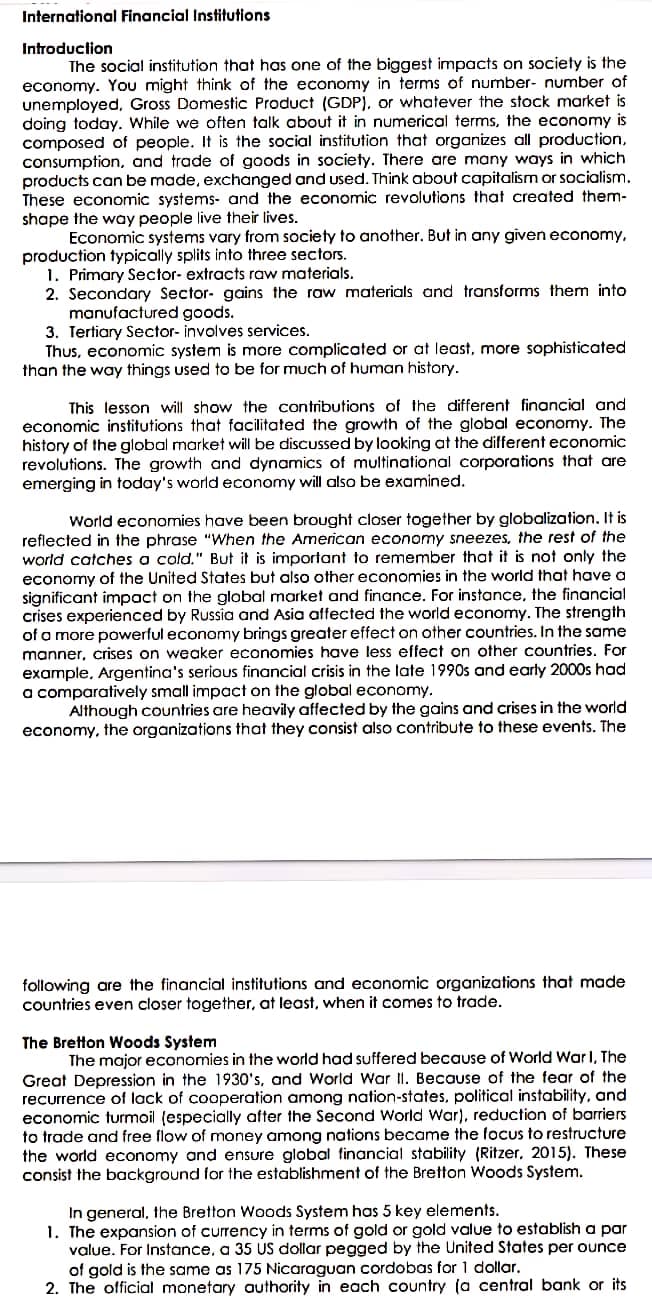
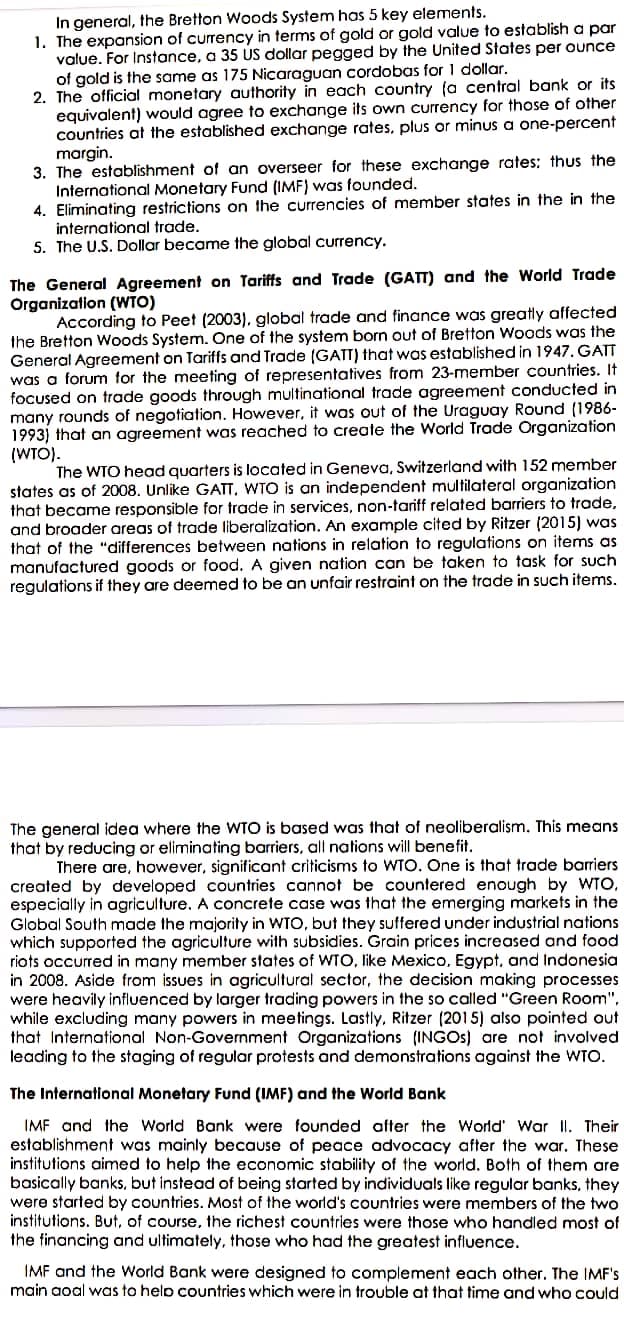
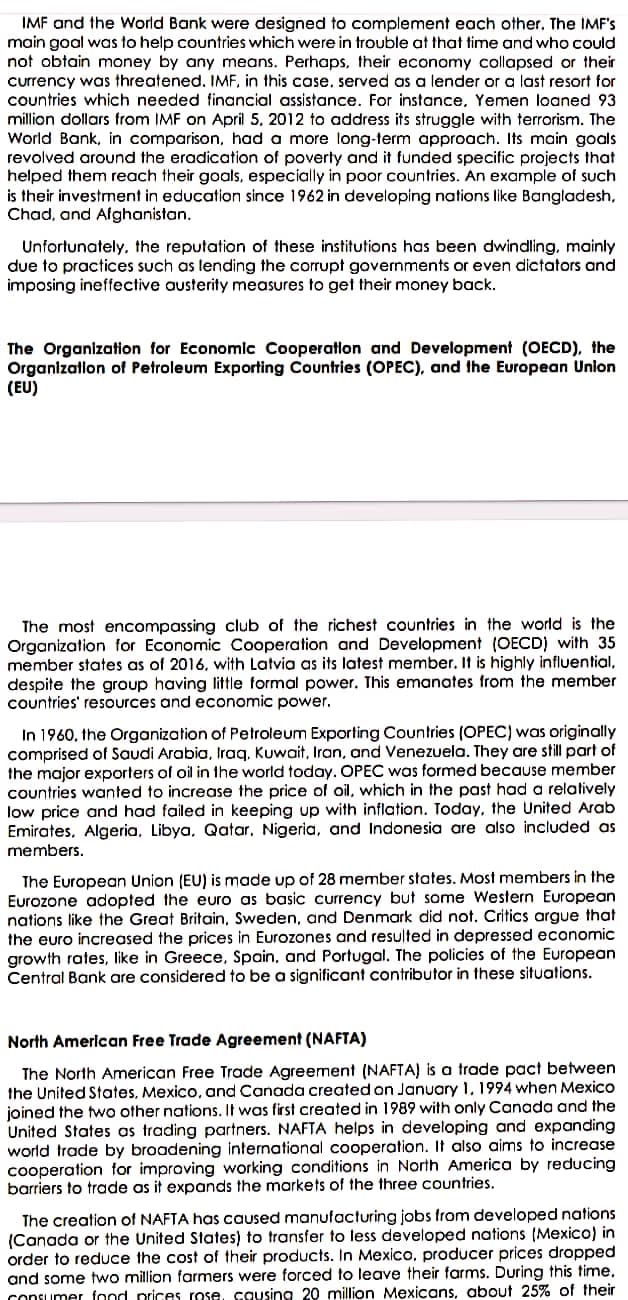
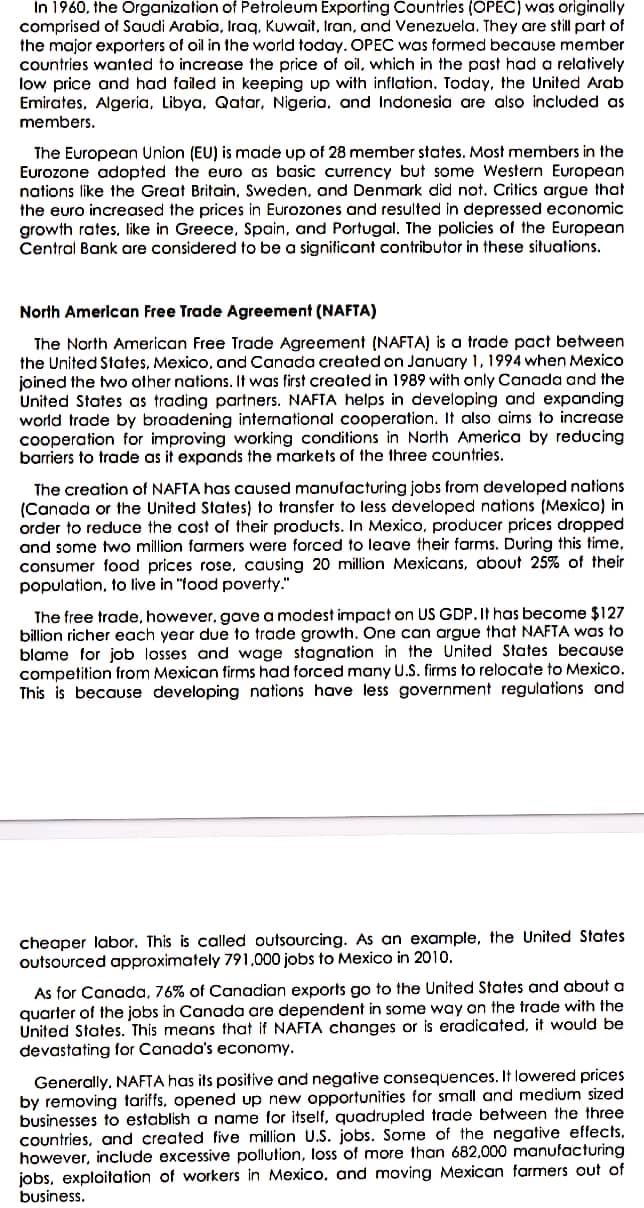
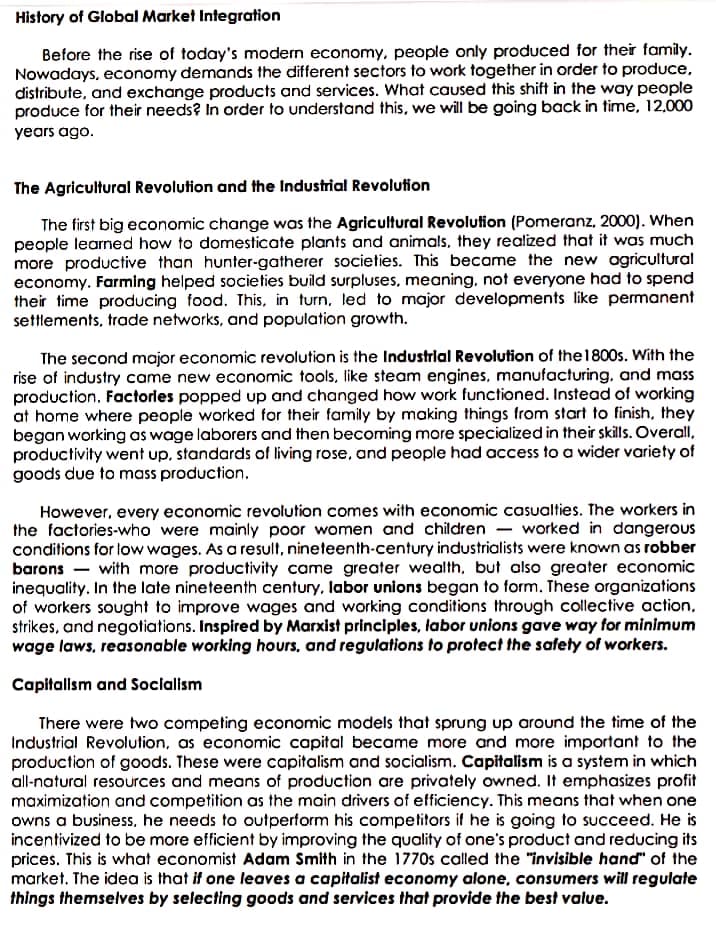
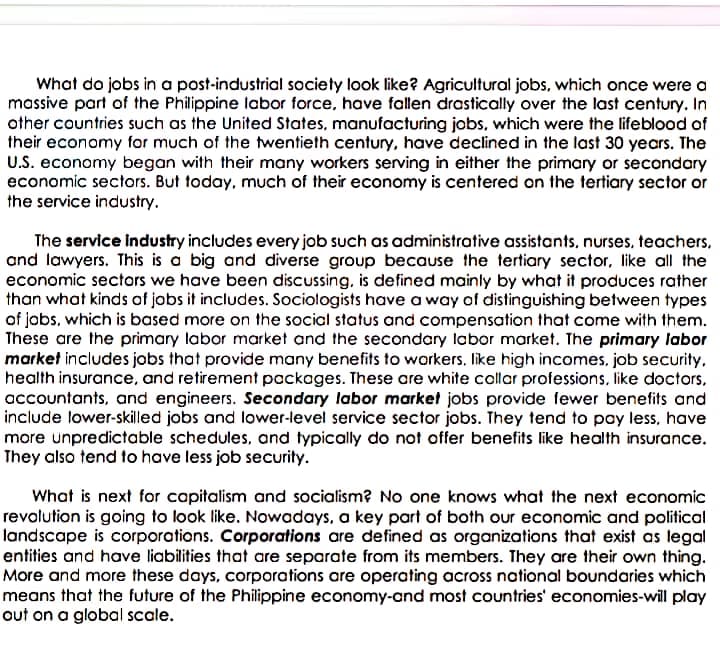
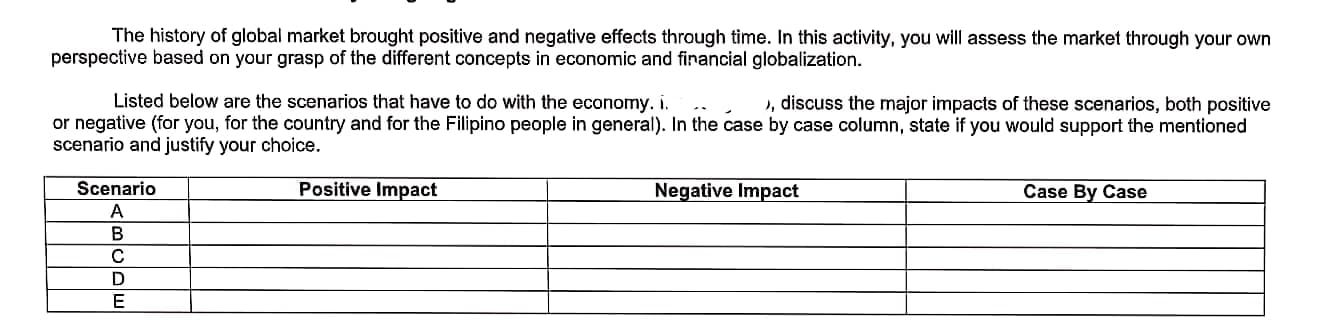
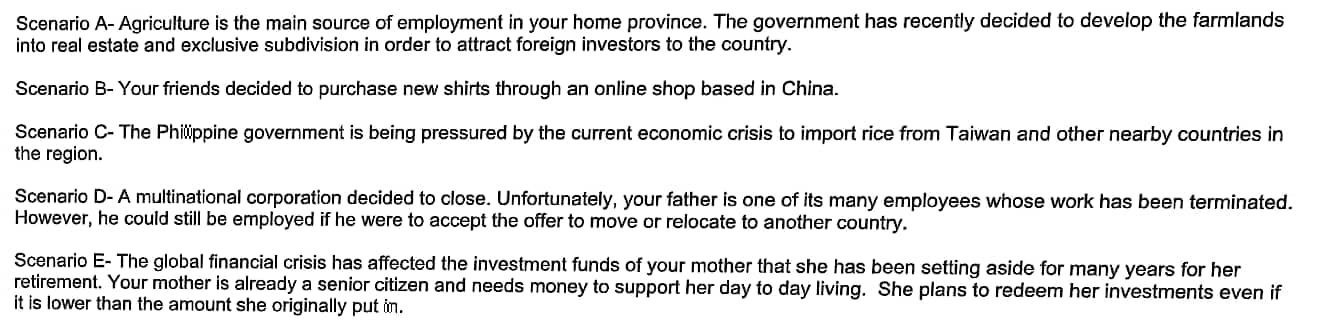
International Financial Institutions Introduction The social institution that has one of the biggest impacts on society is the economy. You might think of the economy in terms of number- number of unemployed, Gross Domestic Product (GDP). or whatever the stock market is doing today. While we often talk about it in numerical terms, the economy is composed of people. It is the social institution that organizes all production, consumption, and trade of goods in society. There are many ways in which products can be made, exchanged and used. Think about capitalism or socialism. These economic systems- and the economic revolutions that created them- shape the way people live their lives. Economic systems vary from society to another. But in any given economy, production typically splits into three sectors. 1. Primary Sector- extracts raw materials. 2. Secondary Sector- gains the raw materials and transforms them into manufactured goods. 3. Tertiary Sector- involves services. Thus, economic system is more complicated or at least, more sophisticated than the way things used to be for much of human history. This lesson will show the contributions of the different financial and economic institutions that facilitated the growth of the global economy. The history of the global market will be discussed by looking at the different economic revolutions. The growth and dynamics of multinational corporations that are emerging in today's world economy will also be examined. World economies have been brought closer together by globalization. It is reflected in the phrase "When the American economy sneezes, the rest of the world catches a cold." But it is important to remember that it is not only the economy of the United States but also other economies in the world that have a significant impact on the global market and finance. For instance, the financial crises experienced by Russia and Asia affected the world economy. The strength of a more powerful economy brings greater effect on other countries. In the same manner, crises on weaker economies have less effect on other countries. For example. Argentina's serious financial crisis in the late 1990s and early 2000s had a comparatively small impact on the global economy. Although countries are heavily affected by the gains and crises in the world economy, the organizations that they consist also contribute to these events. The following are the financial institutions and economic organizations that made countries even closer together, at least, when it comes to trade. The Bretton Woods System The major economies in the world had suffered because of World Warl, The Great Depression in the 1930's, and World War II. Because of the fear of the recurrence of lack of cooperation among nation-states, political instability, and economic turmoil (especially after the Second World War), reduction of barriers to trade and free flow of money among nations became the focus to restructure the world economy and ensure global financial stability (Ritzer. 2015). These consist the background for the establishment of the Bretton Woods System. In general. the Bretton Woods System has 5 key elements. 1. The expansion of currency in terms of gold or gold value to establish a par value. For Instance, a 35 US dollar pegged by the United States per ounce of gold is the same as 175 Nicaraguan cordobas for 1 dollar. 2. The official monetary authority in each country (a central bank or itsIn general, the Bretton Woods System has 5 key elements. 1. The expansion of currency in terms of gold or gold value to establish a par value. For Instance, a 35 US dollar pegged by the United States per ounce of gold is the same as 175 Nicaraguan cordobas for 1 dollar. 2. The official monetary authority in each country (a central bank or its equivalent) would agree to exchange its own currency for those of other countries at the established exchange rates, plus or minus a one-percent margin. 3. The establishment of an overseer for these exchange rates: thus the International Monetary Fund (IMF) was founded. 4. Eliminating restrictions on the currencies of member states in the in the international trade. 5. The U.S. Dollar became the global currency. The General Agreement on Tariffs and Trade (GATT) and the World Trade Organization (WTO) According to Peet (2003), global trade and finance was greatly affected the Bretton Woods System. One of the system born out of Bretton Woods was the General Agreement on Tariffs and Trade (GATT) that was established in 1947. GATT was a forum for the meeting of representatives from 23-member countries. It focused on trade goods through multinational trade agreement conducted in many rounds of negotiation. However, it was out of the Uraguay Round (1986- 1993) that an agreement was reached to create the World Trade Organization (WTO) The WTO head quarters is located in Geneva, Switzerland with 152 member states as of 2008. Unlike GATT. WTO is an independent multilateral organization that became responsible for trade in services, non-tariff related barriers to trade, and broader areas of trade liberalization. An example cited by Ritzer (2015) was that of the "differences between nations in relation to regulations on items as manufactured goods or food. A given nation can be taken to task for such regulations if they are deemed to be an unfair restraint on the trade in such items. The general idea where the WTO is based was that of neoliberalism. This means that by reducing or eliminating barriers, all nations will benefit. There are, however, significant criticisms to WTO. One is that trade barriers created by developed countries cannot be countered enough by WTO. especially in agriculture. A concrete case was that the emerging markets in the Global South made the majority in WTO, but they suffered under industrial nations which supported the agriculture with subsidies. Grain prices increased and food riots occurred in many member states of WTO, like Mexico, Egypt, and Indonesia in 2008. Aside from issues in agricultural sector, the decision making processes were heavily influenced by larger trading powers in the so called "Green Room", while excluding many powers in meetings. Lastly, Ritzer (2015) also pointed out that International Non-Government Organizations (INGOs) are not involved leading to the staging of regular protests and demonstrations against the WTO. The International Monetary Fund (IMF) and the World Bank IMF and the World Bank were founded after the World' War II. Their establishment was mainly because of peace advocacy after the war. These institutions aimed to help the economic stability of the world. Both of them are basically banks, but instead of being started by individuals like regular banks, they were started by countries. Most of the world's countries were members of the two institutions. But, of course, the richest countries were those who handled most of the financing and ultimately, those who had the greatest influence. IMF and the World Bank were designed to complement each other. The IMF's main aoal was to help countries which were in trouble at that time and who couldIMF and the World Bank were designed to complement each other. The IMF's main goal was to help countries which were in trouble at that time and who could not obtain money by any means. Perhaps, their economy collapsed or their currency was threatened. IMF, in this case. served as a lender or a last resort for countries which needed financial assistance. For instance. Yemen loaned 93 million dollars from IMF on April 5. 2012 to address its struggle with terrorism. The World Bank, in comparison, had a more long-term approach. Its main goals revolved around the eradication of poverty and it funded specific projects that helped them reach their goals, especially in poor countries. An example of such is their investment in education since 1962 in developing nations like Bangladesh, Chad, and Afghanistan. Unfortunately, the reputation of these institutions has been dwindling, mainly due to practices such as lending the corrupt governments or even dictators and imposing ineffective austerity measures to get their money back. The Organization for Economic Cooperation and Development (OECD), the Organization of Petroleum Exporting Countries (OPEC), and the European Union (EU) The most encompassing club of the richest countries in the world is the Organization for Economic Cooperation and Development (OECD) with 35 member states as of 2016. with Latvia as its latest member. It is highly influential. despite the group having little formal power. This emanates from the member countries' resources and economic power. In 1960. the Organization of Petroleum Exporting Countries (OPEC) was originally comprised of Saudi Arabia, Iraq. Kuwait, Iran, and Venezuela. They are still part of the major exporters of oil in the world today. OPEC was formed because member countries wanted to increase the price of oil, which in the past had a relatively low price and had failed in keeping up with inflation. Today, the United Arab Emirates. Algeria. Libya. Qatar. Nigeria, and Indonesia are also included as members. The European Union (EU) is made up of 28 member states. Most members in the Eurozone adopted the euro as basic currency but some Western European nations like the Great Britain, Sweden, and Denmark did not. Critics argue that the euro increased the prices in Eurozones and resulted in depressed economic growth rates, like in Greece, Spain. and Portugal. The policies of the European Central Bank are considered to be a significant contributor in these situations. North American Free Trade Agreement (NAFTA) The North American Free Trade Agreement (NAFTA) is a trade pact between the United States, Mexico, and Canada created on January 1. 1994 when Mexico joined the two other nations. It was first created in 1989 with only Canada and the United States as trading partners. NAFTA helps in developing and expanding world trade by broadening international cooperation. It also aims to increase cooperation for improving working conditions in North America by reducing barriers to trade as it expands the markets of the three countries. The creation of NAFTA has caused manufacturing jobs from developed nations (Canada or the United States) to transfer to less developed nations (Mexico) in order to reduce the cost of their products. In Mexico, producer prices dropped and some two million farmers were forced to leave their farms. During this time. causing 20 million Mexicans, about 25% of theirIn 1960. the Organization of Petroleum Exporting Countries (OPEC ) was originally comprised of Saudi Arabia, Iraq, Kuwait, Iran, and Venezuela. They are still part of the major exporters of oil in the world today. OPEC was formed because member countries wanted to increase the price of oil. which in the past had a relatively low price and had failed in keeping up with inflation. Today, the United Arab Emirates, Algeria, Libya. Qatar, Nigeria, and Indonesia are also included as members. The European Union (EU) is made up of 28 member states. Most members in the Eurozone adopted the euro as basic currency but some Western European nations like the Great Britain. Sweden. and Denmark did not. Critics argue that the euro increased the prices in Eurozones and resulted in depressed economic growth rates. like in Greece, Spain, and Portugal. The policies of the European Central Bank are considered to be a significant contributor in these situations. North American Free Trade Agreement (NAFTA) The North American Free Trade Agreement (NAFTA) is a trade pact between the United States, Mexico, and Canada created on January 1, 1994 when Mexico joined the two other nations. It was first created in 1989 with only Canada and the United States as trading partners. NAFTA helps in developing and expanding world trade by broadening international cooperation. It also aims to increase cooperation for improving working conditions in North America by reducing barriers to trade as it expands the markets of the three countries. The creation of NAFTA has caused manufacturing jobs from developed nations (Canada or the United States) to transfer to less developed nations (Mexico) in order to reduce the cost of their products. In Mexico, producer prices dropped and some two million farmers were forced to leave their farms. During this time. consumer food prices rose, causing 20 million Mexicans, about 25% of their population, to live in "food poverty." The free trade, however, gave a modest impact on US GDP. It has become $127 billion richer each year due to trade growth. One can argue that NAFTA was to blame for job losses and wage stagnation in the United States because competition from Mexican firms had forced many U.S. firms to relocate to Mexico. This is because developing nations have less government regulations and cheaper labor. This is called outsourcing. As an example, the United States outsourced approximately 791.000 jobs to Mexico in 2010. As for Canada, 76% of Canadian exports go to the United States and about a quarter of the jobs in Canada are dependent in some way on the trade with the United States. This means that if NAFTA changes or is eradicated, it would be devastating for Canada's economy. Generally. NAFTA has its positive and negative consequences. It lowered prices by removing tariffs, opened up new opportunities for small and medium sized businesses to establish a name for itself, quadrupled trade between the three countries, and created five million U.S. jobs. Some of the negative effects. however, include excessive pollution, loss of more than 682,000 manufacturing jobs, exploitation of workers in Mexico. and moving Mexican farmers out of business.History of Global Market Integration Before the rise of today's modern economy, people only produced for their family. Nowadays, economy demands the different sectors to work together in order to produce. distribute, and exchange products and services. What caused this shift in the way people produce for their needs? In order to understand this, we will be going back in time, 12.000 years ago. The Agricultural Revolution and the Industrial Revolution The first big economic change was the Agricultural Revolution (Pomeranz. 2000). When people learned how to domesticate plants and animals, they realized that it was much more productive than hunter-gatherer societies. This became the new agricultural economy. Farming helped societies build surpluses, meaning, not everyone had to spend their time producing food. This, in turn, led to major developments like permanent settlements, trade networks, and population growth. The second major economic revolution is the Industrial Revolution of the 1800s. With the rise of industry came new economic tools, like steam engines, manufacturing, and mass production. Factories popped up and changed how work functioned. Instead of working at home where people worked for their family by making things from start to finish, they began working as wage laborers and then becoming more specialized in their skills. Overall. productivity went up, standards of living rose, and people had access to a wider variety of goods due to mass production. However, every economic revolution comes with economic casualties. The workers in the factories-who were mainly poor women and children - worked in dangerous conditions for low wages. As a result, nineteenth-century industrialists were known as robber barons - with more productivity came greater wealth, but also greater economic inequality. In the late nineteenth century, labor unions began to form. These organizations of workers sought to improve wages and working conditions through collective action. strikes, and negotiations. Inspired by Marxist principles, labor unions gave way for minimum wage laws. reasonable working hours. and regulations to protect the safety of workers. Capitalism and Socialism There were two competing economic models that sprung up around the time of the Industrial Revolution, as economic capital became more and more important to the production of goods. These were capitalism and socialism. Capitalism is a system in which all-natural resources and means of production are privately owned. It emphasizes profit maximization and competition as the main drivers of efficiency. This means that when one owns a business, he needs to outperform his competitors if he is going to succeed. He is incentivized to be more efficient by improving the quality of one's product and reducing its prices. This is what economist Adam Smith in the 1770s called the "invisible hand" of the market. The idea is that if one leaves a capitalist economy alone. consumers will regulate things themselves by selecting goods and services that provide the best value.What do jobs in a post-industrial society look like? Agricultural jobs, which once were a massive part of the Philippine labor force, have fallen drastically over the last century. In other countries such as the United States, manufacturing jobs, which were the lifeblood of their economy for much of the twentieth century, have declined in the last 30 years. The U.S. economy began with their many workers serving in either the primary or secondary economic sectors. But today, much of their economy is centered on the tertiary sector or the service industry. The service Industry includes every job such as administrative assistants, nurses, teachers. and lawyers. This is a big and diverse group because the tertiary sector, like all the economic sectors we have been discussing. is defined mainly by what it produces rather than what kinds of jobs it includes. Sociologists have a way of distinguishing between types of jobs, which is based more on the social status and compensation that come with them. These are the primary labor market and the secondary labor market. The primary labor market includes jobs that provide many benefits to workers. like high incomes, job security. health insurance, and retirement packages. These are white collar professions, like doctors. accountants, and engineers. Secondary labor market jobs provide fewer benefits and include lower-skilled jobs and lower-level service sector jobs. They tend to pay less, have more unpredictable schedules, and typically do not offer benefits like health insurance. They also tend to have less job security. What is next for capitalism and socialism? No one knows what the next economic revolution is going to look like. Nowadays, a key part of both our economic and political landscape is corporations. Corporations are defined as organizations that exist as legal entities and have liabilities that are separate from its members. They are their own thing. More and more these days, corporations are operating across national boundaries which means that the future of the Philippine economy-and most countries' economies-will play out on a global scale.The history of global market brought positive and negative effects through time. In this activity, you will assess the market through your own perspective based on your grasp of the different concepts in economic and financial globalization. Listed below are the scenarios that have to do with the economy. i. ), discuss the major impacts of these scenarios, both positive or negative (for you, for the country and for the Filipino people in general). In the case by case column, state if you would support the mentioned scenario and justify your choice. Scenario Positive Impact Negative Impact Case By Case A B C D mScenario A Agriculture is the main source of employment in your home province. The government hes recently decided to develop the farmlands Into real estate and exclusive subdivision in order to attract foreign investors to the country. Scenario B- Your friends decided to purchase new shirts through an onllne shop based in China. Scenario C- The Philippine govemmerrt is being pressured by the cun'ent economic crisis to import rice from Taiwan and other nearby countries in the region. Scenario 0- A multinational corporation decided to close. Unfortunately. your father is one of its many employees whose work has been terminated. However, he could still be employed if he were to accept the offer to move or relocate to another country. Scenario 5- The global financial crisis has affected the Investment funds of your mother that she has been setting aside for many years for her retirement. Your mother is already a senior cih'zen and needs money to support her day to day living. She plans to redeem her investments even if It is lower than the amount she originally put in
Step by Step Solution
There are 3 Steps involved in it

Get step-by-step solutions from verified subject matter experts
 Study Help