







Question: Hello! I could really use some help with a calculus III project! It's fall break and my partners for the project are still home and
Hello! I could really use some help with a calculus III project! It's fall break and my partners for the project are still home and don't get back until tomorrow... This project is due on Thursday and I wont have much time to thoroughly go through it and finish it myself. I have an honors biology test on Friday and I do not feel prepared at all for it and need to spend all my time studying. Thanks in advanced!
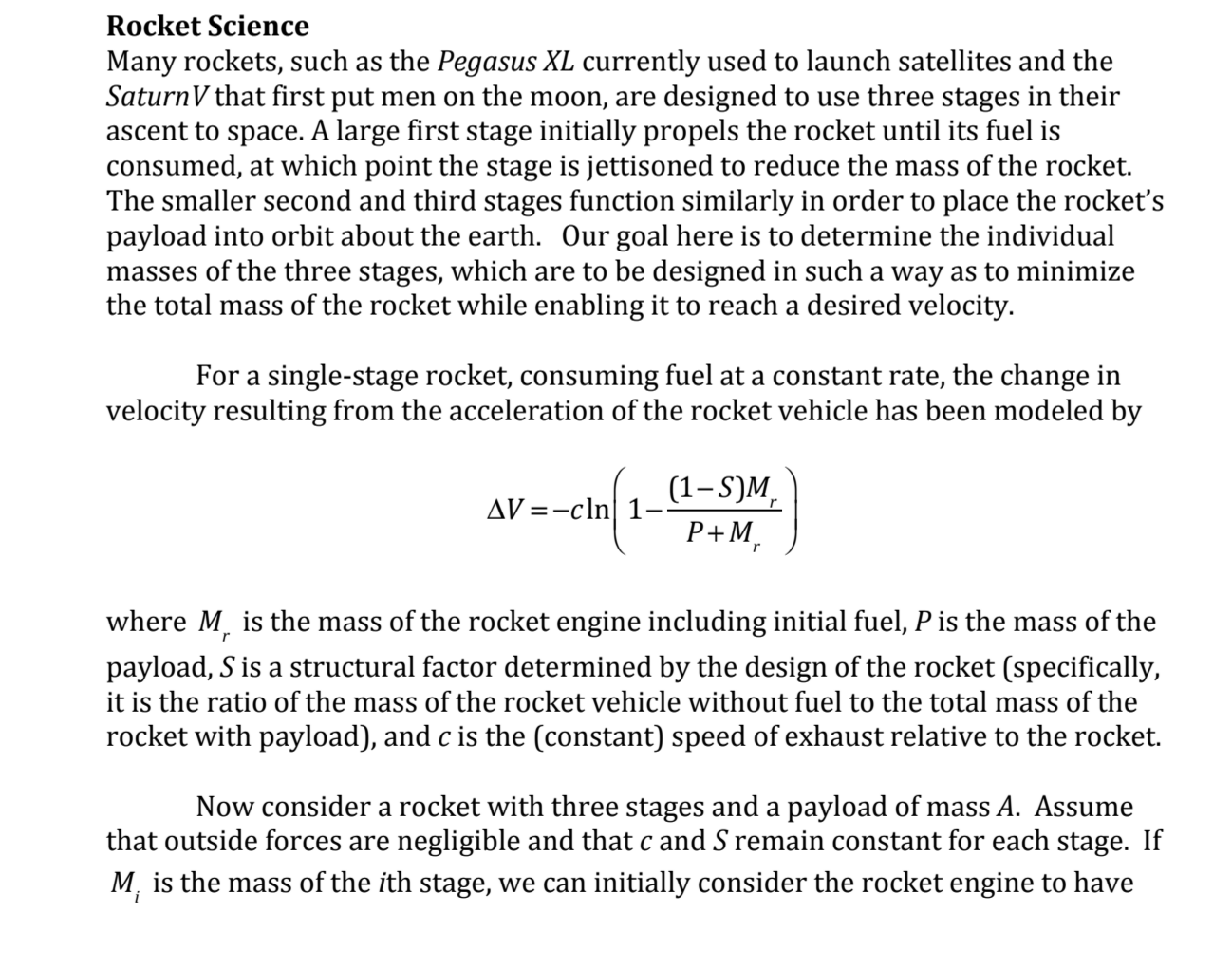
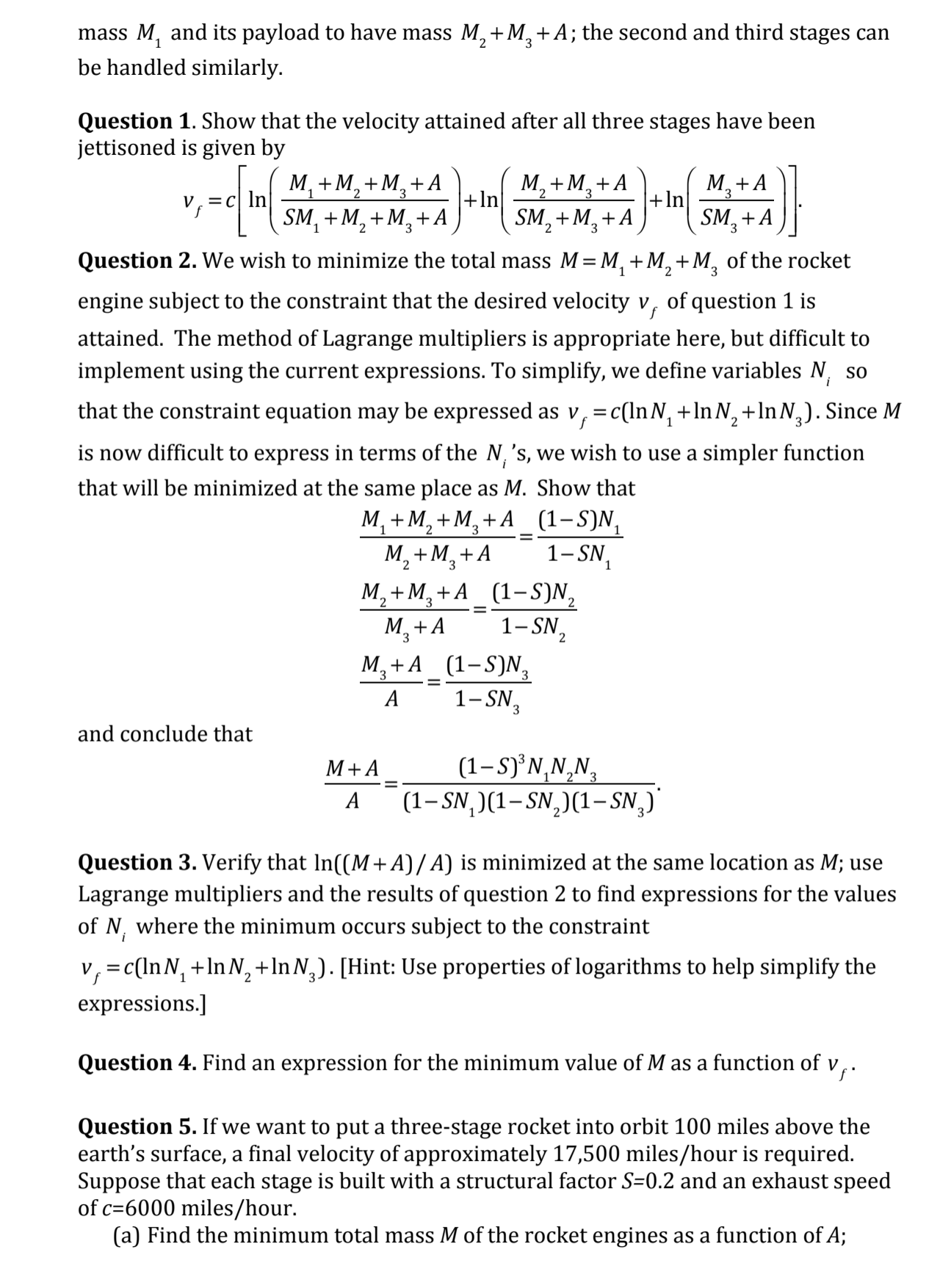
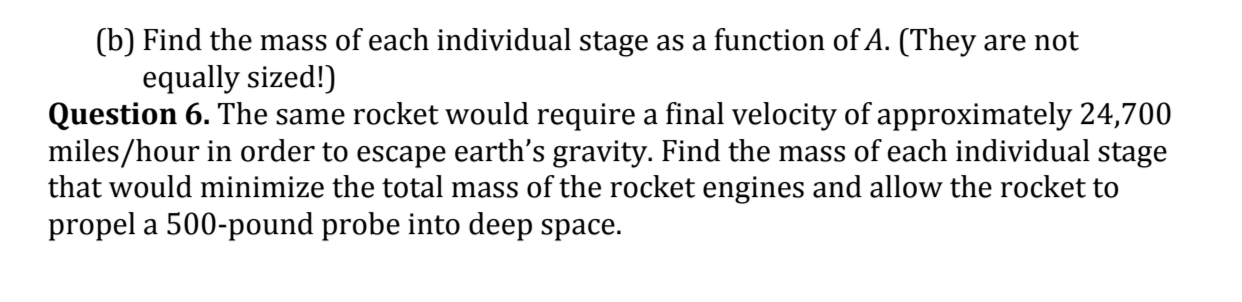
Rocket Science Many rockets, such as the Pegasus XL currently used to launch satellites and the Saturthhat first put men on the moon, are designed to use three stages in their ascent to space. A large rst stage initially propels the rocket until its fuel is consumed, at which point the stage is jettisoned to reduce the mass of the rocket. The smaller second and third stages function similarly in order to place the rocket's payload into orbit about the earth. Our goal here is to determine the individual masses of the three stages, which are to be designed in such a way as to minimize the total mass of the rocket while enabling it to reach a desired velocity. For a single-stage rocket, consuming fuel at a constant rate, the change in velocity resulting from the acceleration of the rocket vehicle has been modeled by AV=c1n lw P+Mr where Mr is the mass of the rocket engine including initial fuel, P is the mass of the payload, S is a structural factor determined by the design of the rocket (specifically, it is the ratio of the mass of the rocket vehicle without fuel to the total mass of the rocket with payload], and c is the [constant] speed of exhaust relative to the rocket. Now consider a rocket with three stages and a payload of mass A. Assume that outside forces are negligible and that c and 5 remain constant for each stage. If M], is the mass of the ith stage, we can initially consider the rocket engine to have mass M1 and its payload to have mass M2 + M3 +A; the second and third stages can be handled similarly. Question 1. Show that the velocity attained after all three stages have been jettisoned is given by M+M+M+A M+M+A M+A v=cln#+ln#+ln 3 . f 5M1+M2+M3+A SM2+M3+A SM3+A Question 2. We wish to minimize the total mass M = M1 + M2 +M3 of the rocket engine subject to the constraint that the desired velocity V; of question 1 is attained. The method of Lagrange multipliers is appropriate here, but difcult to implement using the current expressions. To simplify, we dene variables N: so that the constraint equation may be expressed as V! = c[lnN1 +ln N2 +1nN3] . Since M is now difcult to express in terms of the N: 's, we wish to use a simpler function that will be minimized at the same place as M. Show that M1+M2+M3+A = [1SJN1 M2 +M3+A 1SN1 M2+M3+A = (1S)N2 M3 +A 1SN2 M3+A = (15)N3 A 1SN3 and conclude that M+A _ [1S)3N1N2N3 A (1SN1)[1SN2)[1SN3]' Question 3. Verify that ln[(M+A] / A] is minimized at the same location as M; use Lagrange multipliers and the results of question 2 to find expressions for the values of N,- where the minimum occurs subject to the constraint v), =c[lnNl +lnN2 +lnN3). [Hint Use properties of logarithms to help simplify the expressions] Question 4-. Find an expression for the minimum value of M as a function of V," Question 5. [f we want to put a three-stage rocket into orbit 100 miles above the earth's surface, a nal velocity of approximately 17,500 miles/hour is required. Suppose that each stage is built with a structural factor 3:02 and an exhaust speed of c=6000 miles/hour. [a] Find the minimum total mass M of the rocket engines as a function of A; (b) Find the mass of each individual stage as a function of A. [They are not equally sized!) Question 6. The same rocket would require a nal velocity of approximately 24,700 miles/ hour in order to escape earth's gravity. Find the mass of each individual stage that would minimize the total mass of the rocket engines and allow the rocket to propel a SOD-pound probe into deep space
Step by Step Solution
There are 3 Steps involved in it

Get step-by-step solutions from verified subject matter experts
 Study Help