



Question: Hello I figured out a and b I just need assistance with C and D. Thank you a. Show that the following two basis functions
Hello I figured out a and b I just need assistance with C and D.
Thank you 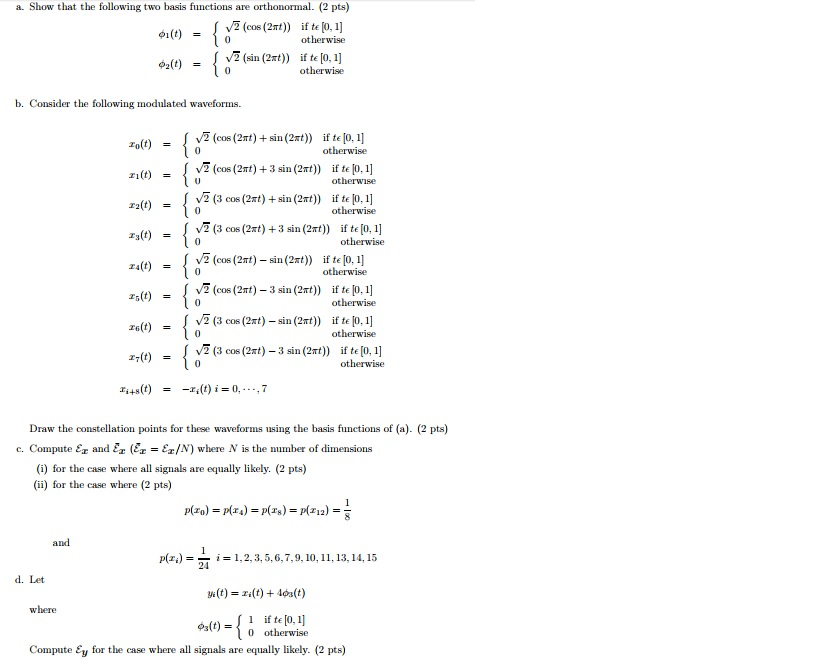
a. Show that the following two basis functions are orthonormal. (2 pts) V2 (cos (2rt) if te [O,1i] otherwise VE (sin (2t) if te [0, 1] b. Consider the following modulated waveforms. V2 (cos (2t) sin (2xt) if te [O,] V (cos (2t) 3 sin (2t) if te [0, 1] V2 (3 cos (2xt) sin (2t if te o, 1 Fo(t) = 10 otherwise r2(t) = rs(t) = 24(t) = 0 otherwise V2 (3 cos(2xt)3 sin (2t) if te [o, 1] 0 V2 (cos (2Tt) sin (2xt) if te [o, ] 0 otherwise V2 (cos (2t) -3 sin (2t) if te [0, 1] otherwise 0 V2 (3 cos (2xt) sin (2t if te [0, 1 V (3 cos (2xt) -3 in (2t) if te [0, 1] re(t) rr(t) xi +8(t) = = 0 -zi(t) i = 0,-.., 7 = Draw the constellation points for these waveforms using the basis functions of (a). (2 pts) c. Compute Ez and Ez (Ez = Ez/N) where N is the number of dimensions (i) for the case where all signals are equally likely. (2 pts) (ii) for the case where (2 pts) and p(z.) =-i=1.2, 3, 5, 6, 7, 9, 10, 11, 13, 14, 15 24 d. Let where @g(t) ={ l if te [0. Il 0 otherwise Compute y for the case where all signals are equally likely. (2 pts) a. Show that the following two basis functions are orthonormal. (2 pts) V2 (cos (2rt) if te [O,1i] otherwise VE (sin (2t) if te [0, 1] b. Consider the following modulated waveforms. V2 (cos (2t) sin (2xt) if te [O,] V (cos (2t) 3 sin (2t) if te [0, 1] V2 (3 cos (2xt) sin (2t if te o, 1 Fo(t) = 10 otherwise r2(t) = rs(t) = 24(t) = 0 otherwise V2 (3 cos(2xt)3 sin (2t) if te [o, 1] 0 V2 (cos (2Tt) sin (2xt) if te [o, ] 0 otherwise V2 (cos (2t) -3 sin (2t) if te [0, 1] otherwise 0 V2 (3 cos (2xt) sin (2t if te [0, 1 V (3 cos (2xt) -3 in (2t) if te [0, 1] re(t) rr(t) xi +8(t) = = 0 -zi(t) i = 0,-.., 7 = Draw the constellation points for these waveforms using the basis functions of (a). (2 pts) c. Compute Ez and Ez (Ez = Ez/N) where N is the number of dimensions (i) for the case where all signals are equally likely. (2 pts) (ii) for the case where (2 pts) and p(z.) =-i=1.2, 3, 5, 6, 7, 9, 10, 11, 13, 14, 15 24 d. Let where @g(t) ={ l if te [0. Il 0 otherwise Compute y for the case where all signals are equally likely. (2 pts)
Step by Step Solution
There are 3 Steps involved in it

Get step-by-step solutions from verified subject matter experts